“Understanding Organizational Evolution: Toward a Research Agenda using Generalized Darwinism’”

15 01 2014


That’s the title of a talk delivered yesterday at University of Liverpool Management School by Professor Geoff Hodgson, Business School, University of Hertfordshire. Hodgson is probably best known to the readers of this blog as the author of How Economics Forgot History: The Problem of Historical Specificity in Social Science.

The talk was based on a paper he published in Organization Studies (2013) vol. 34 no. 7: 973-992.

Abstract
The terms ‘evolution’ and ‘coevolution’ are widely used in organization studies but rarely defined. Often it is unclear whether they refer to single entities or populations. When specific evolutionary processes are suggested, the labelling is often misleading. For example, in the debate over the roles of individual adaptation and competitive selection, the ‘selectionist’ position of Michael Hannan and John Freeman, which emphasizes the role of selection and stress the limits of individual firm adaptability, is often described as ‘Darwinian’ whereas opposing views that emphasize adaptability are described as ‘Lamarckian’. But these labels are not strictly dichotomous. Scholars have shown that core Darwinian principles, resulting from abstract ontological communality rather than analogy, apply to social evolution. This opens up a research agenda using the principles of generalized Darwinism and the replicator–interactor framework to help understand the evolution of organizations. Some illustrations of the conceptual value of this approach are provided, including understanding the entwinement of selection and adaptation, the nature and role of organizational routines, the place of strategic choice and the growth of organizational complexity. The framework of generalized Darwinism also helps to bridge apparently divergent perspectives in the business strategy and organizational ecology literatures.
 
*About the Speaker
 
Professor Geoff Hodgson is Research Professor in Business Studies at the Business School, University of Hertfordshire. Prior to his appointment, he held positions at University of Cambridge, Northumbria, Manchester, Manchester Metropolitan and Bennington College (US). Apart from his Ph.D. from Cambridge, he also has an honorary doctorate from the Russian Academy of Sciences. He is the author of 15 books, including: From Pleasure Machines to Moral Communities (2012) and (with Thorbjorn Knudsen) Darwin’s Conjecture: The Search for General Principles of Social and Economic Evolution (2010), both University of Chicago Press; and, The Evolution of Institutional Economics: Agency, Structure and Darwinism in American Institutionalism (2004), How Economics Forgot History: The Problem of Historical Specificity in Social Science, both Routledge. He has published over 180 articles in a wide range of journals including:Journal of Economic Literature, Journal of Economic Issues, Strategic Management Journal, Economy and Society, Review of International Political Economy, New Political Economy, Cambridge Journal of Economics and Organisation Studies. Professor Hodgson is scheduled to give 10 lectures on Conceptualising Capitalism at the Sorbonne, Paris in early 2014.
He is Editor-in-Chief of the Journal of Institutitional Economics, former Editor of Cambridge Journal of Economics and Book Series Editor for several book series. He plays editorial and advisory roles for a large number of journals including: Journal of Economic MethodologyJournal of Evolutionary Economics, Review of Social Economy, Journal of Economic Behavior and Organization and Economic and Industrial DemocracyInternational Review of Applied EconomicsJournal of Economic Analysis and Evolutionary and Institutional Economics Review. He is former President of the Association for Evolutionary Economics and lifelong honorary member of the European Association of Evolutionary Political Economy. His research interests are however wide-ranging, spanning also the methodology of economics, the history of economic thought, the nature of the firm, social theory and a close understanding of the American institutionalists of the 20th Century. Professor Hodgson is one of the leading institutionalist economists of our time and a driving force behind considerations of evolution in the study of economics and organizations.


Yay! More Implicit Subsidies for the Financial Sector

14 01 2014

“Bailout Risk, Far Beyond the Banks”

That’s title of an article by Gretchen Morgenson in the New York Times. She reports that global financial regulators are moving towards the creation of a list of “too big to fail” non-bank financial companies. Many taxpayers around the world will be alarmed by this news, given our recent experience with “too big to fail” banks. Such banks are bailed out by governments whenever their investments go sour because governments are reluctant to allow a mega-bank to go down. Everyone knows that the mega-banks can’t fail and that makes the equity of firms such as JPMorganChase especially attractive to investors. Such banks enjoy an implicit subsidy and find it easier to raise capital, so they will just grow larger and thus “too big to fail” becomes even more of a problem. Moreover, their managers’ knowledge that they are protected by the state changes their calculus about risky investments. It’s a classic case of moral hazard.

According to the NYT,

Last week, global financial regulators moved a step closer to extending the TBTF principle to non-bank financial institutions. A paper published by the Financial Stability Board and the International Organization of Securities Commissioners laid out how regulators planned to identify financial entities that are not banks or insurance companies but nonetheless are systemically significant and whose failure could pose a threat.

Among the paper’s main suggestions: Investment funds with more than $100 billion in assets should be designated as systemically important and subject to closer oversight. Many of these funds currently fall outside of a strict regulatory regime or are subject to only a light touch by financial overseers. Many — think hedge funds — are also shrouded in secrecy.

None of this is earth-shattering news. But no investment executive wants his company to land on a list of systemically important financial institutions. The increased scrutiny that this would bring is unwelcome to many in the powerful asset management industry.

I’m not convinced that “no investment executive” would want the implicit subsidy conveyed by being on this list of systemically important financial institutions. In fact, I think that the opposite is true.


Megan McArdle on Grad School

13 01 2014

In the last few weeks, there has been a lot of discussion online about whether the academic labour market in the United States resembles the drug gangs discussed in Freaknomics. As a follow up to this discussion, I would like to share a great post by Bloomberg’s Megan McArdle on the state of grad school in the United States. She applies standard economic concepts to understanding the plight of sessional lecturers and the reasons for the recent glut in PhDs. She correctly points out that the professoriate is similar to the world of journalism in the career path is something like a tournament. 

The first is that I myself work in a profession that looks a lot like a tournament: a lucky few at the top, and a lot of hopefuls who don’t make it. That’s absolutely true. But I don’t encourage young people to seek jobs in the profession; I tell them the math is terrible and getting worse, and they should do something else. The economics of the industry are very bad, unless you are lucky enough to work for a place like Bloomberg News, which doesn’t depend on advertising. I certainly don’t get paid to train them for journalism jobs that they probably won’t get.

That said, most people don’t spend five or six or eight years just preparing to be eligible to get a job in journalism, and an additional four years or so cycling through post-docs before it becomes clear that that journalism job isn’t going to happen.Nor, when they are six years into their first permanent job, do they have a committee that meets to decide whether to fire them and put them back on the job market, quite possibly with very poor prospects. They don’t have to move to towns in the middle of nowhere or give up relationships because their partners will never be able to find work in the Ozarks. Female journalists do not have to put off starting a family until they’re pushing 40 because it would be insane to reproduce before the tenure committee approves them. The opportunity costs of trying to become a journalist are quite a bit lower than the opportunity costs of trying to become an academic.

She proposes a number of specific reforms to the US PhD program. At one point, she asks for these programs to become more like British ones: shorter and higher initial barriers to entry. 

But I can think of a way to keep fewer young people from burning a decade trying to get one of these jobs, which is to push the competition back to the graduate school application phase, rather than making them compete for a shrinking number of tenure-track jobs.  [AS: That’s exactly what they do in the UK]. Medical training is also a grueling process that takes the better part of a decade to complete (and it’s ruinously expensive, to boot!). But at the end, almost all of them have decent-paying jobs.

Obviously, that means cutting off some people who really would have blossomed in graduate school. But it also means rescuing lost decades for a lot of others. Alternatively, shorten the grad school process and stop requiring massive dissertations that take years to conceive and execute. [AS: Getting a PhD in the UK is relatively quick, as there one isn’t required to do coursework or comps before starting work on the thesis]. Set deadlines. Institute hard exit points every few years, the way consulting and investment banking do. But for heaven’s sake, do something so that people don’t find themselves at the age of 35 having to start over when their peers have spent more than a decade building families and careers.

McArdle concludes by comparing the ethical standard of grad school admissions committees to the casinos that predate on gambling addicts. Personally, I think that this comparison is a bit harsh, but then I’m looking at the world through the perspective of someone who succeeded in the tournament and landed a tenure-track job. 


The Pullman Strike of 1894

9 01 2014

AS: This new BackStory podcast should be of interest to historians of capitalism.

“Pullman, Illinois, was meant to be the perfect capitalist utopia. Built by railroad magnate George Pullman to house his workers, it was touted as a secure, healthy environment that would ensure worker’s happiness, and avoid labor strife. But it didn’t quite work out that way…
Listen to our interview with historical archaeologist Jane Baxter, who tells the story of Pullman’s failed experiment:http://bit.ly/1a21zA8. And hear more in our special web extra exploring the archaeology of the town itself: http://bit.ly/1egKRPZ.

Image: Pullman Prior to the Strike of 1894, courtesy Northern Illinois University.


Fourth Canadian Business History Workshop

8 01 2014

On Friday, April 25, 2014 the Rotman School of Management, University of Toronto will host the Fourth Canadian Business History Workshop. For the past few years, the workshops organized by the Canadian Business History Group/Groupe d’historiens des affaires canadiens have been a bi-annual event. With this format, we are hoping to attract and encourage research on a wide-range of topics done by business historians in Canada.


The core of the workshops has been discussions of papers, distributed to and read by the group, which has in the past consisted of 10 to 20 Canadian historians, students, and guest scholars with a variety of backgrounds and interests. For this meeting, the discussion of two papers in a morning session will be followed by a panel on the future of Canadian business history. Philip Scranton, editor and chief ofEnterprise and Society and Walter Friedman, co-editor of Business History Review have kindly agreed to comment on the papers and participate in the panel.


We are eager to draw on recent business history research, especially work that illustrates the strengths and weaknesses of the Chandlerian model for Canadian business history. We encourage both professors and graduate students to attend and to submit papers for discussion, and students can apply to have their travel expenses paid. Even if you are unable to submit a proposal, please let us know as soon as possible about your interest in and ability to attend the workshop, which will help us with the organization of the meeting. We hope to attract scholars representing the many varieties of business history in Canada. Our intention is that the workshop will last much of the morning and afternoon. Lunch will be provided.


Please communicate your intent to attend by 30 March, and if sending a proposal, please email it by January 31, 2014 to Andrew Ross (jaross@uoguelph.ca) or Chris Kobrak (cpkobrak@aol.com). Decisions will be communicated by February 15, 2014, and papers should be submitted by April 5, 2014. Program, papers, and logistical details will be sent out by April 10, 2014.


New Books in Business History

6 01 2014

AS: The BHC’s Exchange blog has posted a list of new books in business history. I’m re-posting it below.

Marcelo Bucheli and R. Daniel Wadhwani, eds., Organizations in Time: History, Theory, Methods (Oxford University Press, January 2014)

Adam Clulow, The Company and the Shogun: The Dutch Encounter with Tokugawa Japan (Columbia University Press, December 2013)

Katherine C. Epstein, Torpedo: Inventing the Military-Industrial Complex in the United States and Great Britain (Harvard University Press, January 2014)

Walter A. Friedman, Fortune Tellers: The Story of America’s First Economic Forecasters (Princeton University Press, December 2013)

Margaret C. Jacob, The First Knowledge Economy: Human Capital and the European Economy, 1750-1850(Cambridge University Press, January 2014)
David Koistinen, Confronting Decline: The Political Economy of Deindustrialization in Twentieth-Century New England (University Press of Florida, December 2013)

Robert MacDougall, The People’s Network: The Political Economy of the Telephone in the Gilded Age (University of Pennsylvania Press, December 2013)

Quincy T. Mills, Cutting along the Color Line: Black Barbers and Barber Shops in America (University of Pennsylvania Press, October 2013)

Robert W. Patch, Indians and the Political Economy of Colonial Central America, 1670-1810 (University of Oklahoma Press, October 2013)

Edward J. Roach, The Wright Company: From Invention to Industry (Ohio University Press, January 2014)

Richard Roberts, Saving the City: The Great Financial Crisis of 1914 (Oxford University Press, January 2014)

Jeroen Salman, Pedlars and the Popular Press: Itinerant Distribution Networks in England and the Netherlands, 1600-1850 (Brill, October 2013)

James A. Schafer, Jr., The Business of Private Medical Practice: Doctors, Specialization, and Urban Change in Philadelphia, 1900-1940 (Rutgers University Press, December 2013)

Jonathan Silberstein-Loeb, The International Distribution of News: The Associated Press, Press Association, and Reuters, 1848-1947 (Cambridge University Press, February 2014)

Kendra Smith-Howard, Pure and Modern Milk: An Environmental History since 1910 (Oxford University Press, November 2013)

Philip J. Stern and Carl Wennerlind, eds., Mercantilism Reimagined: Political Economy in Early Modern Britain and Its Empire (Oxford University Press, November 2013)

Pamela E. Swett, Selling under the Swastika: Advertising and Commercial Culture in Nazi Germany (Stanford University Press, December 2013)

Gabriel Tortella and José Luis García Ruiz, Spanish Money and Banking: A History (Palgrave Macmillan, October 2013)

Jenifer Van Vleck, Empire of the Air: Aviation and the American Ascendancy (Harvard University Press, November 2013)

Benjamin C. Waterhouse, Lobbying America: The Politics of Business from Nixon to NAFTA (Princeton University Press, November 2013)
John F. Wilson, Anthony Webster, and Rachael Vorberg-Rugh, Building Co-operation: A Business History of The Co-operative Group, 1863-2013 (Oxford University Press, December, 2013)

Robert E. Wright, Corporation Nation(University of Pennsylvania Press


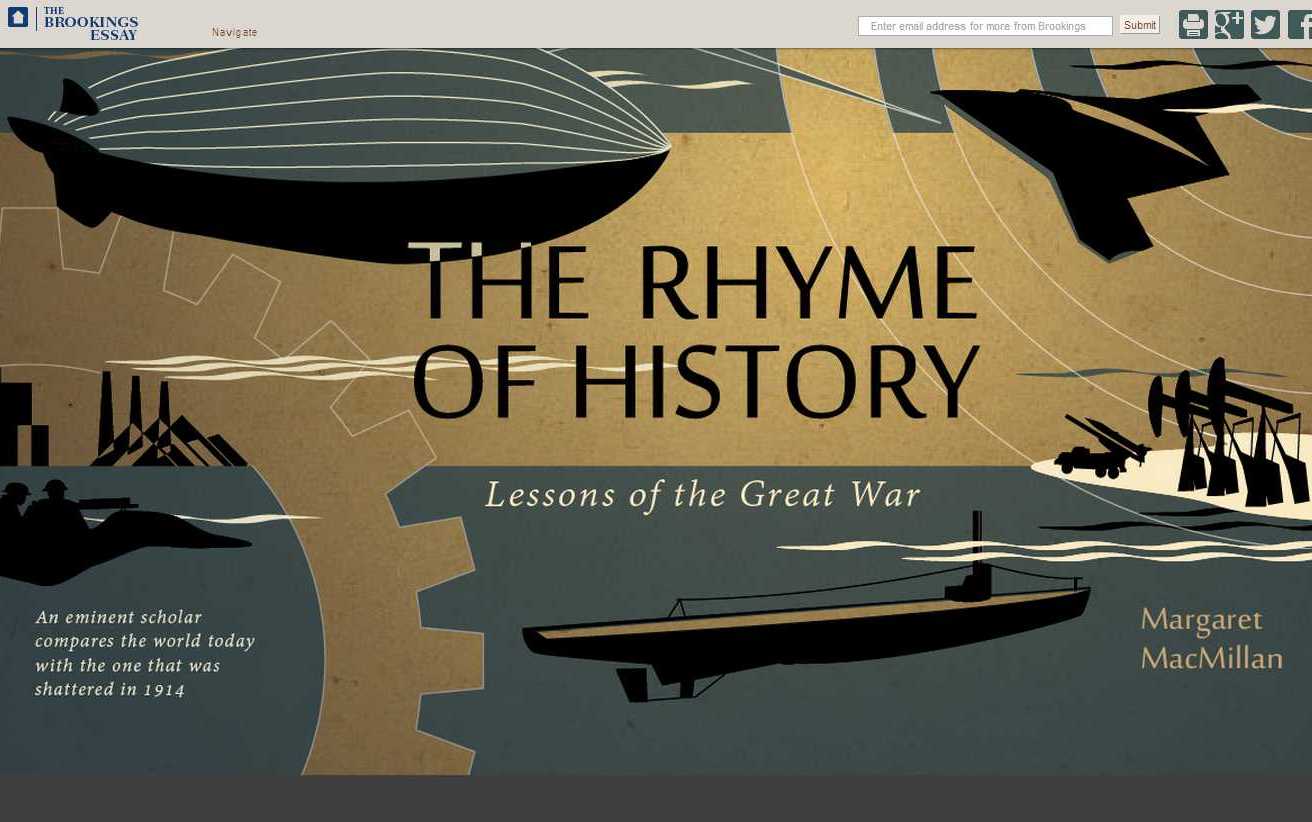
Margaret MacMillan on 1914

6 01 2014

rhymeofhistory

Historian Margaret MacMillan has published an essay on the lessons of the First World War for the present on the Brookings Institution website.

The essay, which is a teaser for her new book on the origins of the First World War, deals with the relationship between globalization and the roots of the conflict.

You can watch Professor MacMillan talk about her book below:


History Wars: First World War

4 01 2014

Was the First World War a just war fought against an evil enemy or was Britain’s decision to get involved in this conflict an appallingly stupid move that doomed millions of young men to death?  This question has been debated extensively in the last 72 hours, ever since the British Education Secretary for England, Michael Gove, declared that he thought that schools should use the upcoming centenary of the war to teach young people that the conflict had been a just war fought against a nation intent on world domination. Gove clearly has no time for the view that Britain and Germany were, in 1914, morally equivalent.  Gove denounced the 1980s TV comedy Blackadder for disseminating left-wing propaganda. He also attacked Sir Richard Evans, a distinguished academic historian of the Third Reich, for having questioned whether British soldiers in the First World War had indeed been fighting for freedom and justice.  In Gove’s view, such comments undermine patriotism and respect for the armed forces.

Gove appears to be departing from the UK government’s official view that the commemorations should not seek to attribute blame to either the Central Powers or the Entente. Since the 1980s, when Francois Mitterand and Helmut Kohl attended a joint commemoration ceremony at a First World War cemetery,  it has been standard practice for national leaders in the EU to honour and remember the dead who fell on both sides in the First World War.

Needless to say, Gove’s remarks, which were reported in the right-wing Daily Mail. Gove earned a smack down from Dr Tristam Hunt, the Labour MP who is the shadow Education Secretary and who happens to be a distinguished academic historian with a PhD. I really liked the opening paragraph of Hunt’s essay on Gove’s views:

Two days after Michael Morpurgo, author of War Horse, published a beautiful essay calling for this year’s First World War commemorations to “honour those who died” and “celebrate the peace we now share”,Michael Gove has delivered the government’s response. In an essay for the Daily Mail, the education secretary announced that the 1914 centenary should be about “battling leftwing myths that belittle Britain” and denouncing historians who “denigrate patriotism”. It is shocking stuff.

Hunt suggests that Gove’s comments may have more to do with the 2014 European parliament elections and the need to appeal to the anti-EU faction within the Conservative Party than a reasoned and evidenced view of history.

In retrospect, it was rather foolish for Gove, who has zero academic qualifications in history, to bring a knife to a gun fight with Hunt.

In this audio clip, you can hear history professors Sir Richard Evans and Gary Sheffield debates Gove’s ideas.

For other responses to Gove’s comments, see here, here, and here.


Gender and Japan’s Stagnation, Or, Why Gender Studies Really Matter

4 01 2014

Cover of the Japanese Edition of Sheryl Sandberg’s _Lean In_

There is a tendency among certain centre-right academics to criticize the gender studies/feminist scholarship one finds in Western universities as excessively politicized, ideological, and emotional. Within each academic discipline and community (e.g., history or IR or organizational studies), there has been a backlash against the rise of feminist scholarship. A common complaint about feminist approaches to scholarly research is that they are a big waste of time and that social scientists should be studying the things that really matter, the factors that determine the fate of nations, rather than the details of sexual harassment legislation or whether child care is cheap enough.

To these critics of gender studies, I will paraphrase John F. Kennedy and say, “Let them come to Japan.”

There is a lot of evidence for the thesis that the major causes of Japan’s post-1990 stagnation is sexism (i.e., the squandering of the talents of roughly half of Japan’s population). In the 1980s, many experts were predicting that Japan was going to dominate the world economy in the 21st century. Japan was seen as a very rich country and was predicted to overtake the US in GDP per capita. Then the Japanese economy stagnated for two decades and leadership in many industries passed to other countries. Japan still has some dynamic industries and big companies, but it appears to have passed into the second tier of industrial powers, where it sits alongside the likes of France.

Social scientists are still debating the causes of the reversal in Japan’s fortunes. The reasons are complex but appear to include gender. Of course,  no society is yet completely free of sexism. That’s true even in the world’s most sophisticated economic regions, which are found in places such as California and North-Western Europe.  However, by most statistical measures of gender equality and female economic empowerment, Japan is very much a laggard. It was ranked 101 out of 130 nations in a recent WEF report on gender equality.  The survey was based on four areas; employment opportunities/salary, educational background, health/longevity, and political participation.

In the combined rankings, the Scandinavian nations, where women’s social progress is well-established, occupied the top positions, with Finland ranking 2nd, Norway 3rd, Sweden 4th. Germany was 13th, the UK was 18th, Canada 21st, and the USA 22nd. Interestingly enough, Japan does very well on the female life expectancy metric, which means that its performance on the other three metrics is especially bad.

At least one Japanese woman I know has compared the treatment of women in the TV show Mad Men, which is set in a US workplace in the 1960s, to conditions in Japan today. At the risk of sounding like a functionalist sociologist, you might say that Japan’s gender culture is suited to an industrial economy rather than a post-industrial one. Such a reading of the situation is consistent with the timing of Japan’s relative decline and the nature of Japan’s competitive advantage: Japan is very strong is somewhat old-fashioned metal-bashing industries such as automobile manufacturing but is weak in the fields that have driven growth in the West since 1990 (e.g., software or financial services). For a great overview of this topic, see Marie Anchordoguy’s Reprogramming Japan: The High Tech Crisis Under Communitarian Capitalism Cornell University Press, 2005.

One of the encouraging recent developments in Japan is that the country’s current Prime Minister appears to recognize this: as part of his efforts to revive the Japanese economy, Shinzo Abe is talking about measures to encourage more housewives to enter the workforce, increase the representation of women on corporate boards, and encourage entrepreneurship by women.    In his public statements, Abe discusses the economic importance of women on an almost daily basis. He has also proposed measures to increase Japan’s dangerously low birthrate by making workplaces more friendly to working mothers and expanding access to childcare.

The bottom line is that gender equality appears to be an important element of Abe’s so-called “three arrows” policy for bringing Japan back. The three arrows are monetary policy, fiscal policy, and structural reforms. Promoting the utilization of female labour would fall into the category of structural reform. The other structural reforms proposed by Abe include a range of essentially neo-liberal measures, including deregulation.

In this piece, BBC’s chief business correspondent Linda Yueh discusses Abe’s attempts to revive Japan by changing attitudes towards working women.


Canadian and US Banking History the 2014 SSHA

26 12 2013

AS: The next conference of the Social Science History Association will take place in Toronto in November 2014. The broad theme of the conference is the history of inequality, which is surely a sexy topic nowadays. I note with interest the Economics Network of the Social Science History Association is encouraging people to present papers on “Comparisons of banking systems (notably US and Canada).” In fact, a number of the designated themes for the economics track  would be of interest to business historians. I’ve highlighted them below.

The Economics Network of the Social Science History Association calls for papers for the 2014 Social Science History Association conference.  It will be held in Toronto, Ontario, from November 6-9, 2014.  The conference theme is “Inequalities:  Politics, Policy, and the Past.”

For more information including the conference-wide call for papers, and the other networks please see the SSHA website.

We invite submissions of economics-related papers or (preferably) full panels by February 14, 2014. We are also interested to hear from volunteer chairs or discussants.

The Economics network meeting at the November 2013 meetings
generated numerous ideas for panel sessions, including:
·         Approx. 100 years since the Federal Reserve Act and World War I
·         150 years since National Banking Acts
·         Approx. 200 years since War of 1812
·         Border studies, noting our conference’s proximity to
the Canada-US border
·         Meet the authors panel. We welcome suggestions of potential
books by authors and readers
·         Comparisons of banking systems (notably US and Canada)
·         Fifty years of the War on Poverty

Other submissions related to social science history that can be incorporated into interdisciplinary panels are welcome, especially if
they relate to the conference theme of “Inequalities”.

Submissions of either individual papers or whole sessions are welcome. A full sessions has four papers.

SSHA draws submissions of papers and panels through networks organized
by topic or field. The Economics network representatives are below.
Please contact the network chairs with any questions.

A submission must provide an abstract, title and contact information, and designate a network (or networks) where the paper is likely to fit. Please submit paper and session proposals at http://conference.ssha.org
.

We look forward to reading your interesting panel and paper proposals,
and the conference itself will be a pleasure.

Regards  — the Economics Network Representatives of the SSHA
·         Mark Geiger <mwgeiger1@gmail.com>,
·         Matt Jaremski <mjaremski@colgate.edu>
·         Peter Meyer <meyer.peter@bls.gov>
·         Evan Roberts <eroberts@umn.edu>