AOM PDW: Frontiers of Digital History Methods

26 06 2017

This PDW at the Academy of Management on Digital Humanities is rather interesting. I’m looking forward to attending! Even though I once taught a course on digital history, that was ages ago and I’ve lost touch with this fast-moving field. I welcome the chance to learn about new research techniques, even if I probably won’t be able to use them in my own research.

The organizers are Robin Gustafsson, Aalto University, Mirko Ernkvist of the Ratio Institute, a market-oriented thinktank in Sweden.

Presenter: Charles Edward Harvey, Newcastle U.
Presenter: Mirko Ernkvist, Ratio Institute
Presenter: Mairi Maclean, U. of Bath
Presenter: Johann Peter Murmann, U. of New South Wales
Presenter: Michael Rowlinson, U. of Exeter
Presenter: David A. Kirsch, U. of Maryland

This PDW This PDW sets out to provide a broad overview and insights to management, organization, and history scholars at large on the current research forefront in how digital databases, methods and tools could contribute to the integration of management, organization, and history research. Overall the PDW centers on the idea for outlining opportunities and current frontier work with digital methods and tools for systematic digital reconstruction of historical sources, rigor and transparency of analysis and inference from evidence. These methodological advances enable new forms of scholarship and research groups collaborations. This PDW will: (1) introduce the participants to the historical developments of digital databases, tools and methods; (2) provide perspectives by forerunner management, organization, and business history researchers on methodological advantages, challenges and opportunities with digital history methods and tools for the integration of management, organization, and historical research; (3) present leading recent research work with digital methods and tools using large-scale digitized historical sources and evidence; (4) provide ample of time for Q&As and open discussions.


Source: AOM PDW: Frontiers of Digital History Methods


Tyler Cowen on the Resurgence of Economic History

23 06 2017

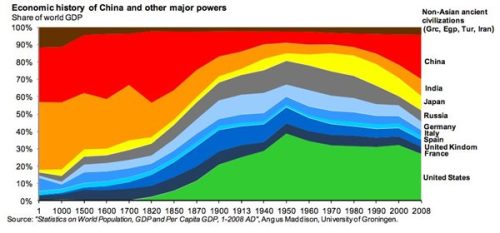
Tyler Cowen has published an interesting piece on the resurgence of economic history. In the last decade, this area of research, which was previously extremely niche, has received much more attention for both social scientists and the wider public. Tyler is trying to explain two separate yet related phenomena: the fact that economic-historical  research is increasingly important in the ivory tower, especially within the disciplines of economics, management, and history, and the fact that more and more non-academics are thinking about economic history, broadly defined. Economic-historical debates such as Great Divergence are now starting to filter down into the popular historical consciousness and the makers of bank strategy are starting to pay attention to the research of scholars of such as the late Angus Maddison. In 2012, Michael Cembalest, chairman of market and investment strategy at JP Morgan, used the following chart in a research newsletter. The chart went viral2000-years-of-economic-history-by-cembalest in the investment community and attracted a great deal of attention, which suggests that investors may using long-term trends in economic history to try to predict the future.

So what explains this (apparent) surge in the popularity of economic history. Tyler offers us eight possible explanations, some supply-side, some demand-side.

1. We now know much, much more about the earlier economic histories of China, India, and some other locales.  The rise of more and better graduate students from the emerging economies, or for that matter from Europe, has been essential here.

2. Some of the turn toward economic history came with the financial crisis, and the search for longer-term parallels, which meant looking back in history, most of all to the Great Depression.

3. Although the advance of cliometrics started a long time ago, we are now finally at intergenerational margins where economic historians are as quantitatively well-equipped as most parts of the applied micro spectrum.

4. The stranger the time period, the more people will have to look to broader stretches of history for understanding.  Yes, this one is an uh-oh.

5. Some applied micro fields have become a little more boring, so that has helped a partial shift of status to economic history.  Public data sets have been exhausted, and a lot of economic history data sets are “weird or idiosyncratic” data sets, which now are “in” and I predict will stay “in” for a long while to come because they offer the possibilities of both new discoveries and moats.

6. An academic trend that hasn’t yet been exploited usually ends up exploited, sooner or later, once the right nudge comes along.

5b, 6b. In chess, the top players are opting for the Giuoco Piano once again.

7. Competing economic models are more “allowed” in the subfield — not everything must be neoclassical — which has opened economic historians to more wide-ranging questions.  Economic history remains a good place to pursue the questions about economics that initially interested many people as undergraduates.

8. Academic attention is more media-driven these days, and good economic history papers usually have a story of some kind, and perhaps also a historical personage, event, or institution of broader interest.


The supply-side explanations made by Tyler are pretty straightforward: better access to economic historical data from non-Western countries, growing number of trained economic historians from such countries (think of the first-class economic historians at LSE who can read Indian and Chinese primary sources).  Tyler writes:


1. We now know much, much more about the earlier economic histories of China, India, and some other locales.  The rise of more and better graduate students from the emerging economies, or for that matter from Europe, has been essential here.


The demand-side factor identified by Tyler are, however more interesting to me, as they relate to the apparent increasing level of interest in economic history on the part of members of the reading public: policymakers, private-sector decision-makers, and the rest.

2. Some of the turn toward economic history came with the financial crisis, and the search for longer-term parallels, which meant looking back in history, most of all to the Great Depression.


4. The stranger the time period, the more people will have to look to broader stretches of history for understanding.  Yes, this one is an uh-oh

The demand-side explanation that Tyler is giving here is congruent with a huge body of literature in behavioural economics and cognitive science. This literature shows that people are more likely to use the heuristic of analogy during periods of elevated uncertainty (i.e., crises). This research also suggests that as the crisis intensifies, people are more likely to turn to historical analogies that are increasingly distant from them.

A few years ago,  Barry Eichengreen’s important new book Hall of Mirrors The Great Depression, The Great Recession, and the Uses-and Misuses-of History   drew on the literature in behavioural economics in trying to explain why so many policymakers used historical analogy as a cognitive tool during and immediately after the Global Financial Crisis.  Eichengreen makes the theoretical foundations of his book clear in the first paragraph of the conclusion of the book, which I’ve pasted below.

The historical past is a rich repository of analogies that shape perceptions and guide public policy decisions. Those analogies are especially influential in crises, where there is no time for reflection. They are particularly potent when so-called experts are unable to agree on a framework for careful analytic reasoning. They carry the most weight when there is a close correspondence between current events and an earlier historical episode. And they resonate most powerfully when an episode is a defining moment for a country and a society. For President Harry S. Truman, in deciding whether to intervene in Korea, the historical moment was Munich. For policymakers confronted in 2008-9 with the most serious financial crisis in eighty years, the moment was the Great Depression.

There is a lot going on in this paragraph, so let’s unpack it. Note how Eichengreen is here employing Daniel Kahneman’s distinction between thinking fast and thinking slow. Eichengreen isn’t saying that historical-analogic reasoning always has a massive influence on policymakers, merely that its influence is more pronounced during crises.

Eichengreen’s remarks suggest that Tyler Cowen’s demand-side explanation for the rising level of interest in economic history is accurate.


What Should Replace the TEF?

22 06 2017

Today, the UK government will publish the results of the TEF (Teaching Excellence Framework), a massive bureaucratic exercise designed to measure teaching quality in UK universities. The creation of the TEF was prompted by the belief that teaching quality in the UK was falling behind the US and other countries. The main data point that supported the belief that university teaching in the UK isn’t quite as good as it is the US were the growing numbers of wealthy young Britons who were bypassing Oxbridge and going to the Ivy League. As the headmasters of schools such as Eton and Harrow reported to the media about a decade ago, they were doing so in the belief that the higher quality of education on offer there was worth the higher tuition fees and travel costs.

Rather ironically, the TEF has resulted in the re-direction of resources away from classroom activities towards systems designed to measure the quality of classroom activities!

I would like to suggest a much more efficient and administratively elegant policy the UK government could use to drive up teaching quality in universities: mandate that the children of faculty get free undergraduate tuition, but only at the university that employs their parents. This rule, which could be embodied in a statute of about two pages,  would incentivize the parents of under-18 children to monitor teaching quality and to speak up whenever they see teaching practices that are so bad that they fail what I call “The Parent Test.”  What that means is that if a professor hears about  something really awful going down in a colleague’s classroom, they will say “Hey, my kid is only 8 years old now, but in a decade that could be him in there!”  The academics at the university would then discipline the bad teachers in their midst through various informal measures that could be begin with offers of mentoring and advice and could then escalate all the way to denial of tenure and, in the case of bad professors who already have tenure, total social ostracism in the form of the Silent Treatment. This mode of punishing colleagues who are bad teachers is particularly effective, I’ve been told, when there is an active Faculty Club on campus where the professors hang out to exercise, eat, and socialize.


I’m privileged to work in a department with well-rounded academics who are good at both teaching and research and who actually care about students. However, I’ve got lots friends who are lecturers at other UK universities and I often hear horror stories about awful teachers. My awful, I don’t mean well-meaning incompetents who are ineffective. I mean truly malicious, cruel, and warped people. The rule I am proposing would improve UK university teaching by inducing such individuals to either leave academic work or perhaps to emigrate to developing countries where universities will hire anyone with a PhD and a pulse.


Now it is true this policy would cost the university sector a bit of money—there are tens of thousands of lecturers in the UK and if each of them has two children, the policy of free tuition at your parent’s university would end up costing tens of millions of pounds. That’s because each kid pays the university £9,000 per year for three years.  However, not all parents would end up sending their children to their own university, as we know from countries that have this system, many professors pay for their child to have the experience of living and studying at a university in a different city.

I know that the optics of giving the children of faculty free tuition might be awkward and I certainly recall from my own undergraduate days resentment when it was realized that “faculty brats” were being educated for free. I distinctly remember the reaction when the son of a professor foolishly mentioned at a party that he wasn’t paying to study at our university.  However, I think that this system would, on balance, work well in driving up teaching quality. Since not all faculty families would avail themselves of the offer of free tuition at the parent’s university, the system might costs less than the TEF. I would note that the estimates of the full economic costs of the TEF, which include lost faculty time, have never been released by the government.

The UK government should scrap the TEF, introduce the “Free Tuition at Your Parent’s University” rule for faculty children, and then wait for the rule to work its magic. In five or ten years, university teaching will improve dramatically. The rule I have proposed is in place in many of the US universities that have been poaching the graduates of Eton and Harrow and other top-performing British youngsters. The rule works well because it harnesses one of the most powerful forces at work in society—the desire of parents to protect their children from harm. In designing a policy to boost teaching quality, you want to a policy that works with human nature, not against it.

A UK university could adopt this rule independent of the government, as long they factored it into their long-term financial planning. Having this rule and then letting everyone know about it would serve as an important signal of teaching quality to prospective students – “Look. Our teaching is so good even the children of faculty attend this university!” Moreover, such a rule might help with faculty recruitment and retention.


Note that this post represents only my own views and reflects the views of neither my employer nor any of the scholarly organizations in which I am involved. I would be most happy to provide consultancy services to any UK organization that wishes to discuss the ideas in this blog post.


“Berle and Means’ The Modern Corporation and Private Property: the Martial Roots of a Stakeholder Model of Corporate Governance”

20 06 2017

Tomorrow, my co-author Kevin Tennent will present this paper at EURAM in Glasgow. Our paper is part of the Corporate Governance Track.  Here are the full details of our panel:

Session Type : Competitive
Chairperson  : Ken Starkey

Papers :
1783 – HUMAN CAPITAL AND INTERNAL GOVERNANCE OF THE FIRM: A LEGAL AND ECONOMIC PERSPECTIVE ON INTERNAL GOVERNANCE
Xavier Hollandts – KEDGE BS
Bertrand Valiorgue – UCA

1778 – IS LAW NORMALIZING HYBRID ORGANIZATIONS? PUTTING PROFIT-WITH-PURPOSE CORPORATIONS INTO HISTORICAL PERSPECTIVE
Kevin Levillain – MINES PARISTECH, PSL RESEARCH UNIVERSITY
Blanche Segrestin – MINES PARISTECH, PSL RESEARCH UNIVERSITY
Armand Hatchuel – MINES PARISTECH, PSL RESEARCH UNIVERSITY

1259 – BERLE AND MEANS’S THE MODERN CORPORATION AND PRIVATE PROPERTY: THE MILITARY ROOTS OF A STAKEHOLDER MODEL OF CORPORATE GOVERNANCE
Andrew Smith – UNIVERSITY OF LIVERPOOL
Jason Russell – EMPIRE STATE COLLEGE
Kevin Tennent – UNIVERSITY OF YORK


The image below speaks to many of the issues dealt with in our paper, particularly the role of academic ideas in changing practitioners’ ideas about the ultimate social purpose of the business corporation: is it to make as much money as possible for the shareholders or something else, as Berle and Means argued?

purpose of corporations


150 Years of Canadian Business

20 06 2017

Date:   September 11-12, 2017

Location:  Rotman School of Management, University of Toronto

Sponsors:  Historica Canada, Deloitte, TD Bank Group

Co-Presenters: Historica Canada; Canada’s History Society; Michael Lee Chin Family Institute for Corporate Citizenship; Oral History Centre, University of Winnipeg; Department of History, University of Toronto; Economics Department, University of Toronto.

8:00 am – 8:45 am        Registration, coffee/tea and Continental Breakfast

8:45 am – 9:00 am        Introductory Remarks, Professor Dimitry Anastakis, CBHA
Welcome, Tiff Macklem – Dean, Rotman School of Management

9:00 am – 10:30 am      Plenary Session

Session One: Plenary Session – Regions and Provinces in Canada’s Business History

Prairies: Bill Waiser (University of Saskatchewan)
Central: G. Taylor (Trent University)
Quebec: Thierry Nootens (Universite du Quebec a Trois Rivieres)
Atlantic: Don Nerbas (Cape Breton University)

10:30 – 10:45 am        Comfort Break

10:45 am – 12:15 pm  

Session Two – The Role of Women in Canadian Business History
Melanie Buddle (Trent University)
Tabitha Fritz (Rotman School of Management)
TBD

Session Three – Journalism, the Press, and Canada’s Business History
Gene Allen (Ryerson University)
Gordon Pitts (DeGroote School of Business)

12:30 pm – 1:30 pm Luncheon

Keynote Speaker TBD –  Robert McIntosh, Director-General, Library & Archives Canada  Archives and Canadian Business History 

1:45 pm – 3:15 pm

Session Four: Indigenous Canadians and Canadian Business History
Brian Gettler (University of Toronto)
David Newhouse (Trent University)
Alison Kemper (Ryerson University)

Session Five: Global Trading and Investment (Multinational Investors, FDI)
Walid Hejazi (Rotman School of Management)
Stephen Azzi (Carleton University)
TBD

3:15 pm – 3:30 pm Comfort Break

3:30 pm – 5:00 pm

Session Six: The Importance, Relevance and Necessity of Teaching of Canadian Business History
Joe Martin (Rotman School of Management)
Red Wilson (Business Executive, Co-founder: Historica)
Lauren Epstein (Director of Investments, Epstein Enterprises)

Session Seven: Advertising and Marketing, and R&D, to Canadians over 150 Years
Daniel Robinson (Western University)
Janis Thiessen (University of Winnipeg)
Bruce Smardon (York University)

5:30 pm Reception and Dinner

Announcement of CBHA/ACHA Book Prize Winner

Keynote Speaker Mr. Jim Leech,  –Former Chief Executive Officer, Ontario Teachers Pension Plan,  Pension Plans in Canadian Business History

DAY TWO: September 12th, 2017

8:00 am – 8:45 am    Coffee, Tea and Continental Breakfast

8:45 am – 9:00 am    Chris Kobrak Memorial

9:00 am – 10:30 am

Session Eight: Plenary Session – The Resource Sector and Multinationals in Canadian Business History
Robin Gendron (Nipissing University)
Stan Sudol (Communications Consultant)
Mark Kuhlberg (Laurentian University)

10:30 am – 10:45 am Comfort Break

10:45 am – 12:15 pm

Session Nine:  150 Years of Canadian Banking Industry -Domestic to Global Growth, and Banking Oversight

Helen Sinclair (Former President, Canadian Bankers Association)
Robert Wright (Augustana University)
Laurence Mussio

Session Ten:  A Conversation About Corporate Law, Accounting and Canadian Business History
Jim Baillie (Retired, Torys)
Jim Goodfellow (Former Partner & Vice Chair – Deloitte)

12:30 pm – 1:30 pm Luncheon

Keynote Speaker Mr. Perrin Beatty, President & Chief Executive Officer – Canadian Chamber of Commerce, Canadian Commerce in Canada’s Business History

1:45 pm – 3:15 pm

Session Eleven: 150 Years of the Canadian Financial Industry
Amy Young (Upside Consulting) – Stock Exchanges
Patricia Best (Author) – Trust Companies
Mark Bonham (Massey College) – Insurance Companies

Session Twelve: Canadian Rural Business History
University Professor Emeritus Doug McCalla (University of Guelph)
Simon Berge (University of Winnipeg) – Co-Operatives
Catherine Wilson (University of Guelph)/Beatrice Craig (University of New Brunswick)

3:15 pm – 3:30 pm Comfort Break

3:30 pm – 5:00 pm

Session Thirteen: Archives Session  TBD

TBD
TBD
TBD

Session Fourteen:  New Trends and Issues in Canadian Business History
Donica Delisle (University of Regina)
Jason Russell (Empire State College)
Andrew Smith (University of Liverpool Management School)

5:15 pm                     Closing Cocktail Social and Thank You
CBHA Chris Kobrak Research Fellowship Announcement
Dean, History Department, University of Toronto
Comments from Historica, Ann Dadson


Contingencies of Company Law: On the Corporate Form and English Company Law, 1500-1900

19 06 2017

I’m sharing another excellent review piece from Nep-Hist blog run by the multi-talented Bernardo Batiz-Lazo.

bbatiz's avatarThe NEP-HIS Blog

The Development of English Company Law before 1900

By: John D. Turner (Queen’s University Belfast)

Abstract: This article outlines the development of English company law in the four centuries before 1900. The main focus is on the evolution of the corporate form and the five key legal characteristics of the corporation – separate legal personality, limited liability, transferable joint stock, delegated management, and investor ownership. The article outlines how these features developed in guilds, regulated companies, and the great mercantilist and moneyed companies. I then move on to examine the State’s control of incorporation and the attempts by the founders and lawyers of unincorporated business enterprises to craft the legal characteristics of the corporation. Finally, the article analyses the forces behind the liberalisation of incorporation law in the middle of the nineteenth century.

URL: http://econpapers.repec.org/paper/zbwqucehw/201701.htm

Ditributed by NEP-HIS on: 2017-02-19

Review by Jeroen Veldman (Cass Business School, City University)

The…

View original post 1,669 more words


On the rise of unproductive entrepreneurs like Travis Kalanick

16 06 2017

Izabella Kaminska of the FT’s Alphaville Team has written a great piece that applies Baumol’s typology of entrepreneurs to the present and the past. However, I’m not at all convinced that Unproductive Entrepreneurship is new. The article kinda suggests that there was a long period between the end of the Roman Empire and the present in which Unproductive Entrepreneurship went away and the “good” type of entrepreneurship was predominant. I’m convinced that this was really the case, even during the thirty years of high growth after 1945, although I would concede that there is a great deal of anecdotal evidence that Unproductive Entrepreneurship is becoming more frequent today.


New Book: The Emergence of Routines (Raff and Scranton)

16 06 2017

Yet another book to put on my summer reading list! If the publisher sends a copy to me, I will promptly review it here.

Dan's avatarOrganizational History Network

Business historians Dan Raff and Phil Scranton have published an interesting new edited collection that explores the intersection of business history, business strategy, and entrepreneurship. Published by OUP, The Emergence of Routines includes a series of historical case studies examining the origins of organizational order in firms. The book includes a conceptual introduction and an intriguingly titled concluding chapter on “learning from history” that should be of interest to readers of this blog.

From the OUP Site’s Description:

This book is a collection of essays about the emergence of routines and, more generally, about getting things organized in firms and in industries in early stages and in transition.

These are subjects of the greatest interest to students of entrepreneurship and organizations, as well as to business historians, but the academic literature is thin. The chronological settings of the book’s eleven substantive chapters are historical, reaching as far back as the…

View original post 148 more words


The Poverty of Entrepreneurship: The Silicon Valley Theory of History

14 06 2017


That’s the title of an intriguing new piece on by Professor John Patrick Leary on a new historical heuristic that has been adopted by many people in Silicon Valley. A historical heuristic is a type of mental short cut that people use to make sense of the world. We use many heuristics. A historical heuristic is a theory derived from an understanding of history that allows one to understand the present and predict the future. Political scientists have shown that historical heuristics are used all the time by policymakers, especially those who make foreign policy. My own research is on how historical heuristics are used in business, an issue that has received very little attention in management journals until very recently but which is very important, in my view. [Political scientists and political psychologists, in contrast, have published a great deal on the use of historical heuristics by policymakers]. My current research (as yet unpublished) suggests that historical heuristics are not only pervasive in business (especially in finance and technology) but that if used correctly can be an important source of competitive advantage. I’m working on two papers in this area, one of which looks at historical heuristics and entrepreneurial cognition in an area of technology, the other is about historical heuristics and the making of bank strategy.  Readers will be aware that both of these sectors are characterized by very levels of uncertainty (Knightian uncertainty to be technical) and very complex systems.

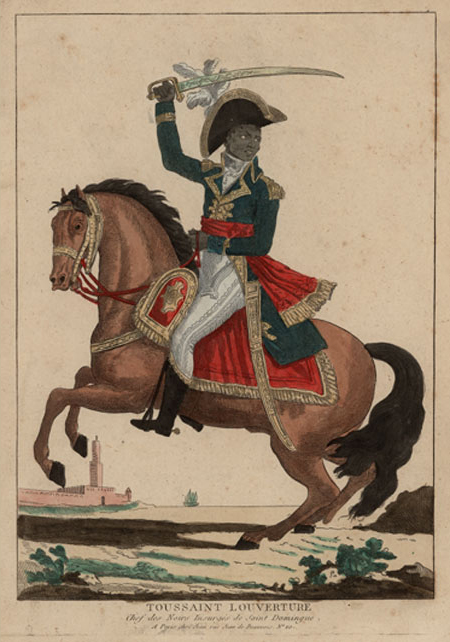
Anyway,  the historical heuristic discussed by Professor Leary was created by Ben Horowitz, co-founder of the powerful venture capital firm AndreessenHorowitz. Horowitz’s day job is to evaluate the many applications for venture capital that his company receives and then decide which start-up is most worthy of investment. Horowitz presented this theory of history in a talk called Culture and Revolution that you can view online.  Horowitz’s theory of  the relationship between organizational change and success is based on a particular reading of the life and times of  Toussaint L’Ouverture, the slave who led a successful rebellion in Haiti in the 1790s. (Think of Spartacus but in the tropics).  Horowitz developed his theory of why certain insurgent organizations succeed in changing the world based on a reading of C.L.R. James’s Marxist history of the Haitian Revolution, The Black Jacobins. The implication of his historical heuristic is that a start up organization, be it a small conspiracy of slaves determined to revolt or a start-up firm that aims to disrupt an industry via an app (think Uber and taxis) is more likely to succeed if it is led by a dynamic, charismatic leader similar to Toussaint L’Ouverture.

toussaint_l27ouverture

Professor Leary  appears to object to the historical analogy Horowitz is drawing here because it is rather flattering to would-be disrupters in Silicon Valley: outside of perhaps a few hard-core conservatives in the Deep South who still regret the Emancipation Proclamation, most Americans who think about historical rebellions see the slaves as “the good guys” and the masters as the “the baddies”. (Certainly that’s the case in any Hollywood film about slave revolts– the rebel slaves are always depicted in sympathetic terms). By associating entrepreneurs with the leaders of slave rebellions, Horowitz is helping to legitimate entrepreneurship. Leary doesn’t like that.

Ok. Leary is entitled to his opinion, which is obviously rooted in a political point of view. As a management academic, I’m more interested in knowing whether Horowitz ever uses the historical heuristic based on the Haitian Revolution to evaluate the prospects of the firms that come to him for capital. If Horowitz’s historical theory does influence his business decision-making, it would be fascinating to determine the extent to which he is aware that this is taking place. The funny thing about historical heuristics and other forms of analogical reasoning is that once we start using a given heuristic (mental short cut) in one area of life, we may start using them in other domains without being aware that we are doing so.

I would love to interview Mr. Horowitz at some point about the issues I’ve raised here.


How Management Theory Helps Us to Understand Why the Canadian Government’s Celebrations of the 150th Anniversary of Confederation Ignore Confederation

3 06 2017

How Management Theory Helps Us to Understand Why the Canadian Government’s Celebrations of the 150th Anniversary of Confederation Ignore Confederation

Management academics are increasingly interested in the uses of the past (see here).  For a good gateway into this literature, see the very recent article in Administrative Science Quarterly by  Mary Jo Hatch and Majken Schultz (both of Copenhagen Business School). The focus of much of this research how managers and other social use ideas about history to get what they want in the present. In this blog post, I’ll try to show how this body of theory is useful in understanding a recent development in Canadian politics.

As long-time readers of this blog know, I’m now every interested in social memory (i.e., how perceptions of the past influence thought and action in the present). In an early stage of my academic career, I published extensively on the process by which the Canadian constitution of 1867 was created.  This process is called Confederation. British North America Act of 1867, which united several British colonies into a federal state, still forms the basis of Canada’s written constitution, which is why 2017 is considered to be the 150th anniversary of Canada.

can150intro

The 150th anniversary has been marked with public celebrations and commemorative projects all across the country, some of which are funded by a special program of the Canadian government. To mark the 150th anniversary of Confederation, the entry fees to all national parks have been temporarily lifted.  The government has decided to use the 150th anniversary of Confederation as an excuse to fund a variety of perfectly worthy projects that range from making playgrounds more accessible disabled children to orchestra tours to more funding for a ParticiPACTION, a campaign to make Canadians exercise a bit more.  (see full list here).

ns-centennial-pool-852x479-1-8col

Most of these fine projects have zero heritage or historical content and are thus similar to the civic projects that marked the 100th anniversary of Confederation in 1967. The 1967 Centennial project fund resulted in the construction of a string of municipal swimming pools, hockey arenas, roads,  libraries, etc all across Canada, all of which have the name Centennial.   As someone who was born in the 1970s, I was able to make use of some of the facilities built in 1967, so I would imagine that the facilities that will be opened this summer will benefit future generations.

170310worlds-largest-rubber-duck

[I must confess that I am less certain that the gigantic rubber duck that Toronto has rented for the summer to celebrate the 150th anniversary of Confederation will actually benefit future generations, or indeed current residents of that city. The plan is to let the duck drift around Toronto harbour for the summer in a “whimsical” fashion. Although we are assured that the duck does not pose a threat to navigation, its arrival in the city has generated some debates about cost effectiveness].


Ok, let me get back to my main point. Some people have observed that the projects that the government has funded to mark the sesquicentennial of Confederation do not have anything to do with the actual event being commemorated (Confederation). Some historical or heritage projects are being funded, but they are designed to share stories about many events and historical periods in Canadian history rather than the events of 1867 itself.  For instance, there has been an oral-history initiative called Red Couch, which invites people to sit on a sofa in a public place and reminisce about what they have observed during their lives. Since nobody born in the nineteenth century is still alive, of course, this form of heritage will say nothing about Confederation in 1867. Similarly, children are being invited to make short videos called Here’s My Canada in which they talk about whichever events in Canadian history are of interest to them. From what I can see, the children were not asked to speak about the events of 1867 and they probably weren’t even told of them.


The legal academic Leonid Sirota has recently noted that while academics are using the sesquicentennial of Confederation as occasion for debating Canada’s  past and future constitutional development , the same is not true of the non-academic events designed to mark the sesquicentennial. In other words, whilst law school professors and political scientists interested in the constitution have organized scholarly conferences and journal special issues about that discuss the events of the 1860s, the government-funded events for the public have avoided discussing this issue.   In management journals, we have the concept of “organizational forgetting.” My fellow business-school professors have published a great deal of work on this subect. That’s what appears to be taking place in Canada right now—a conscious desire to try to supress discussion of 1867 and to get people to forget about the snippets of historical knowledge they have from high school that relate to the process that resulted in Confederation in 1867.
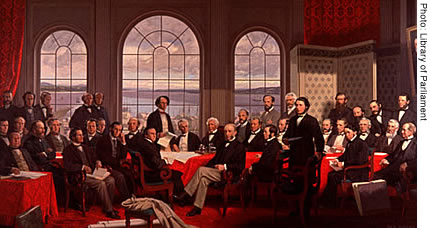
fathers

An Iconic Image of the 1864 Quebec Conference


c006799

Another Canadian-Famous Picture. The London Conference 1866

Most Canadians vaguely remember a little a bit about the various constitutional conferences in Charlottetown, Quebec City, and London that resulted in Confederation in 1867. The iconic pictures of these conferences taking place used to be very common in Canadian history textbooks and can still be found hanging in Canadian public buildings. These conferences have also been depicted on postage stamps (see below).

canada_3_cents_1917

The organizers of the Canada 150 celebrations could have used this summer’s celebrations as a teachable moment for building on the public’s rudimentary knowledge of politics in the 1867 to teach people about the process by which their constitution was created. It appears that they consciously decided to avoid doing so.


So we have a very curious pattern: there is a concerted effort to  ensure that little is said about the making of the Canadian constitution of 1867 in a series of celebrations designed to mark the 150th anniversary of this constitution.  The journalist Andrew Coyne recently mocked the whole Canada 150 project for, er, forgetting about Confederation.  Lawyers, who are naturally inclined to think that the 1867 constitution is rather important, have also noted that the celebrations are skipping over the thing they are supposed to be celebrating.

In a recent issue of the magazine of the Canadian Bar Association, Sirota speculates that part of the Liberal government’s evidence reluctance to mention the events of 1867 may be a desire to avoid accusation of partisanship and the manipulation of the historical record. He notes that  “both Liberal and Conservative governments have a record of playing politics with history and refusing to honour figures associated with the other [main] party, and it would have been difficult to mark Confederation without talking John A. Macdonald and George-Étienne Cartier” who were both Conservatives.

I have a somewhat different explanation for the policy of not mentioning the war not mentioning Confederation.  Anniversary celebrations can themselves be “performative” to use a fancy social-science term. That means that discussing a historical events may encourage people to think about doing something similar.  The historical event or figure becomes a sort of role model.

Consider the case of the firm du Pont Company, which was founded in 1802. According to the historian Alfred Chandler (1962, p.52), the process of planning  the 100th anniversary in 1902 forced the firm’s senior leaders to reflect on the future of the firm and whether dramatic administrative reorganization was required to deal with certain real changes in the firm’s operating environment. In the next few years, Du Pont, dramatically changed its internal organization. The firm likely would have made the same changes  anyway had the anniversary not focused the minds of its leaders of fundamental issues, but it does appear that the anniversary had at least some impact on their thought process.

A more dramatic case of anniversary celebrations being a focal point that encourages people to think about institutional change is the 1967 centennial celebrations in Canada. The 100th anniversary of the introduction of a new constitution (the British North America Act of 1867) prompted the political leaders to think about whether the constitution needed to be changed. The public celebrations of Confederation coincided with a meeting of senior politicians called The Confederation of Tomorrow where future changes to the constitution were discussed.

tspa_0004929f

Confederation of Tomorrow Conference, 1967

Now there was no obvious reason why constitutional change was urgent in Canada in the mid-1960s: although a very small nationalist movement was present in Quebec, the existing institutional arrangement represented by the 1867 constitution appeared to be working well—the country was politically stable, GDP was growing rapidly, unemployment was low, etc. Canada was a net recipient of migrants from the US, which was another sign the existing institutional arrangements were performing well. In some societies, constitutional change is necessary. In Canada in the 1960s, it was a solution looking for a problem. However, I can understand why Canadian politicians of the 1960s wanted to hold meetings and change the constitution. That’s because they had been brought up in a political culture that valorizes well, politicians who sit around in conferences and talking about changing the constitution. In some countries, they way to get your face on a postage stamp is to lead your country into war. In Canada, the way earn a place in the historical record is to attend meetings where you negotiate changes to the constitutional order. The men in the picture from 1967 I’ve pasted above may well have grown up licking postage stamps that celebrated the men who attended the 1864 constitutional conference in Quebec City. (I’ve also pasted a 1917 Canadian postage stamp that celebrated this meeting and the men who attended it).  Come of think of it, the politicians who attended the 1967 Confederation of Tomorrow Conference probably did see the 1917 postage stamp as boys.


I would speculate that staring at pictures of the Canadian constitutional meetings of the 1860s inspired Canadian politicians of the 1960s to become constitution-makers themselves. They had a role to perform! At around the time of the 1967 confederation celebrations, Canada’s federal and provincial leaders began a series of grand conferences devoted to the subject of how the constitution should be modernized.   These meetings were, visually, rather similar to the constitutional meetings that led to Confederation in 1867: they involved representatives of all of the provinces sitting together to talk about details of the constitution. The clothing styles were different and there were TV cameras rolling, but in other ways the process was basically similar to the earlier constitutional conferences.
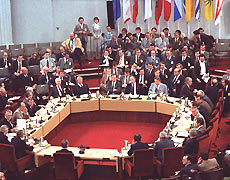
constitutio_cp_1696322

1981 Constitutional Conference Meeting

Constitutional politics came  to dominate Canadian politics from the 1970s to the early 1990s, when the last of these attempts at macro-constitutional change failed, when the they so-called Charlottetown Accord, a package of constitutional amendments was rejected in a deeply divisive national plebiscite.  For symbolic reasons, this accord had been negotiated in the city of Charlottetown, which has also hosted the famous 1864 constitutional meeting (see pictures below).

From about 1993 to the present, the Canadian political class has sought to avoid  marco-constitutional politics—the use of the so-called C-word (i.e., “constitution”). The focus has been economic policy, healthcare policy, global warming, the war on terror,  and pretty much everything except the constitution. The focus of politics has been on making decisions within the existing constitutional framework rather than changing the constitutional issues themselves.

I have no insider knowledge of the process by which the planners of the Canada150 celebration decided to ignore the actual events of 1867. However, I suspect that they were thinking that any public events that commemorated earlier rounds of constitutional bargaining (e.g., high-profile visits by political leaders to the sites of the constitutional meetings of 1864 and 1866-7) might encourage political actors to re-open the subject of constitutional reform. The last thing any Canadian Prime Minister wants is to legitimate calls for another set of constitutional conferences.  Instead, the Prime Minister wants to simply enjoy the festivities, which will culminate on 1 July, Canada’s national holiday and the precise moment when the Canadian constitution turns 150 years old. There will be a massive party and outdoor music festival in front of the Canadian parliament.

As if on cue, the Quebec government announced on 1 June that it was seeking to re-open  the subject of the constitution. It proposed a gathering of political leaders from across Canada so that the constitution can be re-written so as to satisfy its five demands for constitutional change, along with demands that may come from Aboriginal Peoples. In releasing a document with its proposals for constitutional change, the Quebec government explicitly stated that the timing of its publication was connected to sesquicentennial celebrations. The government’s 200-page policy paper  (available in French here and in English here) refers to the sesquicentennial and the events of 1867 and declared that:  “We must work to re-establish what Quebecers have always wanted since 1867: a Canada that accepts them for who they are….” The first 40 or so pages of the document consist of a historical narrative covering Quebec history from before 1867 to the 1995 Referendum on Quebec independence.

The timing of the Quebec’s government decision to re-open the constitution strongly suggests that historical anniversaries can become performative. In my view, it illustrates the utility of the growing body of research in management, and indeed across the social sciences, on social memory and the power of history to shape action in the present.