Canadians at the 31st International Conference on Business History

12 09 2013

The 31st International Conference on Business History will be taking place in Kyoto on 12-14 September 2013. Formerly known as the Fuji Conference, this event is the annual conference of the Business History Society of Japan.

Looking through the program, I see that Canadian academics will be participating as either presenters or discussants. It looks like a great conference full of good sessions. The organizers have also laid on trips to two factories. However, I hope that the overseas visitors find the time to see a bit of Kyoto, which is one of my favourite Japanese cities, not least because my honeymoon was there!
9:45-12:00 Session I : Methodology, Concepts and Overview
Chair: Bram Bouwens (Utrecht University, Utrecht, Netherlands)

Takafumi Kurosawa (Kyoto University) “Industry Specific Time and Space: Methodology of the Industry History and the Possibilities  of Regional Perspective”

Jari Ojala (University of Jyväskylä, Jyväskylä, Finland) and Juha-Antti Lamberg (Jyväskylä , Finland) “Evolution of global paper and pulp industry 1800 – 2000: Regional Sources for  Competitiveness of Clusters”
Takeo Kikkawa (Hitotsubashi University, Tokyo) “Sinking Japan and Floating East Asia: The Cases of the Financial and Chemical Industries”

Discussant: Matthias Kipping (York University, Toronto, Canada)

13:15-15:30 Session II Automobile Industry

Chair: Ayumu Banzawa (Osaka University, Osaka)

Dimitry Anastakis (Trent University, Ontario, Canada) “From National to Continental to International: The Evolution of the Canadian Auto Industry, 1960-2000″

Zejian Li (Osaka Sangyo University, Osaka)” Competitive Advantage and Organizational Dynamics: The Rise of Automobile Makers in Asia, 1990s-2000s”
Harm G. Schröter (University of Bergen, Norway) The World Truck-Market –A Regional Issue?
Discussant: Takashi Hikino (Kyoto University)

11:45-13:00 Research Strategy: An Interim Review
Chair: TBD

Matthias Kipping (York University. Toronto) “Competitive Advantage and Industry Location (revised edition)”

Takafumi Kurosawa (Kyoto University) “Good Strategy, Bad Strategy”: An Interim Self Review on the CARIS Project


What do the happiest countries in the world have in common?

10 09 2013

Snow. And lots of it.

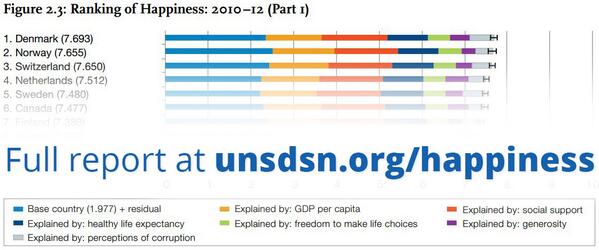
The latest rankings of countries according to average level of reported happiness have been released by the United Nations.  Here are the top performing countries.


If you look at, say, the top six countries, they have a number of things in common (they are wealthy and Western). They also tend to be cold in the winter. It’s clear  that the creators of this ranking system didn’t incorporate climate into their rankings. In contrast, The Economist’s rankings of cities takes weather, along with wealth, crime rates, etc into account. For many years, Vancouver beat many other Canadian cities and was rated the best city in the world simply because its climate was so mild. In recent years, Australian cities, which have an enormous weather advantage, have captured the top spots. The happiness rankings suggest that perhaps severe winters should not receive such a heavy weighting in calculating The Economist’s city rankings.


Top 30 “Happiest Countries”

1. Denmark (7.693)
2. Norway (7.655)
3. Switzerland (7.650)
4. Netherlands (7.512)
5. Sweden (7.480)
6. Canada (7.477)
7. Finland (7.389)
8. Austria (7.369)
9. Iceland (7.355)
10. Australia (7.350)
11. Israel (7.301)
12. Costa Rica (7.257)
13. New Zealand (7.221)
14. United Arab Emirates (7.144)
15. Panama (7.143)
16. Mexico (7.088)
17. United States (7.082)
18. Ireland (7.076)
19. Luxembourg (7.054)
20. Venezuela (7.039)
21. Belgium (6.967)
22. United Kingdom (6.883)
23. Oman (6.853)
24. Brazil (6.849)
25. France (6.764)
26. Germany (6.672)
27. Qatar (6.666)
28. Chile (6.587)
29. Argentina (6.562)
30. Singapore (6.546)


Margaret MacMillan on 1914

9 09 2013

Margaret MacMillan, the Warden of St. Antony’s College, Oxford, is currently in Toronto. Tonight, she will be presenting material taken from her forthcoming book  The War that Ended Peace: The Road to 1914 at the new Bill Graham Centre for Contemporary International History, which is part of the Munk School at University of Toronto. I’ll check to see if any videos of the talk are placed online. If they are, I’ll share them here.

Update: Prof. MacMillan will be speaking at York University on 12 September.  The title of that talk is “Does History Matter in International Relations.”


Ian Milligan and the Internet Archive

9 09 2013


The ActiveHistory.ca blog published a piece in which Ian Milligan of the University of Waterloo discusses the uses of the Internet Archive in historical teaching and research. He has blogged about the Internet Archive before and has talked about how it is the basis of his current major research project. Today’s blog post includes an admirably concise account of what the various options for using the Internet Archive’s massive collection of digitized historical images.

Ian mentions that it is his first day of classes today. I wish everyone who is starting their academic year right now good luck. Milligan’s post reminds me of just how good the average standard of teaching in Canadian universities is. In many ways, Canada is blessed among nations.


Adam Crymble’s PhD Thesis in 2 Minutes

9 09 2013

The website Piled Higher and Deeper has a series of videos in which the research of current doctoral candidates is summarized in two minutes using animation and voice overs. A few days ago, they profiled the work of Adam Crymble, a PhD student at King’s College in London, UK. Here it is.


The Bet: Paul Ehrlich, Julian Simon, and Our Gamble over Earth’s Future

5 09 2013

AS: Paul Sabin’s new book looks interesting. It’s called The Bet: Paul Ehrlich, Julian Simon, and Our Gamble over Earth’s Future

Abstract:
“In 1980, the iconoclastic economist Julian Simon challenged celebrity biologist Paul Ehrlich to a bet. Their wager on the future prices of five metals captured the public’s imagination as a test of coming prosperity or doom. Ehrlich, author of the landmark book The Population Bomb, predicted that rising populations would cause overconsumption, resource scarcity, and famine—with apocalyptic consequences for humanity. Simon optimistically countered that human welfare would flourish thanks to flexible markets, technological change, and our collective ingenuity.
Simon and Ehrlich’s debate reflected a deepening national conflict over the future of the planet. The Bet weaves the two men’s lives and ideas together with the era’s partisan political clashes over the environment and the role of government. In a lively narrative leading from the dawning environmentalism of the 1960s through the pivotal presidential contest between Jimmy Carter and Ronald Reagan and on into the 1990s, Paul Sabin shows how the fight between Ehrlich and Simon—between environmental fears and free-market confidence—helped create the gulf separating environmentalists and their critics today. Drawing insights from both sides, Sabin argues for using social values, rather than economic or biological absolutes, to guide society’s crucial choices relating to climate change, the planet’s health, and our own.”
Through sheer coincidence, I’ve been listening to a recent podcast in which Robert Pindyck is interviewed about climate change. Pindyck argues that while there is little doubt about the existence of anthropogenic global warming, there is tremendous uncertainty about what the effects of the rapidly rising temperature will be. Moreover, we can’t even agree on the discount rate we should use in calculating the present value of future environmental damage.  Nevertheless, Pindyck thinks we should act now on climate change. He invokes the precautionary principle and says that a carbon tax would be a damn good idea, even though we aren’t yet 100% certain that it would benefit future generations.


Ronald Coase

5 09 2013

More details are emerging about the life of the recently departed Ronald Coase, a great economist whose ideas changed public policy in many countries.  In the early 1960s, he was effectively persecuted for his belief in the free market by a dean at the University of Virginia who was apparently intent on eliminating anyone who disagreed with the basic principles of the New Deal.  In 1964, one of Coase’s colleagues

accidentally received a copy of a secret dossier compiled by then Dean of the Faculty Robert Harris in which Harris outlined a plan to change the economics faculty. Under then President Edgar Shannon, Harris allegedly used non-promotion and non-offer-matching to force Jefferson Center scholars to disperse. Coase left UVA for Chicago in 1964; Buchanan departed four years later.

In 1997, Coase recalled that:

They thought the work we were doing was disreputable. They thought of us as right- wing extremists. My wife was at a cocktail party and heard me described as someone to the right of the John Birch Society. There was a great antagonism in the ’50s and ’60s to anyone who saw any advantage in a market system or in a nonregulated or relatively economically free system.

Today, Coase’s ideas are very mainstream. In fact, there is a citation of a paper by Coase in a co-authored paper I am working on today. You can read more about Coase and the University of Virginia here.


David S. Landes

3 09 2013


The world has lost a truly great historian. The research of David Landes, which spanned political, economic, and technological history, was fundamentally about understanding the “Rise of the West” to global dominance. His ideas laid the foundation for the more recent literature on the Great Divergence (i.e., the attempts by historians to explain why the Industrial Revolution took place in the West rather than in East Asia or some other civilization).   Simply put, until a few centuries ago, life in all of the world’s main agricultural civilizations was pretty similar: nasty, brutish, short, slow technological progress, people surviving on the equivalent of a dollar day. Then Western Europe, followed by other parts of the world, started to take off economically.


Since the year 2000 or so, the Great Divergence has become one of the central research questions for historians. In fact, the Great Divergence has become one of the most important paradigms through which we organize information about a wide range of countries, periods, and historical topics. The big first-year World History survey course for history students at this university, which I teach, is structured around the Great Divergence. Material from Landes’s books ends up in my lectures and, one hopes, the students’ final exam papers.

Although he did not agree with all of the scholars who later published on the Great Divergence, including the California School, Landes always engaged with his critics in a very respectful way, as far as I can tell.  [By sheer coincidence, The Economist published a great explanation of the Great Divergence yesterday].

His two most important works were:

The Unbound Prometheus: Technological Change and Industrial Development in Western Europe from 1750 to the Present (Cambridge University Press, 1969) and The Wealth and Poverty of Nations: Why Are Some So Rich and Others So Poor? (W. W. Norton, 1998). I personally think that anyone running for public office should be tested on their knowledge of this book.

His other important works include Bankers and Pashas: International Finance and Economic Imperialism in Egypt (Harvard University Press, 1958) and Revolution in Time: Clocks and the Making of the Modern World (Harvard University Press, 1983).

I learned from his son’s obituary that Landes’s hobby was collecting watches and clocks. I’m not certain what the Landes house sounded like at noon each day—probably a cacophony of clocks making noise at the same time.

Reflections on his life and career can be  found here,  here,  and here.

Hat tip to the BHC blog.


John A. Macdonald: Canada’s First Prime Minister — in 49,000 Words

3 09 2013

AS: In this talk, Ged Martin will talk about the challenges he faced in trying to write the biography Canada’s first Prime Minister in a single volume and with a tight word limit. Other biographers of the man had two volumes to work with. I recently read this biography. It’s both accessible and scholarly and ought to be read by every Canadian who cares about their country’s history.


University College London Institute of the Americas

51 Gordon Square, London WC1

MONDAY 7 OCTOBER 2013

5.30 p.m. for 6.00 p.m.

Speaker: Ged Martin

JOHN A. MACDONALD: CANADA’S FIRST PRIME MINISTER — IN 49,000 WORDS

Ged Martin’s long-running biographical project on Sir John A. Macdonald has focused on specific issues in his life, including his relations with his constituents in Kingston, Ontario, and his alcohol problem.
The project has now made the transition to a volume in Dundurn’s Quest Biography series, a format limited to a text of 49,000 words.
In this seminar, Ged Martin discusses the challenges and the advantages of this tight framework in discussing the career of a politician who died in office at the age of 76, and attempts to highlight new perspectives on Macdonald.

An attempt may be made to use Powerpoint.

Survivors will be invited to retreat to the bar in the Tavistock Hotel afterwards to recover.

Ged Martin has published widely in Commonwealth history. His latest book is John A. Macdonald: Canada’s First Prime Minister (Dundurn, 2013). Other books include Britain and the Origins of Canadian Confederation 1837-1867 (Macmillan/UBC Press, 1995), Favourite Son? John A. Macdonald and the Voters of Kingston 1841-1891 (Kingston Historical Society, 2010) and Past Futures: the Impossible Necessity of History (University of Toronto Press, 2004).

Ged Martin is Emeritus Professor of Canadian Studies of the University of Edinburgh and an Honorary Fellow of Hughes Hall, Cambridge. He lives in Ireland.


Podcasts About Business Archives

2 09 2013

AS: Business archives are crucial to the work of business historians. That’s why I was excited to learn that the National Archives of the UK has podcast two talks in which the archivists of prominent European firms talk about their jobs and the role of internal archives in maintaining the social memory of their respective employers. 

 The Archives of F Hoffmann-La Roche

The Archives of F Hoffmann-La Roche

In the first podcast, Dr Andrea Tanner, archivist at Fortnum and Mason, shares some of the delicious secrets of the archive

In the second podcast, Alexander Bieri, the archivist at the Swiss pharmaceutical company F Hoffmann-La Roche, talks about the international angle of Roche’s work, the role of corporate archives in the company today..