Andrew Lih and the Future of Online Public History

23 09 2013

Andrew Lih is the author of The Wikipedia Revolution. He now teaches at American University. He has launched a cool new project that aims to populate the most important Wikipedia articles with moving images. He noticed that while many articles in the for-profit Britannica Encyclopaedia include multimedia content where appropriate, very few Wikipedia articles contain moving images. This is the case even if the subject is one that cries out for such images (e.g., articles about a particular sports move or dance).

Here is how I am going to help his project out in a modest little way.  I currently teach a course for senior undergraduates called Digital Public History. I’m also a huge fan of Wikipedia and believe that it has the potential to transform our planet, particularly the poorer regions where people can’t afford to buy the knowledge they need to make more efficient uses of scarce resources. Next term, I’m going to connect these two interests.  Last year, my students’ group projects involved creating websites about local historical sites. The students based  their websites of archival research. Here is an example of one of the projects.

This year, the group projects will involve creating short videos about historical topics that will be inserted into some Wikipedia articles.  They will also be based on archival research, but will involve somewhat different skill sets.

Many citizens now get their information about history from the Wikipedia. It is therefore up to academic historians to ensure that this information is as accurate as possible. Moreover, we ought to contribute to increasing the effectiveness of Wikipedia articles as tools of communication. As every good teacher knows, sometimes a (moving) picture is worth a thousand words!


Scalpers at the University of Toronto

23 09 2013

Crowded Lecture Theatre

According an article in the Toronto Star,

University of Toronto students desperate for scarce seats in fully booked classrooms are offering cash to classmates willing to give up a spot, turning registration into a bidding war.

“$100 to whomever drops (History of Modern Espionage),” posted Christopher Grossi on Facebook Tuesday. “I really need this course.”The third-year history student said the 180-person course filled up before his designated registration time. After talking to the professor without success, he said offering money was his last chance to coax someone to trade with him.”

Right now, the scalpers “early bird” students who register in a class and then sell their places to others are collecting value. It’s analogous to a baseball stadium selling tickets at a low price to people who queue at midnight and then allowing them to sell the tickets for their true or market price to actual fans later on. I wonder whether U of T is considering ways of recapturing the revenue it is losing to scalpers, perhaps by charging more for courses that are in demand.  Doing so, however, would open up a huge can of political worms within departments. However, doing so would generate the revenue needed to address the shortages in class spaces and thus put this black market out of business.

Ideally, however, U of T would use its massive resources to provide a suitable number of spaces anyway.  Regardless of whether the extra money ends up in the hands of the university registrar or some scalper, requiring students to pay extra for the most desirable classes within a department disadvantages students who rely on loans. (Unless payments to scalpers  can be covered by the student loan programme, which would require the scalpers to issue receipts, which isn’t likely to happen).

The fact students are bidding for spaces in the History of Espionage class must be a great morale boost to the professor, Wesley Wark.

Hat tip to MR.


Increasing Resistance to Open Access in the UK

22 09 2013

It is nice to see that policymakers in this country are finalizing realising that there are problems with the model of Open Access David Willetts, the Minister of Science and Universities, has championed.

As long-time readers of this blog will know, my attitude towards Open Access has changed over time. I’ve long been supportive of the general principle that academic research should be placed online, without a paywall, for everyone to read. When the so-called Academic Spring of 2011 began, I cheered it on because its proponents favoured Open Access. I still like the general idea of Open Access. As the recent case of Ian Mosby’s research on Residential Schools in Canada illustrates, Open Access research can benefit society.

However, the devil is in details and it wasn’t clear in 2011 precisely how Open Access journals would be funded. It takes money to run a journal, even one that doesn’t distribute print copies. Right now, consumers of knowledge pay for it (hence the paywalls). If you eliminate paywalls, you need to find another source of funding.

The UK government, which is run by busybodies who like to micromanage universities, decided to become involved the debate on Open Access rather than simply allowing university librarians, disciplinary associations, publishers, and faculty unions to sort it out amongst themselves. They commissioned a sociologist to write a report. At this point, I became alarmed by the direction the Open Access movement was taking in the UK. As I reported at the time, the “Finch Report” advocated so-called Gold Open Access. Gold Open Access involves the author and/or the author’s employer paying an “article processing fee” to publish each item. In return for paying this fee, the article would be placed online sans paywall the moment it is published. This model was designed to protect the interests of the companies that publish journals. Under the rival Green Open Access model, article stay behind a paywall for a  few years, then becomes Open Access after the journal has made money from subscription fees and paywalls.

In 2012, the minister responsible for British universities endorsed the Gold Open Access model. I reported this move on my blog. As a long-time fan of the television program Yes, Minister, I think it would have been very interesting to watch the discussions that led up to this announcement.

The apparent reasoning behind the move was that the Gold Open Access model would pay for itself: universities would have to pay an article processing charge each time one of their academics published an article, but they would save a fortune in journal subscription fees. As I pointed out at this time, this reasoning was flawed as academic scholarship and the publishing industry are highly international and the goal of eliminating journal subscription fees will only be accomplished if all of the research-producing nations agree to adopt Open Access at more or less the same time. If they don’t, UK universities will have the double burden of paying article processing charges for their own academics while still paying subscription fees to the American and other journals they require. In any case, the nationality of academic journals is hard to determine, as I pointed out in a blog post. The creators of the Finch Report appear to be under the impression that UK universities exist in some sort of closed system in which they only subscribe to British journals and their academics only publish in British journals. In my view, this belief is likely connected to the fact the author of the report, Janet Finch, has spent her entire academic career in UK universities and, judging from her CV, has published pretty much exclusively on British topics and with British publishers such as Allen and Unwin, Routledge, and Polity Press. This certainly isn’t to say she that is an inferior academic compared to be people who are more international or who are able to disseminate research via publishers based in countries not their own. However, this personal background likely influenced the thinking that went into the Finch Report.


I wrote in 2012 that:

“Some universities may ask their academics to pay for publishing costs out of their personal finances. That simply isn’t going to fly, since it would represent a marked reduction in the salaries of the academics in question. In fact, it might accelerate the brain drain from British to overseas universities.”

Make no mistake: it would be a marked reduction in net pay. This week, I heard a representative of an academic publisher say that the article processing charge will be about £1,200 per item. For someone who publishes two articles a year, that’s a substantial reduction in take home pay.

The suicide of Aaron Swartz galvanized the Open Access movement by highlighting some of the problems with the existing paywall model of academic publishing. I blogged about the likely impact of his martyrdom. The University of California system generated a great deal of attention earlier this year when it announced that all of its academics would be required to publish in Open Access journals. However, when people took a closer look at this policy, they realised that there were so many loopholes in this requirement that this commitment to Open Access was essentially meaningless: UC academic authors will not be penalized in any way if they publish in non-Open Access journals. As an academic blogger observed at the time:

So basically the UC policy works like this. If the publisher allows it, then the article will be posted by the repository immediately. If there is a publisher-specified embargo period then it will be honored. If there is no such period then the article will not be posted by the repository. In short the UC repository is simply doing whatever the publisher allows. How this is a political victory for OA is beyond me. Perhaps the confusion stems from the fact that none of this is mentioned in the UC press release or the FAQ.

The University of California released an FAQ for concerned faculty worried about the Open Access policy.  Item 23 in the FAQ indicates that this Open Access policy is voluntary:

23. My publisher is offering me Open Access for $(absurd amount). Should I pay for this?

Not unless you want to. The policy gives you the right to make a version of the article available in the eScholarship repository without paying fees to anyone. Paying for this kind of open access (often called “hybrid” open access, because it makes a single article in a closed access journal openly available) will allow your article to be immediately available on the publisher’s site. You should however, verify that the license terms and availability of the article will be better than the rights you have already reserved under this policy.

Anyway, I am very pleased to see that a committee of British MPs have come to their senses are questioning the move to Open Access being championed by the Conservative-Liberal Democratic coalition government. The Business, Innovation and Skills Select Committee, which chaired by a Labour MP named Adrian Bailey was highly critical in a report it released earlier this month.  According to the Times Higher Education supplement:

According to the committee’s report, there is “a considerable volume of evidence” suggesting that the average article fees used in the Finch Report’s calculations was “very high”. There was a risk that, despite the report’s intentions, the figure was seen by publishers as a “benchmark”.

Article fees are unlikely to be driven down unless researchers are made more sensitive to them by allowing them to pay for article fees out of their own grants, the MPs add.

Their report also calls for the subscription prices that institutions pay to be made public. It says the non-disclosure agreements by which they are typically shrouded present a “significant obstacle” to efforts to drive the price down. If publishers do not respond to representations, the government should consider referring the matter to the Competition Commission, the committee says.

I’m glad to see that MPs from all parties are injecting a bit of common sense into this debate. It remains to be seen whether the government actually listens. I suspect that something dramatic will have to take place before the government reconsiders. Just as the suicide of Aaron Swartz energized the Open Access movement in the US, it may take the emigration of a prominent British academic to cause the British government to reconsider Gold Open Access.



Queen’s Alumni in the UK

20 09 2013

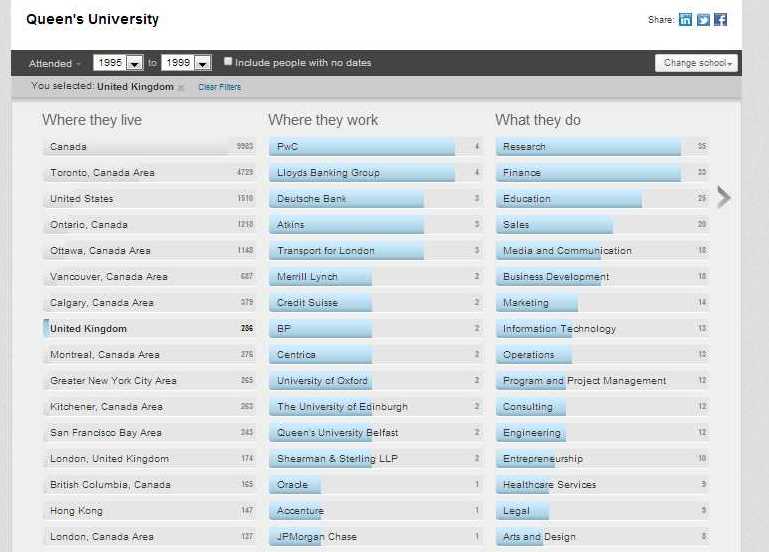
I recently noticed that LinkedIn will provide a geographical breakdown of where people who attended a given university are now living. You can further refine your search to show the locations of people who graduated in particular years. It looks like a great resource.


In a spare moment, I looked up graduates of my Alma Mater who are currently living in the United Kingdom. LinkedIn says that just over 76,000 Queen’s students and alumni are on LinkedIn, which sounds reasonable because I think about 100,000 people have studied at that university since its creation in 1841.  Most Queen’s alumni on LinkedIn live in Canada, which isn’t surprising, with large numbers living in Toronto, Ottawa, Calgary, and Vancouver, which is precisely what you would expect. 1,310 of  Queen’s graduates live in the United Kingdom. Of these, 414 were my contemporaries (i.e., people who studied at Queen’s between 1995 and 1999 and who are therefore now likely in their thirties). LinkedIn doesn’t say where in the UK they live, but given that many of these individuals work for firms such as PwC and Deutsche Bank, I suspect that most are in London.

Queen's Alumni in the UK All Dates

The first screen grab shows all Queen’s alumni in the UK. The image below show just my rough contemporaries (1995 to 1999).

Queen's Alumni in the UK, My Contemporaries

Queen’s Alumni in the UK, My Contemporaries

I know that there was a branch of the Queen’s alumni association in the UK before the financial crisis, but I think that it is now inactive. I haven’t the time to help re-establish one. However, if some other Queen’s alumni were to organize an informal gathering, say a barbecue in or near London, I would be interested in attending.


In the Shadow of William Henry Seward: Canadian Expansionism and the British West Indies in the 1860s

19 09 2013

In the Shadow of William Henry Seward: Canadian Expansionism and the British West Indies in the 1860s.

That’s the title of the paper I will be presenting at St Antony’s College, Oxford on 4 November 2013. The co-author of the paper is Kirsten Greer, who used to be at the University of Warwick here in Coventry and who is now at Nipissing University in Ontario. She won’t be with me at the presentation.

Essentially, our paper examines what the Fathers of Confederation thought about the British West Indies and their future relationship with the British colonies in mainland North America.  In 1866, a group of prominent British North Americans were sent by the Fathers of Confederation to observe conditions in the West Indies and Brazil. Although ostensibly just about improving commercial relations,  the 1866 trade mission was a precursor of future Canadian proposals to annex all or part of the British West Indies.  [I’ve published on one such initiative and my co-author has published on other linkages between British North America and the British West Indies]. Our paper places the 1866 mission in its context, which included William Henry Seward’s expansionist programme, the cancellation of the Canada-US Reciprocity Agreement [i.e., free trade],   the racial politics of contemporary North America, the 1865 Morant Bay rebellion in Jamaica, and the ongoing movement to federate the British colonies on the North American mainland. Our paper is based on correspondence in the Colonial Office files, Canadian archival materials, and newspapers.

Who was the William Henry Seward referenced in our title?  He was the Secretary of State in the administrations to Presidents Lincoln and Johnson. During the Civil War, Seward’s focus was, of course, on using US diplomacy to help defeat the South. After 1865, he focus turned outwards.  Seward had an ambitious program of territorial expansion he advocated the acquisition of a variety of territories in the Western Hemisphere by the US.  Had his plan been implemented, the United States would be larger and would have a population with a much smaller proportion of whites, which is one of the reason’s his plans were opposed. Seward’s plan for the annexation of Russian America (Alaska) was actually implemented: in 1867, the United States purchased Alaska from the Tsar for $7,200,000. Needless to say, the actual inhabitants of Alaska had no say in this process.  Seward also attempted, unsuccessfully, to acquire  others territories near the United States. In 1865, he attempted to purchase the Virgin Islands from Denmark.  He also attempted to increase US power in other parts of what might be called “Greater North America.”  Between 1865 to 1867,  the United States support the rebels in Mexico who were attempting to overthrow the French-backed Emperor. Seward also spoke about annexing all or part of Canada to the United States.  In the 1860s, it was seriously proposed by a number of US policymakers that Britain simply give Canada to the United States in lieu of a cash payment for the damage to the US merchant marine that had been done by the Confederate commerce raiders constructed in British shipyards. Such proposals overlooked the fact that British North America had its own elected governments and population with their own identity and belief in their right to self determination.

W.H. Seward

The mid-1860s were a crucial turning point as it saw Canadians going from being objects of Great Power politics to being actors in the international arena in their own right. The 1860s is also when we start to see the first stirring of Canadian sub-imperialism, that is the desire of Canadians to acquire overseas colonies of their own.  Seward and other Americans implied that Canadians could be traded from Britain to the United States are bargaining chips in a complex diplomatic bargaining game. In the 1860s, the Fathers of Confederation came to imitate Seward’s imperialism by developing their own expansionist vision that embraced both the British territories in western North America and the British possessions in the West Indies.

No actual tariff agreements resulted from the commissioners’ travels in 1866. In the short term, the main practical result of the mission being a semi-monthly steamer service between Halifax and the West Indies. The conversations British North Americans had around the trade mission are chiefly important because they reveal different elements of the emerging Canadian identity on the eve of Confederation. Even though the trade commissioners did not confine their attention to British colonies, visiting the New World monarchy of Brazil and two of the possession of the Spanish Crown, the ideology of Britishness influenced the commission, as did contemporary ideas about race. Monarchism and the belief that monarchical institutions of any sort were better than the republican constitutions that were predominant in the Western Hemisphere also influenced the commission. After 1867, all of these ideas would continue to shape public policy in the new Dominion of Canada.

Street Scene in Jamaica, 1861


豊田 英二, Toyoda Eiji

18 09 2013

Eiji Toyoda, the man who led Toyota from its formative years into a worldwide manufacturing empire, has passed away at the age of 100 years.  He died in Toyota City, near Nagoya. 


I mention Toyoda in one of the lectures in my history of globalization course. I also mention him when I teaching using Ken Lipartito’s “Culture and the practice of business history.” Business and Economic History 24 (1995): 1-42. which shows how cultural differences influence the strategies of firms. That article begins with a comparison of Toyota, which focused on improved fuel economy, and the designs developed by US carmakers, which emphasized the inclusion of creature comforts such as large cupholders. I find that students really enjoy reading this article, or at least the opening paragraphs, which remind them of a famous episode of the Simpson’s in which Homer is tasked with designing an automobile that is supposed to turn around the fortunes of a struggling Detroit automaker. 


“Culture and the practice of business history.”Business and Economic History 24 (1995): 1-42


Copying Canada’s Mortgage Rules?

14 09 2013

Selling Houses in Quebec

Many in the UK are now concerned that we are experiencing a property bubble, particularly in the overheated London market. The Bank of England and other in the UK are looking at how Canada responsed to a similar bubble in 2006-8. The interest in Canada is likely related to the fact BofE Governor Mark Carney is from there.

A recent study from the RCIS, a think-tank, includes a case study of Canada case study 2008-2012:
The Canadian housing market began to heat up
markedly in the wake of the global financial
crisis. This is because, first, the Bank of Canada
cut interest rates aggressively as the global
outlook became increasingly uncertain (and also
to prevent a major appreciation of the Canadian
Dollar given that most other developed market
central banks, including the US Fed, were
aggressively loosening monetary policy).
Second, the Canadian banking system was
relatively unscathed by the sub-prime crisis
(unlike the US, EU and the UK). Extraordinarily
low interest rates coupled with a healthy banking
system resulted in a surge in mortgage debt
levels and house price growth. Indeed,
mortgage backed security issuance rose from
just over $CAD80bn in 2007 to just over
$CAD140bn in 2008, while annual house price
growth exceeded 15% on some key measures
the following year. Subsequently, the Canadian
authorities stepped in with a series of measures
over the next four years to cool the housing
market

You can read the full study here. The report was prepared by Josh Miller  RICS Senior Economist 


L’incendie du parlement à Montréal: un événement occulté

13 09 2013

The current issue of the Bulletin d’histoire politique is about the burning of the parliament buildings in Montreal in 1849 by a frenzied Tory mob. The contributors are Robert Comeau, Gaston Deschênes, François Deschamps, Gilles Laporte and Gilles Gallichan.

L’incendie du parlement à Montréal: un événement occulté

Révélateur incontournable des vives tensions ethniques et politiques qui ont émaillé le XIXe siècle canadien dans les années qui ont précédé la Confédération, l’incendie qui a ravagé l’Hôtel du Parlement à Montréal le 25 avril 1849 est pourtant largement ignoré par les discours officiels et médiatiques. Pour mieux comprendre les causes et conséquences du drame, ce dossier du BHP revient sur l’idéologie radicale tory, sur la fameuse Loi d’indemnisation, sur les émeutes, et finalement sur la perte de la bibliothèque du Parlement. Cinq articles qui éclairent l’événement sous un jour nouveau.
The contributors are Robert Comeau, Gaston Deschênes, François Deschamps, Gilles Laporte et Gilles Gallichan


How Do MNCs Think About Macro-Geographical Regions?

13 09 2013

I’m interested in how people have constructed large macro-regions, i.e., ways of dividing up the world and categorizing spaces, and how these imagined communities of nations influence behaviour, especially business behaviour.

Most readers will be familiar with Samuel Huntington’s influential Clash of Civilizations thesis. Writing in the 1990s, Huntington identifies several large transnational regions or “civilizations” and then predicted the geopolitical conflict in the future would be between civilizations rather than traditional nation states. His book, which was translated into a number of languages, influenced how many people thought about International Relations during the War on Terror of the noughties. I’ve put a German map based on Huntington’s ideas below.

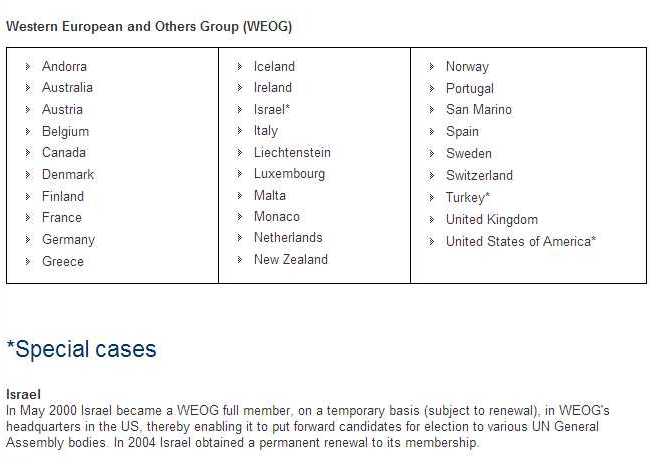
Interestingly, the US State Department and the US military use different macro-regions in thinking about the world and organizing their internal structures. It is well known that for much of the twentieth century, the US State Department assigned responsibility for relations with Australia and Canada to its Europe desk, even though neither country was in Europe. Australia was arguably an Asian country! This arrangement is a case of culture and ethnicity trumping geography. Even today, the allocation of nations to the various “Regional Groups” in the United Nations is informed by culture. Interestingly enough, Israel and Turkey have both joined the “Western European and Others Group” as so-called “Special Cases.”

UNITED NATIONS DGACM

In contrast, the US military’s command structure is more focused on just geography: the macro-regions it has created tend to be geographically contiguous rather than cultural-linguistic.

Map of the Unified Combatant Commands of the United States Military

I don’t know if the discrepancies between these two maps of the world has ever caused friction between the Defense Department and the State Department. Apparently, the US Defense Department is thinking of changing is system of commands.

P&G, the consumer products giant, has subsidiaries in many nations. The chemical subsidiaries are organized into three big regions. As this map shows, the regions ignore culture and contain countries are very different level of development. P&G’s system of regions also seems to divide the Russian Federation, which is fascinating. Mexico is defined as being part of “Latin America” rather than “North America,” even though automotive companies regard Mexico as part of a fairly integrated North American market.

P&G Privacy Central – P&G Global Contacts

Let’s turn now to the British Empire in the nineteenth century. Making maps and charts of the world’s lands and coasts was a big part of the project of Empire. To run a worldwide Empire, you have to know where things are. Technological advances such as a better chronometers allowed for more accurate maps and fewer shipwrecks. Culture also influenced the macro-regions that the British imperial state created. Scientists shaped contemporaries’ thinking about the world’s “natural” regions the British imperial state had developed in the early nineteenth century.

As other historians have shown, the criteria used by the British in the 1840s and 1850s to determine which colonies were worthy of Responsible Government were largely and explicitly racial,although climate was also a factor.[1] In the 1840s, the British adopted a highly liberal policy towards the colonies of white settlement in the temperate zones, such as Canada and Australia, granting these colonies self-government and constitutions that were essentially replicas of the British political system. The British even said that if one of these colonies wanted to declare independence, they could do so with the blessing of the British parliament. At the same time, people in the tropical colonies who challenged Britain’s authoritarian rule were brutally suppressed.

It might be said that the British state thought of its Empire as consisting of three macro-geographical zones: India; the tropical British colonies; and then the self-governing Dominions in the tropics.

The curious thing is that the Royal Navy essentially ignored these racial and cultural boundaries in establishing its own system for categorizing overseas British possessions. The Royal Navy divided the world into zones called stations. In 1818, the West Indies Station was merged with the North American one. The boundaries of this station remained unchanged until 1956, despite massive changes in naval technology, such as the shift from sail to steam.  What is especially curious is that the North American/West Indies station included British colonies of both types: white majority colonies such as Nova Scotia and tropic colonies such as Jamaica.

I don’t know if anyone has explored the issue of the discrepancy between the RN’s system of thinking about regions and the system implicit in the Colonial Office’s decisions about which British colonies were worthy of Responsible Government.

Today, Ford organizes the world into four main regional markets: North America, South America, Europe, and “Asia-Pacific and Africa”. (See screen grab below). In the first half of the twentieth century, there were three regions. As Mira Wilkins has shown, the Ford Motor Company of Michigan was responsible for the United States and any countries in the developing world that weren’t part of the British Empire.  Ford Ltd., in the UK was responsible for all of Europe and the British colonies in the Mediterranean. The Ford Motor Company was responsible for sales in Canada and all parts of the British Empire that weren’t in Europe, a truly massive area. The reasons for this arrangement are explained by Mira Wilkins.

Ford Around the World - Sustainability 2012-13 - Ford Motor Company

Anyway, I would be interested in suggestions for further reading about how Multinational Corporations categorize nations. I doubt that many companies  have ever use P&G’s rather crude system of dividing up the world.  That system seems oblivious to culture, even though culture is so central to marketing products such as deodorants. Moreover, as a business historian, I’ve very interested in how MNCs imagined maps of the world have evolved over time.  I might be wrong, I don’t think that much has been published on this topic.  Any suggestions for reading would be appreciated.


[1] Catherine Hall, Keith McClelland and Jane Rendall, Defining the Victorian Nation: Class, Race, Gender and the British Reform Act of 1867 (Cambridge: Cambridge University Press, 2000), 179-80.


Russ Roberts, National Cultures of Education, and Why Rate My Lecturer Flopped in the UK

12 09 2013

As readers of this blog will know, I’m a big fan of Econtalk, the podcast series hosted by Russ Roberts of the Hoover Institution at Stanford. My wife likes it too, which is why we listen to it in the car. This podcast series covers a wide range of issues related to economics, with the discipline being defined in the widest possible terms. I’ve learned a great deal about topics such as climate change and eighteenth-century moral philosophers in these podcasts, which are becoming an important part of my ongoing education as a historian and a social scientist.

In a recent podcast, Roberts interviews Eric Hanushek of the Hoover Institution about his research on the performance of US education system relative to that of other industrialised countries. Much of the conversation focuses on the performance of children of different nationalities on standardized tests.

I was pleased but not terribly surprised to learn that Canadian schools are much better than American ones, although the average Canadian teenager tests a bit below the average teenager in Massachusetts, the best performing American state. McKinsey Consulting recently said that the Province of Ontario had the best public education system, at least in the English-speaking world. Of course, the qualifier “in the English-speaking world” is important here, as my German and East Asian friends might remind me.

Roberts also said in this podcast that (North) America has the best universities in the world. Based on what I’ve seen in a number of EU countries, I’m inclined to agree with that. The student experience at even the elite universities in Europe can’t really compare with that of an undergraduate at a good university in North America simply because there is less money coursing through the system. I really don’t see much difference between Canadian and US universities and neither do Hollywood film crews, since they have used Canadian campuses for movies set at US universities. The library holdings, quality of the academics, etc are broadly similar.

The conversation got around to the issue of culture and how that influences learning and teaching styles in different societies. East Asian societies are at one end of the spectrum: they are hierarchical, do not reward creativity, and have education systems that are based on rote-learning. The United States is at the other end: the school system and the wider society value individuality, creativity, and innovation. Hanushek recalls that one of his graduate students had a shock when he returned to his native Korea to take a job and then told his boss that he could do something better: making a minor suggestion to the superior was a major faux pas in Korean culture.  Interestingly enough, education officials in South Korea are concerned that their students lack creativity and are trying to come up with a solution. (Personally, I’m sceptical of the idea that the creativity/individuality can be increased by central planners in some education ministry, either through targets, quota, or any other policy).

East Asian students who study in the West are famous for being unwilling to debate with their professors. Doing so goes against deference to elders and other cultural norms. Of course, the West is not a monolithic cultural identity itself, as any North American teaching in a UK university can attest. British university students are far less likely to ask questions, debate with professors, or do anything except sit and take notes passively. In part, this is because they have been conditioned by a secondary school system that is structured around high-stakes standardized tests, such as the A-Level exams that determine the future of young people in a few hours.  Obviously British students are far closer to North Americans than they are to Japanese or Koreans, but there is a definite cultural difference: they are less likely to speak up.

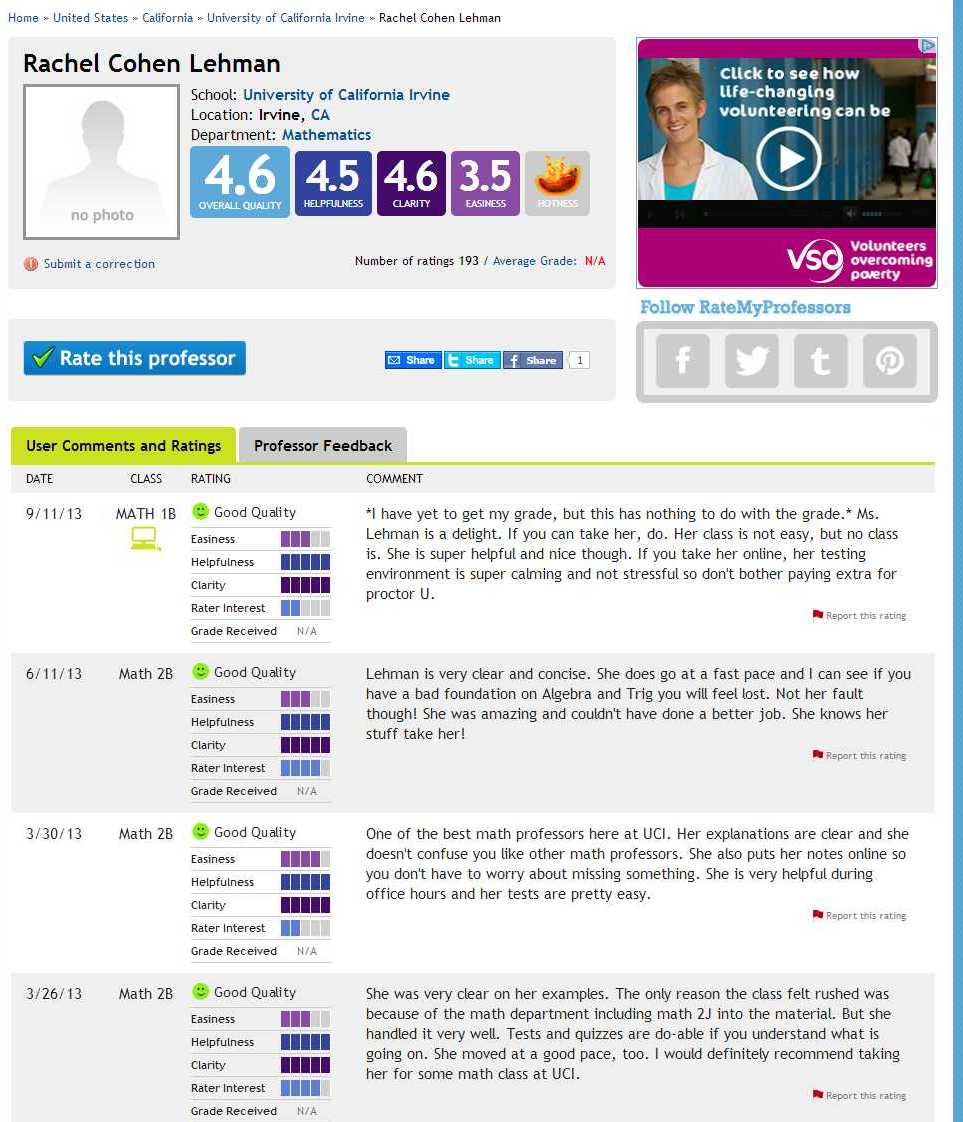
This cultural difference has had an impact on the attempts to popularize websites that allow students to evaluate professors. In North America, RateMyProfessor has been popular for about a decade. This website allows students to grade professors according to a variety of criteria. It also has an infamous chilli pepper icon that students can use to indicate that a teacher is physically attractive. Millions of students have rated one or more of their professors on RateMyProfessor Personally, I find that RateMyProfessor ratings correspond to my own impression of academics provided there is a good sample size (e.g., ratings from more than ten students). Every academic on that website has at least one negative review from a student with a grievance. The key thing is to see what the average rating is. When I was an undergraduate in the 1990s, the student government at my university produced a printed document called the “anti-calendar” that provided student ratings of professors and individual courses. As with RateMyProfessor, every prof, even the most brilliant lecturer, had one or two bad evaluations, perhaps from the guy they caught cheating. The key thing to look for was the average rating.  Here is a sample a rating, selected at random.

Rachel Cohen Lehman - University of California Irvine - RateMyProfessors.com

Anyway, RateMyProfessor tried to expand into the UK by creating stubs for UK universities. The problem was that very few British students bothered to rate their instructors. I remember looking at the ratings of UK academics on it were obviously written by visiting North American students.

I suppose that part of the explanation for the unpopularity of RateMyProfessor  was confusion about which university employees would be listed there. That’s because was that many university teachers in the UK are called “lecturers”: at most UK universities, the title “professor” is reserved for people who would be a full professor in the US system, which is also the system in Canada and Japan. However, I don’t think that’s the main reason for the unpopularity of RateMyProfessor in the British Isles, since many UK students use the term “professor” in ordinary conversation to refer to any university teacher. Moreover, some of the more North Americanish universities, such as Warwick, use titles such as “Associate Professor”. (Warwick is a British university that wishes it was in the New World and even kinda looks like a North American suburban campus).

More recently, RateMyProfessor franchised its format to a UK company that created “RateMyLecturer.” The format is similar except some of the criteria for ranking academics are different. For instance, the UK website does not allow students to score lecturers according to the “easiness” of their marking. Similarly, there are no chilli peppers in the UK version.

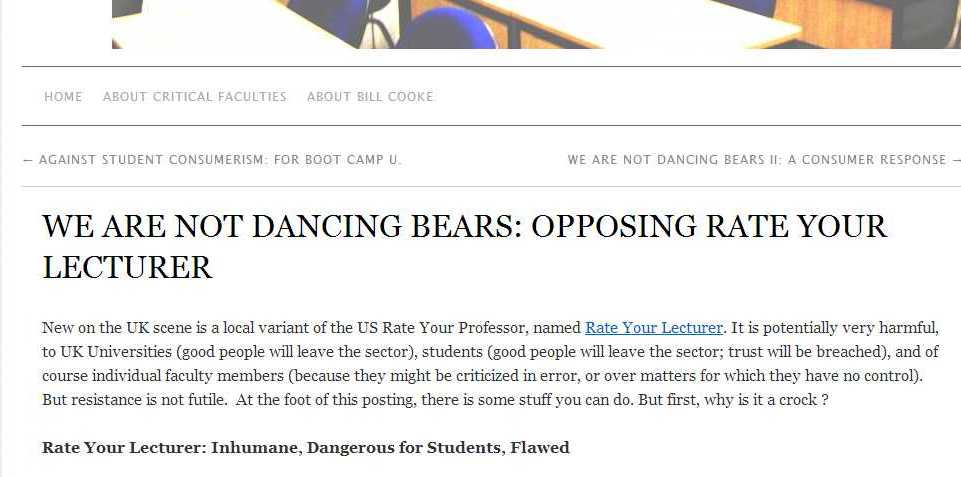
WE ARE NOT DANCING BEARS- OPPOSING RATE YOUR LECTURER » Critical Faculties

When this website went live there were expressions of outrage by some UK academics. The really interesting thing is that very few British students have rated any of their university teachers. The website has been online for months now and few academics have been rated yet. (I’ve checked out a few departments and universities I know).

Very typical RML Stub, Note that there are no ratings by students.

Very typical RML Stub, Note that there are no ratings by students.

I suspect that the underlying reason for the unpopularity of RateMyLecturer in the UK is the reluctance to challenge or critique teachers and other authority figures that is ingrained in UK academic culture. I find this reluctance somewhat odd, since British people have no hesitations in writing frank online reviews of restaurants or hotels, such as this amusingly critical one.

I’m married to a Japanese person and feel that the excessive deference to authority inculcated by Japan’s much over-rated education system is responsible for many of the problems Japan has today. In Japanese organizations, it is difficult for an underling to muster to courage to point out a problem to a superior. What I’ve read suggests that Japanese culture contributed to the sequence of events that resulted in the Fukushima nuclear disaster. In the West, there would likely have been whistleblowers before the disaster. At the very least, someone in a meeting at the power company would have, to use an Americanism, “called bullshit” on some of the claims of senior executives that the plant could withstand a tsunami.

Anyway, I think that the problem of institutional culture we saw at the Electric Power Company is widespread and not just Japan. In thinking about the future of higher education around the world, we need to keep these cultural differences in mind.