Jesuit Archive Opens in Montreal

22 09 2009
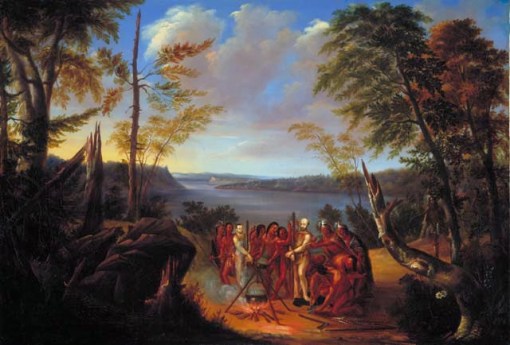
The Martyrdom of Fathers Brébeuf and Lalemant by Joseph Légaré, 1838

The Martyrdom of Fathers Brébeuf and Lalemant by Joseph Légaré, 1838

The Jesuit Archive of Canada opens today in Montreal. It contains manuscript materials, books, and other primary sources related to the history of the Society of Jesus in Canada from 1611 to present. This archive will be a valuable resource for Canadian historians because the Jesuit Order played a very important role in our country’s history.  Fortuitously, the opening of the Jesuit Archive coincides with lectures in my Canadian history survey course in which I discuss the Jesuit missions in New France.  In preparation for my lecture yesterday on the destruction of Huronia, I asked my students to look at a volume of the Jesuit Relations in the original French (see here).

For more information about the archives, click here.

The image above is from the Wikimedia Commons and is in the public domain. It is a nineteenth-century representation of the killing of two Jesuit missionaires by the Iroquois in 1649. The Iroquois had captued these missionaries are part of their campaign against the Huron Confederacy. They were burned to death in a Huron village near the present-day Ontario city of Midland. The Catholic Church declared Jean de Brébeuf to be a saint in 1930.



New Nature’s Past Podcast

21 09 2009
Logo of the Nature's Past Podcast

Logo of the Nature's Past Podcast

The ninth episode of  Nature’s Past, the podcast produced by NiCHE, the Network in Canadian History & Environment is now available here. This episode that looks at environmental history graduate studies in Canada.  Previous episodes can be downloaded from the NiCHE website.

The podcaster, Sean Kheraj, is a postdoctoral research fellow in the Department of History at the University of British Columbia. He has previously written about the environmental history of Vancouver’s Stanley Park. Currently, he is researching a new project on the history of urban animals in Canada.

The monthly Nature’s Past podcasts are a way of keeping abreast of the rapidly growing field of Canadian environmental history.  The podcasts are similar in format to a CBC Radio One documentary and feature interviews with scholars in the field talking about their research. They are designed to appeal to both academic historians and ordinary Canadians who are interested in the environmental history of their country.


CNEH Conference

21 09 2009

I won’t be attending the forthcoming conference of the Canadian Network in Economic History due to the issue of timing. (The conference is taking place in Halifax in early October). There are some really interesting papers on the program, so I really wish I could go.   The keynote address will be given by Joel Mokyr (Northwestern University) and is on “Culture, Growth, and Cliometrics”. From the sounds of it, Mokyr will be asking what role culture plays in promoting economic growth, which is  topic historians have been debating since Max Weber published his famous thesis regarding the Protestant ethic and the spirit of capitalism.

I feel very ambivalent about the culturalist approach to studying why some countries do better economically than others. Clearly culture matters somewhat (as Mokyr’s research on the economic impact of the Enlightenment shows), but so do other factors, including institutions and, to be frank, exploitative extraction of wealth. The economic historian Greg Clark had this to say about cultural approaches to understanding the origins of economic growth:  “my reaction… is one of intellectual schizophrenia. I simultaneously want to endorse his promotion of culture, and to run screaming from his lethal embrace. As an economic historian who studies economic growth in the long run, I agree completely that the banishment of culture from much of the consideration of wealth and poverty by modern economists has left us with untenable theories of growth… yet attempts to introduce culture into economic discussions so far have been generally either ad hoc, vacuous, blatantly false, or void of testability.” (For the original context of this quote, see here).

Clark’s feelings on this issue are similar to my own.


BHC Deadline for Paper Proposals

20 09 2009

If you wish to present at the Business History Conference next year, you will need to get working on your paper proposal soon. The deadline is 1 October.

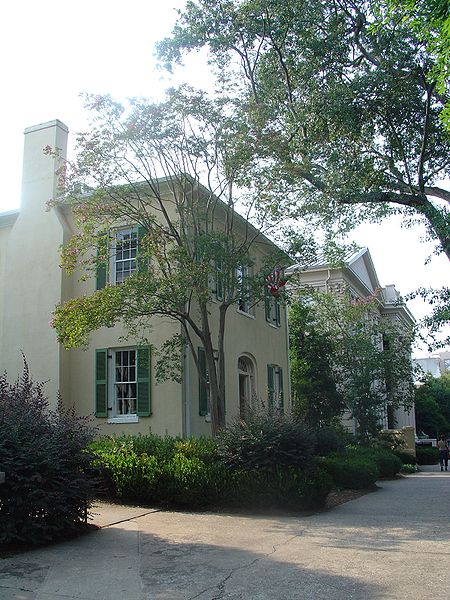
Demosthenic Hall, University of Georgia, Athens.

Demosthenic Hall, University of Georgia, Athens.

The 2010 will be held at the University of Georgia in Athens. Looks like a beautiful campus.

The above image comes from the Wikimedia Commons. It is reproduced under a Creative Commons Share Alike 2.0 Licence.


Historian Peter Cain on European Attitudes to China

18 09 2009

Historian Peter J. Cain has an excellent new paper on the History and Policy website.  The paper is called “China, globalisation and the west: A British debate, 1890 – 1914”.

Other papers on economic-historical themes at History and Policy include:  “The ‘credit crunch’ and the importance of trust” by Geoffrey Hosking; “Equality and incentive: fiscal politics from Gladstone to Brown” by Martin Daunton; and “The real lesson for developing countries from the history of the developed world: ‘freedom to choose'” by Ha-Joon Chang. (I like how Chang’s paper title makes an allusion to this man).

The website, by the way, is designed to bring relevant historical research to the attention of policy-makers. John Tosh outlines the mission of the History and Policy here. The History and Policy website has inspired a group of Canadian scholars to establish a similar project called ActiveHistory. The Canadian project is evidently in its early stages but looks very promising.


New Business History Blog

18 09 2009

Kevin Tennent, a British business historian, has established a blog. The topics covered by his blog included economic history, present-day economic policy, and transport policy. He recently had a fine post on Lehman Brothers and the history of financial regulation in twentieth-century America.


Review of Buckner, Canada and the British Empire

17 09 2009

My (favourable) review of  Philip Buckner, Canada and the British Empire (Oxford University Press, 2008) has been published in the Canadian Historical Review vol. 90, issue 3 (September 2009): 539-40. See here.


Workshop on Writing History for a Mass Audience

14 09 2009

On 19 October 2009, the Network in Canadian History and Environment will be hosting a workshop at the University of Western Ontario for Canadian history graduate students on writing for a popular audience. Graduate students are invited to sign up for this workshop in order enhance their writing skills and develop a proposal for an article to pitch to a newspaper or magazine editor.  There will be a public lecture that evening by MIT’s Harriet Ritvo, president of the American Society of Environmental Historians. Ritvo will be discussing her new book, The Dawn of Green: Manchester, Thirlmere, and Modern Environmentalism (Chicago University Press, 2009).
If you are interested in participating, please contact Adam Crymble.

I think that this is a wonderful initiative! I was recently looking that the history shelves in my local big-box bookstore and was struck by the paucity of books on Canadian history. There were plenty of books on US, British, and other histories, however. I think that fact so few books on Canadian history are consumed by the public has something to do with fact so many Canadian historians don’t know how to write for a mass audience. Historians such as Sean Wilentz, Simon Schama, Sir Martin Gilbert, Alan Taylor, Linda Colley, and Sir David Cannadine have shown that it is possible to write for a mass audience while still maintaining scholarly rigour. Sadly, few Canadian academic historians have been able to bridge the gap between scholarly and popular historical writing. (One of the few honourable exceptions to this generalization in Western’s Jonathan Vance, whose books do indeed grace the shelves of mainstream bookstores).

Hat tip to Sean Kheraj.


Dominion Institute Shuts Its Doors

13 09 2009

The Dominion Institute, the Canadian heritage charity, is merging with the Historica Foundation. Christopher Moore discusses the reasons for the merger on his blog.


NARA Photostream

13 09 2009

The National Archives and Record Adminstration in the United States has been posting digitized historical photos to Flickr. It is now seeking input from the public about which photos it should post online next.

This is great news for history professors in the PowerPoint age.

P.S. The national archives in Canada, now known as Library and Archives Canada, has been posting digitized images from its collection to the Wikimedia Commons.