My Panel at AOM 2015 Vancouver: Entrepreneurship Research Methods

6 07 2015

Here are the details of my paper session panel at the Academy of Management.
Program Session #: 987 | Submission: 19863 | Sponsor(s): (ENT)
Scheduled: Monday, Aug 10 2015 9:45AM – 11:15AM at Vancouver Convention Centre in Room 219

Chair: Martine HLADY RISPAL; U. of Bordeaux;
Discussant: Wadid Lamine; Toulouse Business School;
ENT: Investigating the usefulness of qualitative methods for entrepreneurship research Research-oriented
Author: Martine HLADY RISPAL; U. of Bordeaux;
Author: Estèle Jouison-Laffitte; U. of Bordeaux;
Author: Kathleen Randerson; EDC Paris;

Whereas today the vast majority of entrepreneurship research adopts quantitative methods, the aim of this paper is to demonstrate how qualitative research can clearly and distinctly contribute to the field. More specifically, this study systematically reviews 160 qualitative articles published in three journals: the Journal of Business Venturing (JBV), Entrepreneurship Theory & Practice (ET&P) and Entrepreneurship and Regional Development (E&RD), between January 2007- December 2014.We reveal the specificities of each method, the way researchers leverage on them and the distinct contribution of each to the development of the field of entrepreneurship.

Search Terms: Entrepreneurship , qualitative methods

ENT: English-language Debates About Entrepreneurship in China, 1842-1911 Research-oriented
Author: Andrew David Allan Smith; U. of Liverpool;
This paper will examine the debates about the nature of Chinese entrepreneurship that people who wrote in English had between 1842 and 1911. These debates took place through the media of books, newspapers, and learned journals. The paper will show that these debates were informed by competing theories of culture, political institutions, and human nature. This paper will show that while some Westerners viewed Chinese entrepreneurs through Orientalist or racialist lenses, other contemporary authors depicted Chinese entrepreneurs in a fashion that drew on more universalitistic theory of human nature and which therefore tended to undermine the Us-and-Them dichotomy between the West and the non-West that underpinned Orientalist thought. Scholars of present-day entrepreneurship should draw three main lessons from this study of historical debates about entrepreneurship in late Qing China. First, it is important to remain conscious that one’s cultural biases are particularly likely to affect perceptions of entrepreneurship in other cultures. Second, observers must always be on their guard to ensure they do not unconsciously slip into Orientalist modes of thought when thinking about entrepreneurs in non-Western countries. Third, we must recognize that all lenses for viewing entrepreneurship have historical roots and philosophical foundations of which the scholar may be unconscious. By historicizing present-day theoretical debates about entrepreneurship, this paper should encourage greater scholarly reflexivity.

Search Terms: China , Colonialism , Postcolonial Thought

Selected as a Best Paper ENT: Risk, Uncertainty and Entrepreneurship: Evidence from a Lab-in-the-Field Experiment
Author: Martin van Koudstaal; U. of Amsterdam;
Author: Randolph Sloof; U. of Amsterdam;
Author: Mirjam Van Praag; CBS;

Theory predicts that entrepreneurs have distinct attitudes towards risk and uncertainty, but empirical evidence is mixed. To better understand the unique behavioral characteristics of entrepreneurs and the causes of these mixed results, we perform a large ‘lab-in- the-field’ experiment comparing entrepreneurs to managers – a suitable comparison group – and employees (n=2288) . The results indicate that entrepreneurs perceive themselves as less risk averse than managers and employees, in line with common wisdom. However, when using experimental incentivized measures, the differences are subtler. Entrepreneurs are only found to be unique in their lower degree of loss aversion, and not in their risk or ambiguity aversion. This combination of results might be explained by our finding that perceived risk attitude is not only correlated to risk aversion but also to loss aversion. Overall, we therefore suggest using a broader definition of risk that captures this unique feature of entrepreneurs; their willingness to risk losses.

Search Terms: Entrepreneur , Manager , Behavior

ENT: Seeing Entrepreneurs in Action: Using Video-based Gesture Analysis in Entrepreneurship
Author: Jean Siobhan Clarke; U. of Leeds;
Author: Joep Cornelissen; Erasmus U. Rotterdam;
Author: Rowena Viney; Leeds U. Business School;

In this paper, we elaborate on the potential of using video-based data as part of multi-modal research in entrepreneurship. We first demonstrate how such data record in detail the nature of entrepreneurial interactions, and then go on to illustrate how analysing such interactions multi-modally helps explain the content and effectiveness of an entrepreneur’s efforts to communicate meaning and convince stakeholders to support a venture. We particularly focus on the role of gesture as part of such behavioural displays and interactions, given that gesture is an under-researched but significant aspect of communication in most social settings, including entrepreneurship. Drawing on data collected as part of a larger study on entrepreneurship, we analyse gestures in different contexts of communication (an informal conversation and a formal pitch presentation) and compare two analytical protocols for gesture research drawn from cognitive linguistics and conversation analysis. The comparison of these protocols highlights the role of theoretical assumptions and different units of analysis in video-based gesture research. One of the most noticeable differences between the two approaches to gesture analysis is the way in which gestures are interpreted and analysed as part of communication and social interaction; i.e., as conveyors of meaning, or as pragmatic ways of managing interactions. We discuss these findings, and draw out the methodological implications for further research on entrepreneurship and new venture creation.

Search Terms: Entrepreneurship , Video , Gesture



Our paper at the International Conference of Historical Geographers

5 07 2015

Dr Kirsten Greer will be presenting our paper at the 2015 International Conference of Historical Geographers in London (for venue, see photo above). Details of the panel are below.

Session 97: Historical and cultural geographies of woods and forests (1)

Session abstract:

Our historical geographies are inextricably intertwined with the histories of forests and woodland. From being sites of living and work, spaces of agriculture and forestry, central in the emergence of legal systems and codifications of rights, and in inspiring much popular culture, the historical geographies of forests and woodland cut across space and time. Woodland is a complex category and its utility and the cultural values ascribed to it are diverse, whether it is tilled or grazed by domestic stock; a provider of status or symbolic power, a site of traditional management or scientific experimentation. In recent years there has been a significant revival in interest in the study of woodland and forests by cultural and historical geographers. Given this critical and creative remaking of forest history – and that 2017 will mark the 800th anniversary of England’s defining Charter of the Forest – this session seeks to bring together geographers and others in exploring emergent themes and critical congruencies in understanding our tree-bound pasts.

View abstracts online: http://conference.rgs.org/ICHG/97

Th2 | RGS-LR

Convenors Carl Griffin (University of Sussex, UK), Charles Watkins (University of Nottingham, UK)

Chair Carl Griffin (University of Sussex, UK)

Empire, Trees, and Climate in the North Atlantic: Towards Critical Dendro-Provenancing
Kirsten Greer (Nipissing University, Canada)
Adam Csank (Nipissing University, Canada)
Kirby Calvert (The Pennsylvania State University, USA)
Kimberly Monk (University of Bristol, UK)
Andrew Smith (University of Liverpool, UK)
Margot Maddison MacFadyen (Memorial University, Canada)
How can historical geographies of British imperial expansion, trade networks, and commodity frontiers inform forest and climate histories? This paper contributes to mixed methods in forest histories and climate change research by combining theoretical and methodological approaches in historical geography, dendrochronology, and GIS to understand how the Atlantic triangle trade in timber can inform studies on climate. In the early to mid-nineteenth century, British North America was an integral site in Britain’s triangular trade of timber, fish, sugar, rum, and molasses with the West Indies. Known today as eastern Canada, the region’s forests and watersheds were transformed into the “modern” world system as the Crown secured lands and timber rights during the Napoleonic Wars. Considering that British North American timber was integral to ship-building, imperial infrastructure (dockyards, fortifications, government buildings), and maritime supremacy in the age of sail, we provide an overview our our preliminary findings on how archival and museum research, dendro-provenancing (e.g. analysis of tree ring widths of historic buildings and shipwrecks), and visualizing techniques using GIS can provide important insights into climatic conditions of the past. We also discuss the theoretical challenges of using mixed methods in climate change research, especially when bringing together different approaches from the humanities and environmental sciences, and in thinking about the role of non-human agency in climate change. This project is funded by the Government of Canada’s SSHRC Insight Development Grant (2014-2016).
Uprooted, blackened, burnt and diseased: exploring the historical geography of extreme weather and trees
Lucy Veale (University of Nottingham, UK)
Georgina Endfield (University of Nottingham, UK)
“…Like regiments fallen in battle” was how John Evelyn described the loss of 2,000 oaks on his Surrey estate in the Great Storm of 1703. The uprooting of trees is a sign of the power of storms, an impact that can cause significant and long-lasting changes to the landscape, as well as hamper daily activities through the obstruction of roadways or the bringing down of power lines, cause injury or death, affect livelihood, and trigger emotional reactions. Damage to trees through strong winds, intense rains, lightning, drought, frost, or by rust or blight linked to climatic conditions is one of the more common impacts of extreme weather events recorded in the documentary record. This paper will explore the impacts of, and responses to, extreme weather related tree damage, drawing on historical examples. The paper draws on research using personal diaries and letters that record the impact of extreme weather on garden trees, and estate and agricultural papers noting the effects on larger plantations of fruit, timber and parkland trees. We also explore linkages between forest, woodland and climate histories, and consider whether the loss of trees may constitute a very visual measure by which weather events can be judged ‘extreme’.
Anthropomorphizing Landscapes, Naturalizing People: Cultural Narratives of Forests in Asia Minor / Turkey
Hande Ozkan (Transylvania University Kentucky, USA)
Historically forest landscapes of Asia Minor have been represented by two narratives: travellers’ accounts and the discourse of professional foresters. Constructs of European perceptions of modernity and civilization, travellers’ accounts are Orientalist and romanticized; they anthropomorphize landscapes while attributing the features of the natural landscape to human populations. On the contrary professional foresters’ first hand observations of these landscapes and the peoples who inhabited them offer a more realistic, contextual albeit scientific perspective on how residents of Asia Minor lived on, worked with and changed their forest landscapes. How did modernity manifest itself in the ways travellers and professional foresters imagined and represented the landscapes of Asia Minor? What were their assumptions on the linkages between nature and civilization? And how were these ideas influential in the way nature was imagined, represented and managed in modern Turkey? This paper will offer a comparative analysis of how Asia Minor’s forests were represented in travelogues and forestry reports from the late nineteenth and early twentieth century. Historical and ethnographic research on Turkish forestry will complement this analysis by investigating the vernacularization of the discourses on nature and culture in the context of forestry in modern Turkey throughout the 20th century.
Tropicality, etymology and Indian nature: a brief history of the word jungle
Julian Baker (The University of Edinburgh, UK)
Since Bernard Smith’s European Vision and the South Pacific, geographers have sought to understand Western interpretations of tropical nature. The Indian subcontinent has figured ambiguously within the ‘tropical world’. While lush vegetation, fruit and spice production and a warm climate depicted India affirmatively, medical discourses, mortality rates and everyday colonial experience depicted India as a land of disease and degeneration. During the early nineteenth-century the word jungle entered English (and then other European languages). In Indian languages jangal denoted uncultivated land, dry, forested or swampy. Jungle, however, came to denote wet, dense forests and came to connote a rich contrast between the relatively benign and well-ordered temperate forests and the tangled, mysterious and dank vegetation that constituted tropical forests? (Arnold, 1998, p. 2). This paper traces the word jungle from its adoption into English by colonial officers, administrators and doctors to its metaphorical flights in the early twentieth-century popular culture. It argues that the literal foundations and figurative exaggerations of the word jungle express the predominantly ‘dark’ nineteenth-century British notions of ‘tropical’ Indian nature – an exotic and hazardous environmental counterpart to relatively benign and civilised temperate nature.
Forest Rights of Indigenous Communities in Koraput: Now and Then
Kamla Khanal (University of Nottingham, UK)
The current Koraput forest sub-division and its landscape is a live canvas, holding impressions of its rich cultural, economic and political history. The influence of its past kingdoms, Mughal invaders, British colonisers and post-independence politics; are intrinsically intertwined with the dominating indigenous identity of Koraput. The region today is identified as a key zone of the indigenous heartland of Central India, is a representative of a lively display of tribal ways of life and the tussles of mainstreaming them into the Indian economy. The inhabitants of this forest rich region were referred as the ‘privilege holders’ by the past laws. Their forest use rights were informally recognised by the local kingships and these rights were widely known to all the different groups settled in these regions though a system of customary rights. Today when the Forest Rights Act of India is attempting to ‘re-recognize’ a part of these ‘lost rights’, there is a power and identity struggle going on between the Government agencies and the indigenous claimants; and within the different groups residing in and around the forest lands. The efforts to re-restore forest land and use rights are expected to create new contests and ambiguities for forest land management in Koraput and similar regions elsewhere in India.


ABH Exeter: Coleman Prize Finalists

3 07 2015

I’m attending the Association of Business Historians, 23rd Annual Conference, which is being held at the University of Exeter Business School (beautiful campus by the way).

I’m going to post more about the conference later. For the time being, I’m just going to share the details of the PhD dissertations that were finalists for the Coleman Prize.

The prize is open to PhD dissertations in business history completed within the last two years, either completed at a British university or having a British subject. The value of the prize is £250 and it is sponsored by Taylor & Francis, publishers of Business History, whose support the Association of Business Historians gratefully acknowledges. The winner of the prize will be announced at the pre-dinner reception at Reed Hall on the evening of 3 July.

Tyler Goodspeed, University of Oxford (PhD awarded at Harvard University) Essays in British Financial History

David Singerman, Rutgers University (PhD awarded at Massachusetts Institute of Technology) Inventing Purity in the Atlantic Sugar World, 1860-1930

Michael Weatherburn, Imperial College London Scientific Management at Work: the Bedaux System, Management Consulting, and Worker Efficiency in British Industry, 1914-48


BHC-EBHA 2015 Miami

30 06 2015

For the last few days, I’ve been at the joint meeting of the Business History Conference and the European Association of Business Historians in Miami. This year’s conference had inequalities as its central organizing theme. The keynote address was by Thomas Piketty, who is interested in socio-economic inequality. However,  the working definition of inequalities that informed the conference was, of course, far broader and included such as issues as differences in the capabilities of firms in the same industry.

This year’s BHC featured a number of Paper Development Workshops. I presented at the excellent PDW on the New Entrepreneurial History organized by Dan Wandhawni and Christina Lubinski.  All of the papers I heard at this workshop were excellent and it is inspiring to have been selected as part of this group. I got very useful feedback on my paper from the participants, particularly Daniel Raff, Howard Aldrich, Andrew Godley (three very established management academics) and Ellen Korsager, who is an extremely impressive newbie PhD from Copenhagen Business School.

I also attended a meeting of scholars with research interests or institutional affiliations that connect to Canada. A new organization for Canadian Business History is in the process of being formed (more details to follow, but here is a link to the website).

The main conference was equally excellent. Program committee chair Lucy Newton’s hard work in selecting papers and formed coherent panels deserves to be recognized, as does the hard work of everyone else who made the conference possible, including the superb and under-appreciated staff of the Hyatt Regency Miami.

I was part of a panel on banking history. My fellow panellists were Lucy Newton (Henley Business School), Victoria Barnes (University of Reading), and  Laurence Mussio (McMaster University). We received valuable feedback from audience members including Les Hannah, Youssef Cassis, and the aforementioned Ellen Korsager.

My favourite panels this year were: Corporations and Inequality (Robert E. Wright, Augustana College; Leslie Hannah, London School of Economics; Richard Sylla, Stern School, New York University; Roni Hirsch, University of California, Los Angeles) and The Role of History at Business Schools (Stephanie Decker, Aston Business School; Dan Wadhwani, University of the Pacific; Mads Mordhorst, Copenhagen Business School; Anders Ravn Sørensen).

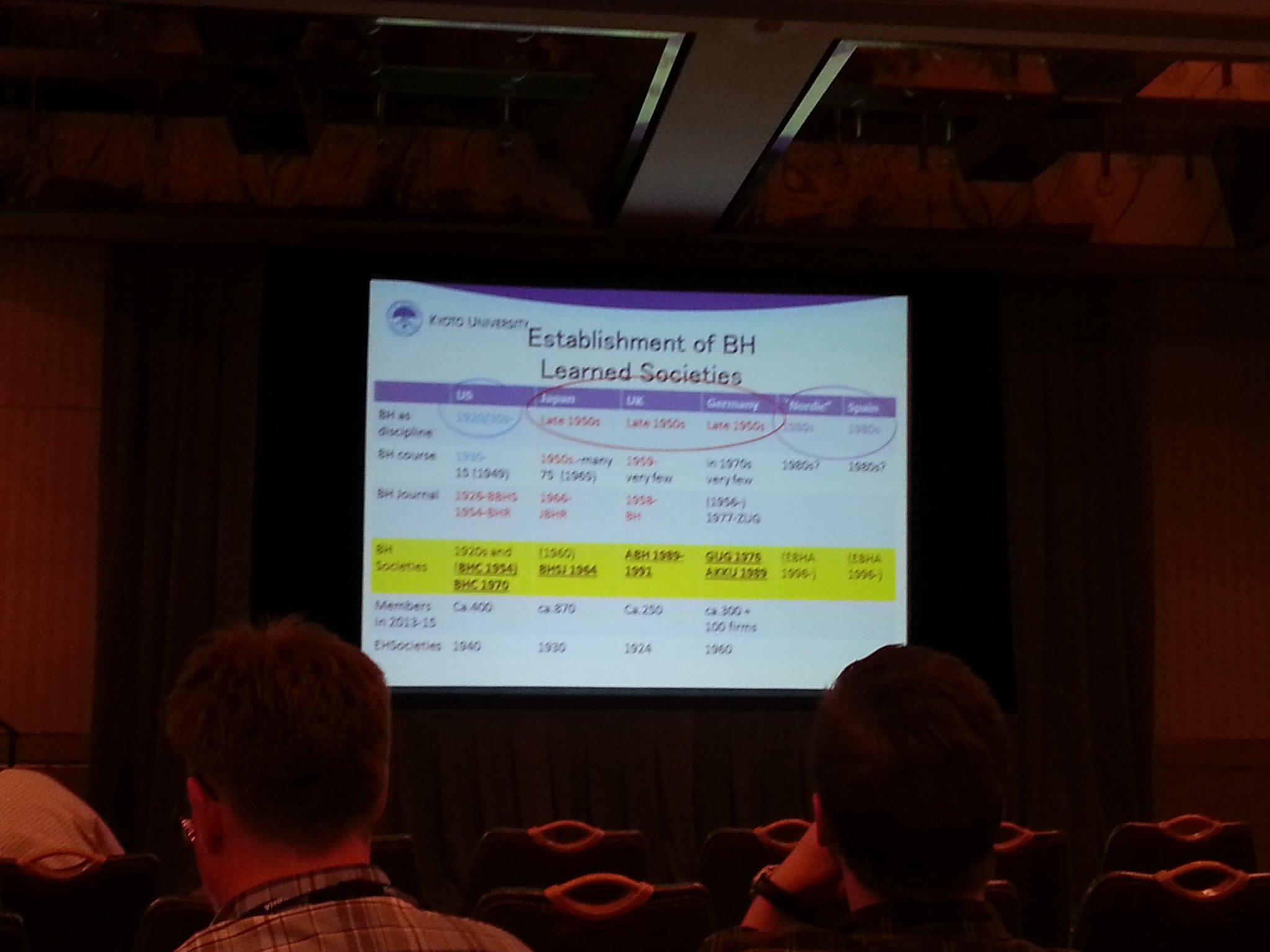
Takafumi Kurosawa of Kyoto University gave a great paper “Who Are We? History and Identity of Business History Societies” that looked at how business history differs around the world (e.g., in the United States, most business historians are in history departments, in the UK they are mostly in management schools, in Japan they work in economics departments). He also presented compared the histories of the main business history organizations around the world.

The winner of this year’s Krooss Prize for best PhD thesis in business history was David Singerman, whose thesis on the development of modern sugar refining was judged to be a superb piece of work that straddled business history and the history of technology.

P.S. The membership of the BHC and EBHA overlaps with that of EGOS, which will be holding its big conference in Athens later this week. At BHC, many of the EGOS members were discussing whether it would be wise to travel to Greece in light of the actual monetary chaos and expected civil disorder there.


International Business Research, Methodological Individualism, and the Judgement-Based View: Implications for Business Historians

14 06 2015

International Business Research, Methodological Individualism, and the Judgement-Based View: Implications for Business Historians

Mark Casson

Mark Casson

I’m attending the Reading-UNCTAD International Business Conference, which is being held this weekend at Henley Business School. I was part of a panel on International Business History that went well, I’d like to think.  One of the other panels, Where is the individual in IB research?, focused on units of analysis in International Business research. The  Panellists were Mark Casson, University of Reading; Timothy Devinney, Leeds University Business School; Marcus Moller Larsen, Copenhagen Business School, and Dunning Fellow; Elisa Giuliani, University of Pisa.

I really enjoyed Mark Casson’s paper, which was a very robust defence of methodological individualism in International Business research.  Casson stressed that when articles in IB journals refer to the decisions and actions of firms, the authors are really using a form of verbal shorthand for referring to groups of individuals.

“Firms don’t take decisions, individuals do. When you say that a firm pursued an international strategy, you really mean that that the CEO persuaded the individuals on the board to go along with his or her strategy.” Professor Casson also pointed out that individuals establish firms to exploit their ideas. Firms founders are highly heterogeneous and firms have a character that is influenced by the personality of the founder.

In the Q&A session, Professor Casson elaborated on some of the implications for future research in IB journals of his methodological individualism. He stressed that there needs to be increased attention to entrepreneurs and more careful reflection on how we define entrepreneurship. Here, Casson appeared to me to be drawing on the Foss-Klein judgment-based view of entrepreneurship (JBV) and some of the themes that are developed in some papers in a forthcoming issue of the Journal of Institutional Economics.  Casson spoke at great length about the need for research that focuses on named individuals, is based on the extensive study of primary sources in archives, takes social and political context into account, and which looks at case studies of entrepreneurs in different time periods. In effect, he was calling for the re-integration of Business History into International Business research.  

Casson’s call for more history in IB journals is consistent with a broader trend in management research, namely the so-called Historic Turn. Casson’s remarks support my view that the JBV of entrepreneurship and the approach to studying entrepreneurship developed by Business Historians are congruent and natural allies.


BLOG #5: Team Canada’s Bermuda Research Trip – May 2015

11 06 2015

My research collaborators on the Empire Timber project have posted a photo essay that chronicles the recent research trip to Bermuda. I wasn’t able to make it but I’m looking forward to working with to help write up this research and get it published in a variety of journals.


BLOG #5: Team Canada’s Bermuda Research Trip – May 2015.


CFP: SI of the Strategic Entrepreneurship Journal

11 06 2015

The Copenhagen Business School Initiative “Re-Thinking History” is working for some time now on the topic of Historical Approaches to Entrepreneurship Research. One of the members of the group, R. Dan Wadhwani (visting Professor at CBS) has organised together with David A. Kirsch, William B. Gartner, Friederike Welter, and Geoffrey Jones, a call for papers for a special issue of Strategic Entrepreneurship Journal on this topic.

Guest Editors
R. Daniel Wadhwani, University of the Pacific
David A. Kirsch, University of Maryland
William B. Gartner, California Lutheran University & Copenhagen Business School
Friederike Welter, IfM Bonn and University of Siegen, Germany
Geoffrey Jones, Harvard Business School

In recent years, scholars have grown increasingly interested in the promise of historical approaches to entrepreneurship research. History, it has been argued, can be valuable in addressing a number of limitations in traditional approaches to studying entrepreneurship, including by providing multi-level perspectives on the entrepreneurial process (Tripsas, 1997; Forbes and Kirsch, 2010; Agarwal and Braguinsky, 2014), in accounting for contexts and institutions (Baumol, 1990; Welter, 2011; Haveman et al, 2012, Zahra and Wright 2011), in understanding the relationship between entrepreneurship and economic change (Schumpeter, 1947; Casson and Godley, 2005; Baumol and Strom, 2007; Lippmann and Aldrich, 2014), and in situating entrepreneurial behavior and cognition within the flow of time (Popp and Holt, 2013). History, in this regard, points the direction to both valuable sources and data for addressing such topics (Forbes and Kirsch, 2010) and to a body of historical theory from which to conceptualize context, time, and change analytically (Wadhwani and Jones, 2014; Wadhwani, 2010). Indeed, it is for many of these same reasons that Schumpeter (1947) called on theorists and historians to collaborate in the study of entrepreneurship. For this special issue, we seek theoretical and empirical work that significantly advances our understanding of whether and how historical research and reasoning can contribute to our understanding of entrepreneurship. In this regard, we encourage submissions that not only make contributions to entrepreneurship research and theory, but also engage the methodological and theoretical issues involved in using historical approaches in the management disciplines (Ingram, et al, 2012; Bucheli and Wadhwani, 2014; Rowlinson, et al, 2014; Kipping and Üsdiken, 2014). We welcome a broad range of ways to conceptualize and integrate history in entrepreneurship research, including as a set of sources and methods, as context (e.g. industry evolution), as an independent variable (experience at firm or founder level), as a mechanism (process, path dependency, or way of interpreting the past), or an outcome (e.g. historical performance).


Matching Business Historians and Business Archives: Can We Look to eHarmony to Improve the Efficiency of the Process

11 06 2015

Matching Business Historians and Business Archives: Can We Look to eHarmony to Improve the Efficiency of the Process?

Business Historians and Corporate Archivists need to find more efficient ways of connecting researchers with primary sources. We should look to the online dating world for possible models.

Let’s think for a second about the evolution of matching technologies in the marriage market.  Prior to the Industrial Revolution, most people had a very limited pool of marriage partners. Over the last few hundred years, our society has evolved a variety of increasingly sophisticated mechanisms for matching men and women in urban centres. Lonely hearts ads, which have been in newspapers for since Victorian times, evolved to supplement more spontaneous ways of meeting potential mates in the big anonymous world of the big city. In the 1970s and 1980s, we saw the emergence of singles bars, which were a different mechanism for accomplishing the same goal. The 1990s witnessed the birth of online dating, which was perhaps a step to greater efficiency. Speed dating in person developed about the same time. In the last few years, advances in computing power have resulted in the creation of new forms of online dating with sorting algorithms designed to pair compatible individuals. eHarmony has become a successful business because it uses clever algorithms to run a highly effective online romantic clearinghouse that matches likeminded souls: neat freaks with fellow neat freaks, triathletes with fellow triathletes, and so forth.

Academic research is never a solitary pursuit, even in disciplines that remain dominated by the single-author paper. As Susann Fellman and Andrew Popp have noted in a recent working paper, “the production of history is always a collective endeavor. Numerous participants are involved, from past generations of historical actors, through past generations of historians, others involved in the gathering and preservation of the traces left by the past, to the historical interpreters of the present… A key site of this collective endeavor – even if it is certainly not the only one – is the archive.” (Fellman and Popp, 2015, 1).

In recent years, academics throughout the world have been introduced to the concept of academic speed dating. Regular speed dating is about finding a partner in life. Academic speed dating is about finding research collaborators with intersecting research interests and complementary skillsets. An increasing number of disciplinary conferences feature academic speed-dating events and the speed-dating format is used within universities to create collaborations between departments and faculties. For instance, a university located in the Strand area of London recently used speed dating to encourage legal academics and social scientists to discuss possible co-authorship. The apparent reasoning  was that since many social-scientific topics have a legal dimension that could be discussed in  paper. On one side of a long table were all of the legal academics who signed up to participate. On the other were an equal number of researchers from outside the law department (political scientists, historians, economists, etc). At the start of the event, each social scientist sat in front of a randomly selected legal academic. They had three minutes to describe their research, after which the law lecturer discussed his or her research for three minutes. In the remaining four minutes, they chatted about possible collaboration on papers, grant applications, and the like. After ten minutes, a bell rang and the academics shuffled down the table, repeating the process with another potential collaborator. At the end of the event, there was a reception with drinks and the chance to resume earlier discussions. The costs of the event were underwritten by senior research administrators who were eager to promote research collaboration between different REF units of assessment. There is some preliminary evidence to suggest that academic speed dating is a fairly efficient way of bringing together research collaborators. The academic speed dating concept can also be adapted to promoting collaboration between academics and non-academic stakeholders (e.g., management academics and the member firms of a local chamber of commerce).

For business historians, perhaps the most important type of collaboration with firms involves access to company archives. Much like academic speed dating or indeed speed-dating of the original, romantic kind, archival research is an activity carried on for mutual benefit. For the business historian, the benefits of archival research are pretty straightforward: getting access to the primary sources required to write a publishable article. From the standpoint of the corporate archivist, and the perspective of the firm who is his or her principal, the benefits are a bit more complex.  Firms give outsiders access to their archives for a wide variety of reasons that include the desire to promote a positive company image, the need to know more about the organization’s own history, and perhaps the tax advantages that come with opening up their archive to academics. A sense of corporate social responsibility may also be part of the firm’s motivation for allowing outsiders access to once confidential documents. Most corporate archivists are eager to encourage academic researchers to use their archives, at least insofar as they have the time and other resources needed to host outsiders and escort them around buildings. Although corporate archivists have a fiduciary duty to exclude muckrakers and other researchers who might use documents to hurt their employers, corporate archivists also have incentives to maximize the number of “safe” researchers who pass through the door of their archives. After all, an archivist will want to be able to demonstrate to their superiors that the archive is indeed in frequent use. Corporate archivists are also frequently motivated by a desire to share their knowledge of their holdings with researchers and a sense of curiosity about their employers’ histories. In my experience, corporate archivists love telling researchers: “you know, there is this obscure piece of correspondence that’s really relevant to your research question. Let me dig it out of deep storage.”

In short, business historians need corporate archivists and corporate archives needs business historians. The challenge is to find an efficient way of putting archivists in contact with the right business historian.  How can we use technology to reduce transaction costs, improve markets, and put researchers and business archives together? Online services such as eBay have brought buyers and sellers of lawnmowers together for years. Various online dating apps are doing the same thing for the romantically inclined.

There is no doubt that the existence of the National Register of Archives and other online directories of business archives has simplified our lives and have thus increased the quality and the quality of the business history being produced.  Corporate archives are now putting more detailed descriptions of their holdings online (see the Barclays Group Archive’s stunning new website), which will further increase utilization. The fact that all academic researchers now have an online presence, which allows corporate archivists to verify the identities of people who email asking for archival access, has also helped. However, the business-history community needs to do more if we are to increase the efficiency of our research process in an increasingly competitive environment.

The UK business-history community could try to organize speed-dating events in central locations (e.g., London or Birmingham) to bring archivists and business historians together. If the speed-dating event were held in the summer, when researchers are normally free of teaching duties, many academics would attend. Unfortunately, few corporate archivists have the funds and indeed travel authorization to attend such events.

A somewhat better option would be arrange an online speed-dating event. However, this arrangement would still be somewhat time-consuming.  The best option would be to create an online resource that would combine detailed descriptions of archival holdings with academics’ personal statements of research interests and then an algorithm for matching.  Our colleagues in the field of genetics, a discipline that is pre-occupied with, er, various forms of matching, have already established a model we can use. In 2014,  Cambridge University geneticist Rafael Carazo Salas and two Italian colleagues wrote an algorithm that matched attendees at an international conference with a view to introducing people to potential research collaborators and co-authors. [It appears that their programme may have been inspired by the fictional character Sheldon Cooper from the TV show The Big Bang Theory]. Dr Carazo-Salas had earlier observed that while chance conversations at conferences sometimes lead to international scholarly collaborations, the attendee of a large conference will only have the opportunity to speak to a small percentage of the other attendees. As a result, many opportunities for collaboration go undiscovered.  The Times Higher Education supplement (2014) quoted Dr Carazo-Salas as saying that he wished to treat conference delegates in the same way “we treat genes, and used mathematical algorithms to build a connectivity picture that could enable new links to be made.”

Business historians and archivists should initiate a conversation about how we adapt the procedure of Dr Carazo-Salas to our needs. In constructing an algorithm, business historians and business archivists will likely need to form collaborations with the following groups: research funding councils, computer scientists, and business historians in other countries. Considerable effort will be required at first but the benefits could be substantial and would likely include a number of happy relationships between business historians and business archivists. Such relationships would produce conference papers that would hopefully grow up into articles in top-ranked ABS-ranked journals. Such publications would doubtless make both of their parents extremely proud.

Works Cited

Barclays Group Archive. (2015). http://www.barclays.com/about-barclays/history/barclays-group-archive.html

Fellman, S. and A. Popp. (2015). “Owners, Archivists and Historians: Towards a Stakeholder Perspective on Corporate Archives.” Unpublished working paper.

Reisz, M. (2014). “’Speed dating’ helps conference academics mix” Times Higher Education Supplement, 23 February.


My Panel at the Reading-UNCTAD International Business Conference

4 06 2015

The Fifth Reading-UNCTAD International Business Conference  will take place on 13-14 June 2015 at Henley Business School at the University of Reading. My panel is called  History in International Business.

Chair Geoffrey Jones

Andrew Smith The persistence of liberal norms in a Hong Kong-based MNE: HSBC in the First World War Discussant: Lucy Newton

Peter Miskell The movie multinationals: why was it only American firms that managed to compete
successfully in international film markets, and how did they do it?
Discussant: Peter Scott

Peter Scott & James Walker, Why Was There so Little Multinationalisation in Retailing Before The 1990s: And Did It
Matter? Discussant: Marcelo Bucheli

Marcelo Bucheli Navigating the regulatory environment through political strategies: the
telecommunications multinationals in twentieth-century Chile Discussant: Peter Miskel

Lucy Newton Multinationals, image and identity: HSBC and the construction of corporate identity through the portrait Discussant: Andrew Smith

Little Multinationalisation in Retailing Before The 1990s: And Did It Matter? Discussant: Marcelo Bucheli Marcelo Bucheli Navigating the regulatory environment through political strategies: the telecommunications multinationals in twentieth-century Chile Discussant: Peter Miskell


The Thought of a Classical-Liberal London Merchant Banker during the First World War

2 06 2015

AS: I’m posting the abstract of the paper I will be presenting at the Business History Conference in Miami later this month. I would like to thank the archivists at the HSBC Group Archive and the School of Oriental and African Studies who helped make the research for this paper possible.

This paper examines the words and deeds of the British merchant banker Charles Addis. Addis was a leading figure in the Hongkong and Shanghai Banking Corporation (HSBC), which was and is an important multinational. In the early twentieth century, he promoted the ethos of commercial cosmopolitanism, a mental framework in which national loyalties are subordinated to other abstract principles, such as a code of commercial honour, loyalty to business partners irrespective of nationality, and the teachings of classical liberalism.  Commercial cosmopolitanism was the hegemonic ideology in Britain during Addis’s youth, but it became increasingly unpopular before and especially during the First World War.  A committed classical liberal, Addis articulated the ideology of commercial cosmopolitanism in his diary, private correspondence, and many public statements. The paper links Addis’s ideology to the strategy of the HSBC and shows how the firm sought to continue trading with German firms in China as far as British law and public opinion would permit. A robust methodological individualist, Addis firmly distinguished the actions of the German state from the German individuals and firms with which he interacted. The paper shows that Addis sought to reduce the impact of the war on the business operations of HSBC and the overall international economy. Addis’s ideas about wartime developments in British and German financial services, particularly the bank merger wave experienced by both countries, are also explored, as are his prophetic comments about the Too Big To Fail problem in banking. The paper also examines Addis’s role in the British deliberations that proceeded the Versailles conference of 1919.  The paper observes that Addis was allied with John Maynard Keynes, another

prominent opponent of the Versailles peace settlement.