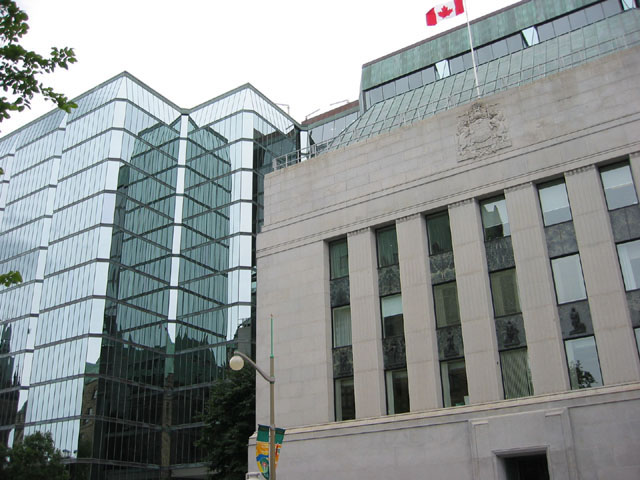
The Bank of Canada at 75

11 03 2010

Bank of Canada building

Canada’s central bank turns 75 today. There have been a number of stories about the anniversary in the media. See here, here, and here.

Governor Mark Carney’s speech on the anniversary says little about the actual history of the institution. The historical parts of his speech focused mainly on the decision of Bank to allow the value of the Canadian dollar to float in 1950. He said:

“In 1950, Canada faced adjustment problems of its own, and the Bank, as a learning institution responded. Large capital inflows threatened to drive up inflation in Canada in the context of our then-fixed exchange rate. In an effort to maintain price stability, the decision, unpopular internationally, was taken to float the Canadian dollar, which duly appreciated. While this was inconsistent with the rules of Bretton Woods, it was consistent with their spirit, as a floating dollar allowed both for domestic stability and for the market to determine the rate, rather than being set by government for national advantage. Canada’s move to a flexible exchange rate was a precursor to the breakdown of the Bretton Woods system 20 years later.”

I think that Mr Carney’s decision to focus on this episode is curious. Today, free-floating exchange rates are uncontroversial. Is it really necessary to defend this decision taken by the Bank in 1950? Aren’t there more controversial actions in the Bank’s history that he might wish to address? The really interesting thing about Mr Carney’s speech are the major omissions.

First, while Mr Carney spoke about the creation of the Bank in 1935, he did not mention that it was nationalized by the government three years later. Wouldn’t it be interesting to know why it was nationalized? Wouldn’t it be possible to draw some useful lessons from this episode?!?!?

Second, Mr Carney ducked the issue of whether the central bank should be independent of elected politicians. Arguments both in favour and against central bank independence can be made. Perhaps the most exciting event in the history of the Bank of Canada was the 1961 fight between Governor James Coyne and the government of John Diefenbaker. It is unfortunate that Mr Carney did not offer some thoughts on this issue. Perhaps Mr Carney wanted to avoid mentioning this episode because it made Canada look like a Mickey-Mouse country.

I looked at the materials on the BofC’s website related to the 75th anniversary. The PDF file “Canada’s Economy since the Founding of the Bank of Canada” set off my BS detector. It included a chart showing that “Real gross domestic product per person has grown almost sixfold over the past 75 years—an indication of improved economic well-being.” There is also chart showing that more Canadians own cars today than they did before the advent of central banking. The document says: “When the Bank of Canada was founded in 1935, the country was still widely regarded as a nation of “hewers of wood and drawers of water.” Back then, there were far more jobs in agriculture than in manufacturing. Today, four out of five jobs are in the services sector.”

Yeah, all of that is true, but it doesn’t necessarily prove that the Bank of Canada was a good economic manager. A somewhat more convincing stat would be to compare the rate of growth in the 75 years before 1935 and the 75 years since. Even then, it would be risky to draw any conclusions from the numbers, since so many other things were going on in the economy. Christ, even my undergraduate students should be able to see through that one.

The National Post published amusingly nutty perspective on the bank’s history from Martin Masse, a former advisor to erstwhile Foreign Affairs Minister Maxime Bernier. See here. Mr Masse thinks that it was a mistake for Canada to leave the gold standard.

If Andrew Coyne says anything interesting about the anniversary on his blog, I shall let my readers know.


Canada’s Billionaires

11 03 2010

Piggy-backing on the Forbes list, the Globe has published a photo gallery of Canada’s billionaires.


Larry Glassford on History Education in Canada

10 03 2010

ActiveHistory.ca has published an interesting piece by Prof. Larry Glassford on how the secondary-school history curriculum in Canada changed in the 20th century. Here is the abstract: “The content of history textbooks and curriculum is an important factor in the political socialization of succeeding generations of students. This study of representative classroom textbooks authorized for use in Ontario at three distinct eras of the 20th century shows how the main lines of interpretation have shifted over time. During the pre-World War II era, the persistent underlying tone was one of reverence for Canada’s connection to Britain. By mid-century, the main theme was Canada’s bilingual dualism within North America. As the end of the 20th century loomed, the textbook authors were focusing much more on previously marginalised groups within the Canadian multicultural mosaic.”


John Nye on the Great Depression

10 03 2010

John V. C. Nye has published an extremely erudite article on the Great Depression, world trade, and its lessons for today. Nye is one of these brilliant polymaths. His undergrad degree was in physics, but then he went on to teach both economics and history at Washington University in Saint Louis, Missouri. He now holds the Frédéric Bastiat Chair in Political Economy at George Mason University. He is a specialist in European economic history. He has done research on a variety of topics from firm size in France and the rise of the British fiscal state to Soviet collusion in championship chess, demography and the history of superstition. He is the author of War, Wine, and Taxes: The Political Economy of Anglo-French Trade 1689-1900 (Princeton, 2007).

You may also be interested in Prof. Robert E. Wright’s recent blog post “The Great Recession of 2008 and the Sordid Historiography of the Great Depression


Being Caribou – NFB Documentary

8 03 2010

This great documentary was sent to me by a student. In theory, I agree with the conservationist sentiment of the film makers, although I also noticed that they were driving a gas-guzzling truck to get the caribou. The oil for such vehicles needs to some from somewhere. This doesn’t excuse development in ANWAR, but it does mean that things aren’t black and white. I also believe that drilling for conventional oil and natural gas in Alaska is far less of an environmental problem than the tar sands in Alberta, which produce massive amounts of CO2 for each litre of gasoline delivered to a consumer (far more than conventional oil). Anyway, you should check out this film.

“In this feature-length documentary, husband and wife team Karsten Heuer (wildlife biologist) and Leanne Allison (environmentalist) follow a herd of 120,000 caribou on foot across 1500 km of Arctic tundra. In following the herd’s migration, the couple hopes to raise awareness of the threats to the caribou’s survival. Along the way they brave Arctic weather, icy rivers, hordes of mosquitoes and a very hungry grizzly bear. Dramatic footage and video diaries combine to provide an intimate perspective of an epic expedition.”

Vodpod videos no longer available.

more about “Being Caribou by Diana Wilson & Leann…“, posted with vodpod


My Teaching This Week

8 03 2010

Undergraduate Teaching

HIST 1407 (Canadian History Survey Course)

My lecture on Monday was on the history of the automobile in Canada. I talked about the origins of the car industry, tariffs and the branch plant economy, pioneers in the field, unions and industrial relations, the origins of the Rand Formula, Canadian-American relations, the 1965 Autopact, the growth of Japanese car manufacturing in Ontario.

My lecture on Wednesday was on “Canada in the 1960s”. I spoke about Canada’s external relations, but my main focus was the relationship between Quebec and the rest of Canada. I began my lecture by talking about Jean Lesage the Quiet Revolution. I pointed out that English-speaking Canada experienced its own Quiet Revolution between 1945 and 1971. I related the “Other Quiet Revolution” to the diplomatic career of Lester Pearson. I spoke about Pearson’s elusive quest for a majority government. Other topics covered in the lecture included bilingualism and biculturalism, the establishment of medicare,   and flag debate.  The students enjoyed my anecdote about President Lyndon Johnson telling Lester Pearson not to piss on his rug. (Pearson had criticized the US war in Vietnam in a speech delivered in Temple University in Philadelphia). I also showed the following video, which many students found rather amusing.

On Monday, I handed some marking back to the students. The assignment I returned was based on two episodes of the Nature’s Past podcast. I designed this assignment as a way of introducing the students to the vast and rapidly growing body of literature on Canadian environmental history.

The assignment was as follows:

“Historians are increasingly using podcasts as a vehicle for research dissemination. Although podcasts will never replace peer-reviewed publications such as the Canadian Historical Review, they are becoming an important way of learning about the past. In the field of Canadian history, the best example of academic podcasting is Nature’s Past, a series of documentaries released every month by NiCHE, the Canadian Network in History and the Environment. The Nature’s Past podcasts typically feature an interview with the author of a recent publication on Canadian environmental history. This assignment requires you to listen to episodes 3 and 8 of Nature’s Past. Then write a three-page description that answers these questions.

1)    Who is the host? What sorts of people are his guests? Are they credible sources of information? What distinguishes these people from other potential sources of information on the internet?
2)    Do the guests mention the primary sources that they used to research environmental history? What special challenges do environmental historians face in doing their research?

3)    Does knowing about a historian’s sources change your assessment of his or her credibility?

4)    What is the central argument that each guest is making?
5)    Based on these two podcasts, what can you say about environmental history and environmental historians?
6)    Is environmental history about the environment, people, or both?
7)    Why do you think that historians get interested in environmental history as opposed other sub-disciplines (e.g., gender history, military history)? How did each guest become interested in his or her particular topic?
8)    Has this podcast increased your interest in environmental history?”

I will probably design assignments around podcasts in the future. Most students did an adequate job of summarizing the two podcasts.  Most students said that they had been unaware of the existence of environmental history prior to doing this paper. Some students said they really liked the concept of environmental history and wanted to learn more in their upper-year history courses. A majority, however, said that they weren’t that interested in environmental history. One student wrote: “I’m more of a couch potato, but I guess if I was into camping and hiking, I would like environmental history.”

HIST 4165

Our seminar reading this week dealt with the entrance of British Columbia and PEI into Confederation. We read  W.L. Morton, The critical years : the union of British North America, 1857-1873 (Toronto : McClelland and Stewart, 1964), 223-263; Paul Phillips, “Confederation and the Economy of British Columbia” in British Columbia and Confederation (Victoria: University of Victoria, 1967); Rusty Bittermann, Margaret McCallum “Upholding the Land Legislation of a ‘Communistic and Socialist Assembly’: The Benefits of Confederation for Prince Edward Island” Canadian Historical Review (2006): 1-28. We also talked about the lives and times of  Amor De Cosmos and Anthony Musgrave (the students read their short biographies in the Dictionary of Canadian Biography).

Graduate Teaching

In my directed readings course with an MA student, we discussed secondary sources related to the history of the Canada-US border in the Great Lakes region:  Karl Hele,  “Manipulating Identity: The Sault Borderlands Métis and Colonial Intervention.” In The Long Journey of a Forgotten People: Métis Identities and Family Histories , ed. David T. McNab (Waterloo: Wilfrid University Press, 2007); David R. Smith, “Structuring the permeable border : channeling and regulating cross-border traffic in labor, capital, and goods” and John J. Bukowczyk “Trade, war, migration, and empire in the Great Lakes basin, 1650-1815” in Permeable border : the Great Lakes Basin as transnational region, 1650-1990 (University of Calgary Press, 2005).

In my graduate seminar, we discussed the following readings: Robin Winks, The Civil War Years: Canada and the United States (MQUP, 1998); Roger L. Ransom, “The Economics of the Civil War”, EH. Net Encyclopedia; Joe Patterson Smith, “American Republican Leadership and the Movement for the Annexation of Canada in the Eighteen-Sixties,” CHAP, 1935.


Locating Ourselves Historically: Why We Are Not Living in Western Civilization | Mercatus

7 03 2010

In this talk, historian Stephen Davies explains why “Western Civilization” is a flawed concept. I don’t know if I’m totally convinced by his argument, but people who teach “Western Civ.” courses should consider it.

Vodpod videos no longer available.


My Last Winter Olympics Post

6 03 2010

In my last Olympics-related post,  I would like to share some links.

First, The Economist has an excellent piece on the Olympics. I liked this bit the best: “Two decades ago 50% of Canadian adults took part in sport of some kind. Now the figure is only 30%, and obesity rates are rising. Perhaps Canada was just renting the podium.”

On Tuesday, CBC Radio One’s The Current featured a great discussion of the significance of the Vancouver Olympics. The guests were; Ron MacLean, the host of Hockey Night in Canada on CBC Television; Margaret MacMillan is a historian and the Warden at St. Anthony’s College at Oxford University; John Ralston Saul, the Toronto-based philosopher. You can hear the whole discussion here.  

Alan MacEachern, an environmental historian at the University of Western Ontario published a piece in the Globe on the gold-medal hockey game.

I’m also sharing a clip of a discussion on TVO’s Agenda about the impact of the Olympics on Terry Gitersos, who is currently working on a PhD in sport history at the University of Western Ontario. His thesis is on NHL hockey and Quebec nationalism in the 1980s.


Reactions in Quebec to the O Canada Controversy

6 03 2010

As I mentioned in an earlier blog post, the federal government has announced that it is considering changing a line of the English lyrices O Canada to remove a sexist line. This proposal has generated a firestorm in English-speaking Canada. Reacting in Quebec is muted, which isn’t surprising since there are no proposals to change the (laughably archaic) French lyrics. Nevertheless, the debate over the proposed changes to the English lyrics of the “hymne national” has been covered by some francophone news outlets. (For Radio-Canada’s coverage, click here.) 

Radio-Canada’s website allows readers to comment on news items. Below, I have pasted some of the more interesting comments. (The translations are my own and non-literal).

Envoyé par garsdusaguenay 6 mars 2010 à 08 h 44 HNE

“L’O Canada est d’abord et avant tout un hymne produit par et pour les canadiens français (les québécois).  Incapables d’être originaux, les canadians ont décidé de l’adopter mais…à leur façon…en la traduisant en anglais et de bien mauvaise façon en plus.”

O Canada was an anthem written by and for French Canadians (Quebeckers). Unable to be original, the English-speaking Canadians decided to adopt it, but they, rather predictably, badly translated it.

Envoyé par Habitant  6 mars 2010 à 09 h 13 HNE

GarsduSaguenay écrit “Qu’on s’en tienne à la version originale. Celle de Basile Routhier et Calixa Lavallée. L’O Canada est d’abord et avant tout un hymne produit par et pour les canadiens français (les québécois). ”

Petite correction- Le O Canada a été écrit pour les Canadiens par un Canadien. Il faut lire l’histoire de Patriotes de 1837-38 pour voir comment ils se désignaient du seul nom de Canadiens. Mon père et des vieux utilisent encore le nom de Canadiens pour nous désigner. Je l’ultilise aussi de plus en plus. Ce nom a été le notre depuis près de 400 ans. Il n’y a pas de raisons pour l’abandonner. On ne change pas de nom à tous les demi-siècle.Quant aux anglos, il ne faut pas se gêner de leur rappeller qu’ils utilisent notre nom et notre hymne!

GarduSaguenay wrote: “O Canada was an anthem written by and for French Canadians (Quebeckers). Unable to be original, the English-speaking Canadians decided to adopt it, but they, rather predictably, badly translated it.”

I want to make a friendly correction to what GarduSaguenay said: O Canada was written for by and for CANADIANS. Read the history of the Patriotes of 1837-8 and you will realize that the word “Canadian” then meant “French Canadian”. My Dad and the other old-timers still use the word “Canadian” when he is speaking of us French Canadians. I’m using the word that way more and more.  Canadian, that’s what we french-speakers have been called for 400 years and don’t see why we have to change the terms for everything every 50 years. Let’s remind these Anglos that they have taken our name and our national anthem.

Envoyé par Clément

6 mars 2010 à 07 h 52 HNE

Une autre réalité qu’il faut considérer c’est qu’il n’existe pas de peuple canadien. Le Canada est un conglomérat de peuples de diverses origines. C’est la somme des peuples du Québec, d’Irlande, d’Angleterre, d’Écosse, de Chine, d’Italie, du Portugal, sans oublier les autochtones, les Sikhs, les Tamouls, les Arabes, etc.  C’est une donnée fondamentale du Canada, le multiculturalisme, qu’on peut constater par une visite de toutes les grandes villes du pays.  J’arrive d’un voyage a Cuba, dans un hotel retiré du bord de mer, et j’entendais toutes sortes de langues parlées. Par curiosité j’ai demandé aux gens, et c’étaient tous des habitants du Canada. Mais chacun parlait sa langue d’origine.  Le Canada n’est pas un état-nation, et n’en deviendra jamais un… Et je suis loin d’être sûr de la viabilité a long terme du Canada.  Quel hymne national pour le Canada? Mission impossible.

There is no such thing as the Canadian people. Canada is a conglomeration of peoples of diverse origins, people from such nations as Quebec, Ireland, England, Scotland, China, Italy, Portugal– and let’s not forget the Sikhs, the Tamils, the Arabs, and the First Nations. Multiculturalism is a basic fact of Canadian life– it’s bleeding obvious if you visit any big city in this country. I once went to a seaside hotel in Cuba and heard all sorts of languages being spoken. I asked where these diverse tourists were from and I was told they were from Canada. They were all speaking their original languages. Canada is not a nation-state and will never be one. In fact, I have doubts about the lon-term viability of Canada as a polity. Writing a national anthem for Canada? Mission impossible.

Envoyé par mrkmni 5 mars 2010 à 17 h 26 HNE

Il faut enlever porter la Croix; parce que ce n’est pas vrai; ils venaient pour l’Or, Jacques Cartier est mort comme un Ch…parce qu’il n’a pas apporté l’Or a son roi…. Les amérindiens ne veulent pas de croix, ils sont emprisonnés dans des réserves.

We have the remove the references to the cross from the French language version. Whites came to this country for gold, not to spread Christianity. Jacques Cartier died like a dog because he had failed to bring back gold to his King. The First Nations don’t want to hear about the cross– they were locked up on reserves.

Envoyé par gilben

5 mars 2010 à 19 h 27 HNE

Il ne faudrait pas oublier que le O Canada provient des canadiens français et qu’il est entré de travers dans la gorge de nombreux royaliste qui n’en avait que que le “God save the queen ou king”selon la personne régnante.Et l’histoire se répètera avec l’unifolié.

Let’s not forget that O Canada came from French Canada and was resisted by monarchists who wanted to sing God Save the King/Queen. Then history repeated itself with the great flag debate of 1964-5.


Anthempalooza

4 03 2010

The web has been awash with reactions to the federal government’s stated intention to change the wording of Canada’s national anthem so that it is more gender-inclusive. Many participants in this debate have revealed a gross ignorance of Canadian history in general and of the history of the anthem in particular. For instance, many English-speaking Canadians have said that the 1908 English lyrics are the “original” words to the anthem, when in reality they are simply a liberal translation of the original French lyrics.

The Globe has a fairly good story about the actual history of Canada’s national anthem. For something produced by a journalist, it’s not bad.

You can read about Sir Adolphe-Basile Routhier, the ultramontanist politician who wrote the original French lyrics in the Dictionary of Canadian Biography.

I will pay $100 to any MP who can tell me about the role of the ultramontanists in 19th-century Quebec politics without looking it up.

Calixa Lavallée, who wrote the tune, is covered here. The Canadian Encyclopedia‘s entry for O Canada is excellent. I hope that this (manufactured as a distraction tactic) controversy causes some people to read it.