My Panels at ABH 2014

16 06 2014

I’ll be presenting two papers at the Association of Business Historians conference in Newcastle later this month. Here are my panels:


Session  3-E:       Bank-Industry Relationships in the 20th Century

Chair: Lucy Newton

Andrew Smith, University of Liverpool: “Trading With the Enemy: HSBC’s Relationships with German

                Companies during the First World War”.

John Wilson (Newcastle University Business School), Gerhard Schnyder (Kings College, University of

                London) & Anna Tilba (Newcastle University Business School): “The Great Divide? Bank–

                industry relationships and corporate networks in Britain, 1904-2003”.

Julie Bower, University of Birmingham: “The formation of industrial conglomerates in the post-World

                War II era: the role of banking and finance”.


and 


Session   4-E       Innovation and Technological Change

Chair: Mitch Larson

Andrew Smith (University of Liverpool) and Bernardo Batiz-Lazo, University of Bangor: “Managing

                technological change in Hong Kong’s retail banking (1945-2005)”.

David Bowie, Oxford Brookes University: “Diffusion of services innovation in mid-to-late nineteenth

                century English hotels: the Continental and American plan”


Please note that this David Bowie does not appear to be the famous musician!


Imagining Britain’s Global Markets

14 06 2014

For the next few years, the University of Exeter will be the hub of an exciting scholarly network called “Imagining Markets: Conceptions of Empire/Commonwealth, Europe and China in Britain’s economic future since the 1870s.” The network will be led by David Thackeray, Richard Toye and Andrew Thompson. The goal is to provide a bridge between historical and contemporary ways of thinking about Britain’s future global economic orientation, bringing together scholars working in the fields of Imperial, European and Asian studies, and scholars from cultural studies and economic studies.

Sounds like a great initiative. They are going to be sponsoring a new of conferences. I certainly have a number of papers relevant to the overall theme that I could present.

CIGH Exeter's avatarImperial & Global Forum

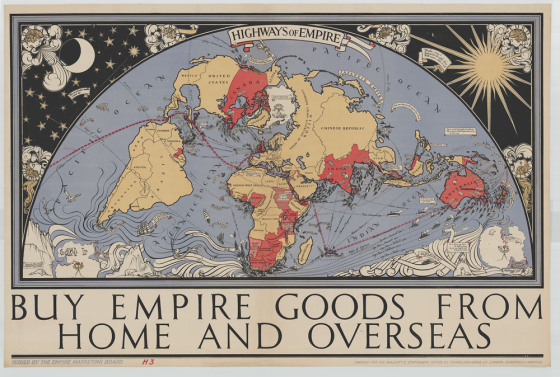
A 1927 pictoral map with all the dominions and trade routes. British Empire Marketing Board.   (Library and Archives Canada, Acc. No. 1983-27-382 Copyright expired.) A 1927 pictoral map with all the dominions and trade routes. British Empire Marketing Board.
Library and Archives Canada, Acc. No. 1983-27-382 Copyright expired.

The History Department at the University of Exeter has recently received funding from the AHRC to support an international research network: ‘Imagining Markets: Conceptions of Empire/Commonwealth, Europe and China in Britain’s economic future since the 1870s’. The network led by David Thackeray, Richard Toye and Andrew Thompson aims to provide a bridge between historical and contemporary ways of thinking about Britain’s future global economic orientation, bringing together scholars working in the fields of Imperial, European and Asian studies, and scholars from cultural studies and economic studies, which have become increasingly separated branches of enquiry calling for reintegration.

View original post 316 more words


Association of Business Historians Programme 2014

10 06 2014

ABH Provisional Programme 2014

Newcastle University Business School


FRIDAY, 27 JUNE


9.30 – 10.45        Registration and Tea/Coffee (Newcastle University Business School)


11.00 – 12.30      Keynote Address:  Roy Suddaby, University of Alberta


“Institutions and History: The Historic Turn in Management Theory”


12.30 – 13.30      Lunch


13.30 – 15.00      Parallel Session 1


Session  1-A:      Corporate Growth and Decline(1)

Chair: Tom McGovern

Shigehiro Nishimura, Kansai University: “Institutions for global technology flows: the development of

                the electrical industry during the interwar period”.

Tom McGovern (Newcastle University Business School) & Tom Mclean, Durham University: “The

                genesis of the electricity supply industry in Britain: A case study of NESCo”.

Sam McKinstry, Ying Yong Ding & Ron Livingstone, University of the West of Scotland: Jacksons of

                Symington, Scotland: a long-term view of the family values/strategy nexus in a rural meat

                business c.1890-1981.


Session  1-B:      Industrial Policy and Government Intervention

Chair: Rory Miller

John Wilson (Newcastle University Business School) & Mark Billings, University of Exeter:

                “Ferranti and the NEB: the implications of government intervention”.

Niall Mackenzie & Andrew Perchard, University of Strathclyde: “Blinded by the light? The rhetoric of

                State-led innovation in the UK after 1945”.

Neil Rollings, University of Glasgow: “The Industrial Policy Group in the 1960s and early 1970s:

                mixing business with politics”.


Session  1-C:      Brands and Branding

Chair: Teresa da Silva Lopes

Michael Heller, Brunel University: “The General Post Office in the 1930s and the Resolution of

                Contradiction: the rise of an iconic brand”.

David Higgins, Newcastle University Business School, “Collective versus private ownership of GI’s: 

                the UK-US experience in the nineteenth century”.

Dana Kakeesh, University of York: “The Impact of strategic Airlines Alliances on the Brand

 Management Practices”.


Session  1-D:      International Business

Chair: Laurence Mussio

Peter Miskell & Teng Li, University of Reading, “Hollywood studios, independent producers and

                international markets: globalisation and the US film industry c.1950-1965”.

Howard Cox & Simon Mowatt, Auckland University of Technology, “The second coming of Condé

                Nast: To transnational twice over”

Maki Umemura, Cardiff University, “Sowing the seeds of domestic success and global failure: the

                Galapagosization of the Japanese cosmetics industry, 1923-2011”.


Session  1-E:       Professions and the Organisation of Work

Chair: Mairi Maclean

Ian  Kirkpatrick (University of Leeds), Matthias Kipping (Schulich Business School), Daniel Muzio

                (Newcastle University Business School) & Bob Hinings (University of Alberta), “The

                Occupational Capture of Professions: The Case of Management Consulting”.

Michael Weatherburn, Imperial College, “Scientific Management at Work: Charles Bedaux, Liberal

                Technocrats, and the Triumph of Scientific Management in Britain, 1920-50”.

James Wilson, Glasgow University, “Management of the Portsmouth Block Mill, 1803-1812”.


15.00 – 15.15      Tea/Coffee


15.15 – 16.45      Parallel Session 2


Session  2-A:      Entrepreneurship

Chair: John Wilson

Bernardita Escobar Andrae, Diego Portales University: “Widowhood and business activity: were

                widows running late husbands’ firms or did they start their own? Evidence from nineteenth

                century Chile”.

Paolo Di Martino & Jennifer Aston, University of Birmingham & Oxford University: “Risk and success:

                re-assessing female entrepreneurship in late-Victorian and Edwardian England”.

Nur Suhaili Ramli, University of York: “World Successful Brands Developed by the Immigrant

                Entrepreneurs”.


Session  2-B:      Crisis Management in Banking

Chair: Ranald Michie

Victoria Barnes & Lucy Newton, University of Reading, “Crisis and accountability: bank management,

                directors and the governance of joint-stock banks, 1826-1844”.

Laurence Mussio, McMaster University, “Crisis leadership in North America’s dangerous decade:

                risk, return and reward at Bank of Montreal, 1860-1870”.

Matthias Kipping (Schulich Business School) & Gerarda  Westerhuis, Utrecht University: 

                “Antecedent of Crises: Turning Bankers into Managers”.


Session  2-C:      Financialized Accounts, Strategy and Control

Chair: Steve Toms

Tom McLean (Durham University), Tom McGovern & Shanta Davie, Newcastle University Business

                School: “Accountants, engineers and company growth: a case study of Clarke Chapman

                1864-1914”.

Alistair Dobie, University of Stirling: “Accounting, financial and management controls in the Reform

                of Monastic decay: the English Benedictines from Innocent iii to the Reformation”.

Colin Haslam & Giuliano                Maielli, Queen Mary, University of London: “Reframing GM’s Business

                Strategy 1909-1940: A Financialized Account”.


Session 2-D:       The Disconsolation of Work

Chair: Ed Barratt

Mike French, University of Glasgow: “Changes and continuities in white-collar work during World

                War 1: employment, earnings and enlistment in J&P Coats’ offices”.

Andrew Popp, University of Liverpool: “The broken cotton speculator”.


Session  2-E:       Reacting and Adapting to Crisis

Chair: Eugene Choi

Sheryllynne Haggerty, University of Nottingham: “Abolition of the British Slave Trade as a Crisis:

                Coping, Management and Adaptation, 1788-1815”.

Emily Buchnea, University of Warwick: “Merchants and the ‘very serious Evil’: Exploring the Impact

                of Epidemics and Quarantine on Transatlantic Trade”.

Neveen  Abdelrehim & Shraddha Verma, University of York: Oil and Independence: the case of

                Burmah Oil Company 1947-1986”.


16.45 – 17.00      Tea/Coffee

17.00 – 18.00      Coleman Prize

18.00 – 19.00      Break

19.00 – 20.00      Drinks Reception at the Discovery Museum (supported by Taylor and Francis Publishing)

20.00 – 22.00      Conference Dinner (Discovery Museum)


SATURDAY, 28 JUNE

8.30 – 8.50 Registration and Tea/Coffee

9.00 – 10.30        Parallel Session 3


Session  3-A       Financial Information in a Historic Context

Chair: Rob Bryer

Anthony Miller & David                 Oldroyd                , Durham University: “An information-economics perspective on the

 objectives of financial reporting and the related cost-benefit framework, drawing on

contemporary and historical evidence”.

Weipeng Yuan (Chinese Academy of Social Science), Richard Macve & Debin Ma, London School of

                Economics: “The development of Chinese accounting and bookkeeping before 1850: insights

                from the Tŏng Tài Shēng business account books (1798-1850)”.

Peter Sims (London School of Economics) & Stephanie Collet, ECSP Europe: “From Chaos to Order:

                National Consolidation and Sovereign Bonds in Uruguay 1890-1914”.


Session  3-B:      Governance and Organisational Forms

Chair: Ray Stokes

Edward Barratt, Newcastle University Business School: “Modernising’ Government – the case of the

                cooperatives of the Civil Service”.

Yves Levant (University of Pau and SKEMA Business School), Leïla Maziane (University of Ben Msik

                Casablanca)& Raluca Sandu (SKEMA Business School): “Crisis of capitalism and the search for

                alternative models. The Pirate Republic of Salé (1627-1668): a critical analysis”.


Session  3-C:      Historical Theory and Organisational Theory  (1)

Chair: Stephanie Decker

Dan Wadhwani, University of the Pacific: The uses of history in new market emergence: savings

                banks and the origins of the personal finance industry in the United states”.

Anna Linda Musacchio Adorisio, Copenhagen Business School: “Tales of the financial crisis:

                historicizing narratives of the global transformation of the banking industry”.


Session  3-D:      Archives: Interpretation and Evidence

Chair: Mike Anson

Roy Edwards, University of Southampton: “Echoes of the Past through lenses of the present:

                Interpreting Archives in Business History”.

Sarah Wilson, University of York: “Interpreting Legal Records for Business Historians”.

Steven Toms, University of Leeds: “Fixed costs, the rate of profit and the length of the working day:

                Evidence from the Factory Act debates, 1832-1847”.


Session  3-E:       Bank-Industry Relationships in the 20th Century

Chair: Lucy Newton

Andrew Smith, University of Liverpool: “Trading With the Enemy: HSBC’s Relationships with German

                Companies during the First World War”.

John Wilson (Newcastle University Business School), Gerhard Schnyder (Kings College, University of

                London) & Anna Tilba (Newcastle University Business School): “The Great Divide? Bank–

                industry relationships and corporate networks in Britain, 1904-2003”.

Julie Bower, University of Birmingham: “The formation of industrial conglomerates in the post-World

                War II era: the role of banking and finance”.


10.30 – 10.45      Tea/Coffee break


10.45 – 12.15      Parallel Session 4


Session  4-A:      Economic Reconstruction

Chair: Niall Mackenzie

Roger  Lloyd-Jones &  M.J.Lewis, Sheffield Hallam University: “Britain in the aftermath of the Great

                War: the state, business and labour and the challenge of reconstruction, c1917-21”.

Armin Grünbacher, University of Birmingham, “Renewal – challenge – continuity. The role of the

                Chambers of Industry and Commerce (IHK) in the immediate post-war years in Germany as

                defender of entrepreneurial independence and mentality”.

Raluca Sandu, SKEMA Business School, “USAid role in (re)building the market in transitional

                economies: the case of the emergence of investor relations (IR) in Romania”.


Session 4-B:       Managing the Public Sector

Chair: Tom McLean

Ray Stokes & Stephen Sambrook, University of Glasgow: “Crises, solutions and accountability in

                British municipal solid waste handling, 1850-2000”.

Laurence Ferry, Newcastle University Business School: “Public sector in crisis? – (modern) origins of

 (r)evolution in England’s municipalities corporate governance analysed through an analytics

of government framework”.

Kevin Tennent & Alex Gillett, University of York: “Lessons from the Past: Managing the 1966 World

 Cup Preparation Process”.


Session  4-C:      Taxation and Public Expenditure in the 20th Century

Chair: Andy Holden

Janette Rutterford & Peter Walton, Open University: “The War, Taxation and the Blackpool Tower

Company”.

Zoi Pittaki, University of Glasgow: “Post-Second World War Greek Economy and Taxation from a

Historical Perspective”.

Florian Gebreiter, University of Aston: “Health, nationalisation, and the insoluble problem of health

expenditure”.


Session  4-D       Historical Theory and Organisational Theory (2)

Chair: Alan McKinlay

Andrea Whittle & John Wilson, Newcastle University Business School: “Ethnomethodology and the

                production of history: Studying ‘history-in-action”.

William Foster,  Diego Coraiola, Roy Suddaby & Elden Wiebe, University of Alberta: “Giving voice to

                corporate archivists: How corporate archivists activate corporate narratives”.

Mairi Maclean (University of Exeter Business School) & Charles Harvey, Newcastle University

                Business School: “Coming to Terms with the Past? Narrative, Metaphor and the Subjective

                Understanding of Transition”.


Session   4-E       Innovation and Technological Change

Chair: Mitch Larson

Andrew Smith (University of Liverpool) and Bernardo Batiz-Lazo, University of Bangor: “Managing

                technological change in Hong Kong’s retail banking (1945-2005)”.

David Bowie, Oxford Brookes University: “Diffusion of services innovation in mid-to-late nineteenth

                century English hotels: the Continental and American plan”


12.15 – 13.00      Lunch


13.30 – 15.00      Parallel Session 5


Session  5-A       Accounting,  History  and Organisational Theory

Chair: Sam McKinstry

Christopher Napier (Royal Melbourne Institute of Technology University ), Gary Carnegie (Royal

                Holloway, University of London) & Lee Parker (Royal Melbourne Institute of Technology

                University ): “Accounting History and Theorizing about Organizations”.

Alistair Mutch (Nottingham Trent University) & Alan McKinlay (Newcastle University Business

                School): “Accountable Creatures’: Scottish Presbyterianism, accountability and managerial

                capitalism”.

Rob Bryer, Warwick University: “Socialism, accounting, and the creation of ‘consensus capitalism’ in

                America, circa.1935-1955”.


Session 5-B         Fraud and Failure in Banking

Chair: Mark Billings

Matthew Hollow, Durham University: “Prevention vs. Manipulation: A Long-Term Historical

                Perspective on Corporate Fraud in the UK Financial Sector”.

Ranald Michie, Durham University: “Bank failures in Britain, 1866 – 2008: Causes, contagion and

                coping”.

Chris Swinson, Durham University: “The Stock Exchange Crash of 1929: an exercise in crisis

                management


Session  5-C:      Managing Corporate Crisis

Chair: Andrew Popp

Eugene Choi, Ritsumeikan University: “Leadership for crisis management: reconsidering the

                corporate governance of Hyundai-Kia Motors Corporation”.

Stephen Sambrook, University of Glasgow: “To melt, or not to melt…recognising and coping with

                crisis in the British optical glass industry, 1840-1920”.

Álvaro Ferreira da Silva & Pedro Neves: University of Lisbon: “In the making: Portuguese business

                groups and the financial crisis”.


Session 5-D        Religion, Philanthropy and Social Development

Chair: Roy Edwards

Andy Holden, Newcastle University Business School: “Accounting for the changing nature of

                philanthropy in the late 19th century – the Newcastle Infirmary”.

Arun Kumar, Lancaster University: “What Development? Whose Modernity? Which Nation? Tatas’

                Philanthropy and Development in postcolonial India”.

Daniel Rossall Valentine, Oxford University and Regents University London: A crisis in Victorian corporate governance – How managerial mistakes led Lancashire shareholders to collude with Scottish sabbatarians and ended Sunday trains on the Glasgow – Edinburgh railway for eighteen years from 1846 to 1864.


Session 5-E         Corporate Growth and Decline (2)

Chair: Peter Miskell

Richard Coopey, Aberystwyth University: “Jacking up the profits: Towards a business history of

                recreational drugs in Britain in the 20th century”.

Peter  Scott & James Walker, University of Reading: “Producer-driven value chains for the inter-war

                US radio equipment sector: were dealers ‘over-sold’ on marketing?”

Robert Greenhill  & Rory Miller, University of Liverpool, “Business, the Chilean State, and the

                Changing Nitrate Commodity Chain, 1918-33”.


15.00 – 15.15      Tea/Coffee break


15.15 – 16.45 Session 6 Round Table and Panel Discussion:


Rethinking Business History? Between Economic History and Organisational History

Convenors: Stephanie Decker & Michael Rowlinson

Panel: Alan McKinlay, Roy Suddaby, Alistair Mutch, Dan Wadhwani,  John Wilson.


Symposium on Literature and Business: Money making in Victorian and contemporary writing

10 06 2014
Symposium on Literature and Business: Money making in Victorian and contemporary writing
 
Date and time: Thursday 19th June 2014, 9-11am
Venue: Chandler Room, Foresight Centre, University of Liverpool 
 
This innovative symposium will explore the contrast between literary representations of business issues in the 19th century, and the way in which those issues have been presented recently (including thoughts on the difference the recent recession has made). The event will be a lively discussion looking at representations of business in all forms of modern media and contrasting it with the 19th century. There will be three panellists at the event, Prof Andrew Popp, Prof Robert Hewison and Dr Nicholas Shrimpton, which will be chaired by Prof Dinah Birch.  The discussions will close with a networking opportunity and refreshments.
 
This symposium is part of the International Business Festival organised by the Management School. The event is free but booking is essential.


When The Chips Are Down

8 06 2014

This week’s Econtalk episode is on the future of work in an age of accelerating technological change. The guests were Andrew McAfeeMegan McArdle, and Lee Ohanian along with with EconTalk host Russ Roberts. The discussion was wide-ranging and included topics such as the idiotic US system for allocating visas to high-tech workers and changing gender roles. However, the discussion kept coming around to the issue of technological unemployment and the possibility that AI will contribute to increasing income inequality by eliminating even more routine jobs when simultaneously boosting the incomes of the 1%ers with the requisite skills.

Last week, the BBC rebroadcast a 1977 documentary called “When The Chips Are Down”. This documentary, which  was about the social impact of the computer, contains extensive scenes filmed inside Silicon Valley companies. The documentary was somewhat prophetic in its discussion of the possible impact of computers on economic inequality.  I recommend listening to the Econtalk podcast first and then watching the 1977 documentary. The really interesting stuff about the socio-economic impact of computers starts around 40 minutes in. The first half of the documentary just deals with the history of the computer– the replacement of vacuum tubes with transistors, the falling cost of computer power, etc.


ABH Newsletter for June 2014

6 06 2014

The Association of Business Historians newsletter for June 2014 has been published. ABH Newsletter June 2014


ULMS Organisation and Management Group Research Seminar Series 2013/14    

6 06 2014
 
 
Time and Date: 2pm, 11th of June
Location: Seminar Room 4, ULMS
Nibbles and drinks served
 
 
Andrew Popp
“The Broken Cotton Speculator”
 
Professor Ansgar Richter
“Revisiting the Role of the Environment in the Capabilities-Financial Performance Relationship: A Meta-Analysis”
 
Dr. Andrew Smith
“Between Organizational Theory and Historical Methodology: a Possible Exit from the Impasse for Business Historians”
 
 
Andrew Popp
Professor of Business, ULMS
Paper title: “The Broken Cotton Speculator”
 
Abstract
 
Liverpool, 1904, is a city caught in the onrush of modernity. The world’s commodities, cotton in particular, flow into its docks in a never ending stream; vast new armies of white collar workers, pouring into the centre from new suburbs via overhead railways and tram, are corralled into emerging bureaucracies; the streets of the commercial centre, lined by an ever growing array of impressive architectural monuments, teem with life; telephones lines criss-cross the centre like a nervous system. At the heart of the city lies The Exchange. On March 3rd 1904 someone sent a postcard of that Exchange to a sweetheart in London, its rich but cryptic language and symbolism capturing some of the essence of this modern life and its dislocating effect.
 
Ansgar Richter (with Amit Karna and Eberhard Riesenkampff)
Professor of Management, ULMS
University Webpage:
Paper Title: “Revisiting the Role of the Environment in the Capabilities-Financial Performance Relationship: A Meta-Analysis”
 
Abstract
Within the dynamic capabilities view of the firm, there is debate about the relative importance of ordinary and dynamic capabilities for firm performance, and about the extent to which their performance effects are contingent on the environment in which a firm operates. We meta-analyze 115 studies to investigate the relationship between both ordinary and dynamic capabilities and the financial performance of firms in stable versus changing environments. The results suggest that the performance effects of both types of capabilities are positive, and similar in magnitude. We find support for the view that environmental dynamism reinforces the effects of both ordinary and of dynamic capabilities. Furthermore, the two types of capabilities are closely associated. Our findings mediate between more moderate and stronger perspectives on dynamic capabilities.
 
 
Andrew Smith
Lecturer in International Business, ULMS
Paper title: “Between Organizational Theory and Historical Methodology: a Possible Exit from the Impasse for Business Historians”
 
Abstract
In a path-breaking article Michael Rowlinson, John Hassard and Stephanie Decker (2013) deal with the relationship between historical writing and organization theory. Rowlinson, Hassard and Decker (henceforth RHD) identify three important methodological differences in how organization theory and historiography approach the study of the past. In stressing the massive differences between these two interpretative traditions, RHD suggest that the two approaches are effectively at an impasse. This paper will draw on what might be called “moderate” postmodernism and will suggest a methodology that could support a research programme capable of bridging the divide between organization theory and historical theory. The paper will suggest that business historians in management schools ought to shift their focus from the study of actual historical events to the examination of how perceptions of the past influence the thoughts, discourses, and actions of present-day economic actors. It will then provide some specific examples of how this social-memory research programme could be implemented with a view to producing business-historical research that is genuinely useful to a wide range of knowledge users in both universities and private industry.


Searching the Montreal Gazette

5 06 2014

Many historical newspapers have been digitized and placed online. Thanks to this wonderful new technology, we can read the New York Times back to 1851. The Times of London can be read back to 1785, at least if you have a subscription, as can the Economist, the Toronto Globe and Mail, the Financial Times, and many other newspapers. Chronicling America allows internet users to read and do keyword searches of a vast number of 19th century US newspapers. Trove offers a similar service in Australia.

Alas, Montreal, which used to be Canada’s commercial capital, has been poorly served by this technology. It is very easy to search the New York Times for, say, 1865 but it much harder to use the Montreal Gazette for that year. Montreal Gazette after 1878 is available in in Google News, but it isn’t keyword searchable, which limits its usefulness to researchers. The Bibliothèque et Archives nationales du Québec has digitized a number of historical newspapers and put them online.  However,its collection doesn’t include the Gazette and isn’t keyword searchable for this period, which makes is a major problem.

Do any of my readers know whether a keyword searchable archive of the Montreal Gazette has been created or is in the process of being created?


The Business of Slavery

5 06 2014


The Centre for Economic and Business History and the Institute for the Study of Slavery at the University of Nottingham are co-hosting a conference entitled ‘The Business of Slavery’. It will run 17th – 19th September 2014. Confirmed speakers include Marcus Joaquim Maciel de Carvalho (Universidade Federal de Pernambuco), Roderick McDonald (Rider) and Ulrike Roth (Edinburgh).


Formally enslaved persons and others forced to provide their labour have always made, and continue to make, an invaluable contribution to the economies of various societies; whether that be collectively through their labour efforts in a slave society, through the state, merchants, and others buying and selling their bodies, through contributions to households or small businesses, or through their independent efforts to sell their labour with the aim of freeing themselves.


The event aims to bring together assessments of the contributions of enslaved people to the economy of different eras and societies and from various perspectives, including the wider economy, the slave traders, the slave holders and the slaves themselves. It will compare these assessments over chronological eras and in societies around the globe, and from a wide variety of disciplines.


We are pleased to have the support of the Economic History Society which has enabled us to offer some postgraduate awards to cover registration and some travel costs. This will only be available to those presenting at the conference and will be spread over two European, three national UK, and two local postgraduates. More information about how to apply for these will follow.


For more details and registration please see our conference website at http://www.nottingham.ac.uk/cebh/research/conferences/business-of-slavery/conferences.aspx


New Article: A tale of two ex-dominions: why the procedures for changing the rules of succession are so different in Canada and Australia

3 06 2014

The journal Commonwealth & Comparative Politics has published our article:A tale of two ex-dominions: why the procedures for changing the rules of succession are so different in Canada and Australia.

Abstract: In 2011, the leaders of the nations that share Queen Elizabeth as their head of state agreed to change the rules governing the inheritance of the throne. The federal nature of the Canadian and Australian Crowns raises the question of whether Canadian provinces and Australian states should be involved in the process for modifying the rules of succession. Australia’s federal government has decided to include its states in the process, whereas Canada’s did not. This article will assess what the differences between these two approaches reveal about the political cultures and leaders of these nations. The issues discussed include relations between the civil service and elected politicians, the contested social memory of the British Empire, and the relationship between neoliberalism and cooperative federalism.

It was a tremendous pleasure working with my co-author Jatinder Mann.