Updated Profile

13 12 2013

I have updated the “About Me” section of this website to reflect the fact I have a new employer, the University of Liverpool’s Management School.  My new description reads:

This is the blog of Dr Andrew Smith, a lecturer in International Business at the University of Liverpool Management School.

I teach about international business, organizational change, and business history. My research interests centre on business and financial history, international business, corporate governance, political economy, and knowledge management.

I am a member of the British Academy of Management, the European Group for Organizational Studies, the Business History Conference, and the Association of Business Historians.

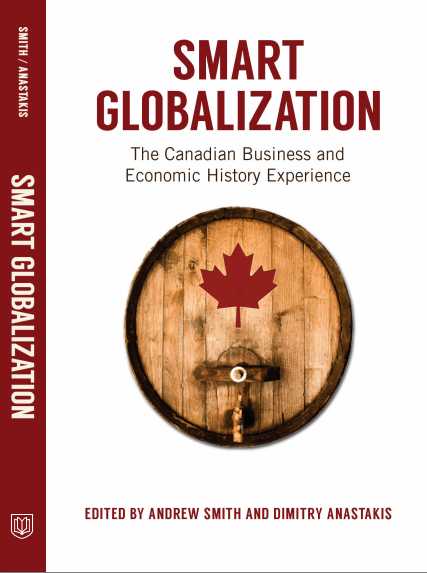
Past research:  My first book, which was published in 2008, was on the financial aspects of Canadian Confederation and the role of the City of London. My second book was a co-edited collection on the history of entrepreneurship in Canada. My third book, which is will be published by University of Toronto Press in January 2014, is an edited collection on globalization and Canadian business.  I have also published a number of articles and book chapters on topics such as the taxation, ethnicity and international capital flows, race and business, entrepreneurship, and banking regulation history.

Correspondence should be sent to: University of Liverpool Management School,  University of Liverpool, Chatham Street,  Liverpool L69 7ZH,  United Kingdom.

I have also updated my Academia.edu profile. My LinkedIn profile is in the process of being updated.


Workshop on Canadian Business and Environmental History

10 12 2013

The Rotman School of Management in Toronto will be hosting a workshop on Canadian business and environmental history on 22-23 May 2014.  I’ve organized this workshop with Jessica van Horssen of Toronto’s York University. Funding has been generously provided by NiCHE (the Canadian Network in History and Environment) and the Wilson Institute for Canadian History, and  L.R. Wilson/R.J. Currie Chair in Canadian Business History.  The main deliverable from this workshop will be an edited collection published by a university press.

Back in 1999, Christine Rosen and Christopher Sellers called for the integration of business history and environmental history. They observed that most business historians have followed Alfred Chandler in ignoring the natural world “beyond factory and office. They devoted equally little attention to the effects of resource extraction and use on plants, animals, land, air, or water, much less entire ecosystems and climate.” They also noted that “our colleagues in environmental history have shown almost as much reluctance to tackle business’s environmental relations as business historians have.”[1]

Can Canadian historians contribute to the project outlined by Rosen and Sellers in their manifesto?  In recent years, historians in the standard comparison countries have made substantial progress in integrating business and environmental history. This trend has been championed by William Cronon, the current president of the AHA, who has supervised both business and environmental history PhD dissertations.[2] Another example would be Richard White’s recent book Railroaded,[3]which has been praised by both environmental and business historians: this book mixes business and environmental history and does so quite well. Members of the Business History Conference have also published in the top environmental history journals.[5] In the last decade, articles on environmental-historical themes have appeared in the three highest “ranking” business-historical journals. As a result of all of this research, we have developed our understanding of the histories of the Netherlands, Japan, Britain, and the United States.[4]  But what about Canada, a nation that has, in per capita terms, a very large community of environmental historians? How have they integrated business into their research?

In recent years, several works on business and the environment in Canadian history have appeared. For instance, a new monograph on the history of the Bow River blends environmental and business history. An article comparing Swedish and Canadian responses to smelter pollution since 1960 appeared in Business History in 2008.[6] However, it is still true to say that historians of Canada have yet to fully undertake research that bridges business and environmental history.

Our workshop and the resulting edited collection will be a contribution to the integration of these two sub-fields of history. We believe that this edited collection will be read and cited by scholars in Canada and around the world. Canada has a large and active community of environmental historians, which means that Canadians have the opportunity to make an important contribution to the international literature on the relationship between business and the environment.

Some top scholars have agreed to present their research at this workshop. Their papers cover a wide range of topics in Canadian business/environmental history, ranging from the history of environmental accounting in the HBC to the overseas operations of Canadian mining companies.

I will present the following paper at this workshop: “Canadian Capitalism, Nature, and Confederation: a Hayekian View of Environmental Regulation in Nineteenth-Century Canada.”

At this point, I would just like to thank everyone who is helping to make this workshop possible, especially my co-organizer Jessica!


[1] Christine Meisner Rosen and Christopher C. Sellers, “The Nature of the Firm: Towards an Ecocultural History of Business,” The Business History Review 73 no. 4 (1999): 577.

[2] “William Cronon’s Students” http://www.williamcronon.net/students.htm#phdstuds.

[3] Richard White,  Railroaded: The Transcontinentals and the Making of Nodern America (New York: W.W. Norton & Co, 2011).

[4] James Darby, “The Environmental Crisis in Japan and the Origins of Japanese Manufacturing in Europe,”  Business History 39 no. 2 (1997): 94-114; Keetie Sluyterman, “Royal Dutch Shell: Company Strategies for Dealing with Environmental Issues,”  Business History Review 84 no. 2 (2010): 203-226; Pierre Desrochers, “How Did the Invisible Hand Handle Industrial Waste? By-Product Development Before the Modern Environmental Era,”  Enterprise and Society 8 no. 2 (2007): 348-374.

[5] Christine Meisner Rosen, “The Business-Environment Connection,” Environmental History 10 no. 1 (2005): 77-79.

[6] Christopher Armstrong, Matthew Evenden, and Henry Vivian Nelles, The River Returns: An Environmental History of the Bow (Montreal: McGill-Queen’s Press, 2009); Magnus Lindmark and Ann Kristin Bergquist, “Expansion for Pollution Reduction? Environmental Adaptation of a Swedish and a Canadian Metal Smelter, 1960–2005,” Business History 50 no. 4 (2008): 530-546.


Interesting New Paper on the Great Divergence

9 12 2013

Accounting for the great divergence” by  Stephen Broadberry

Abstract:

As a result of recent work on historical national accounting, it is now possible to establish firmly the timing of the Great Divergence of living standards between Europe and Asia. There was a European Little Divergence as Britain and Holland overtook Italy and Spain, and an Asian Little Divergence as Japan overtook China and India. The Great Divergence occurred because Japan grew more slowly than Britain and Holland, starting from a lower level. Key turning points are identified around 1348 and 1500, and an explanatory framework is developed that can explain these divergences via the differential impact of shocks on differently structured economies. The key shocks were the Black Death of the mid-fourteenth century and the new trade routes which opened up from Europe to Asia and the Americas at the end of the fifteenth century. The key structural factors were the type of agriculture, the age of first marriage of females, the flexibility of labour supply and the nature of state institutions.


Rethinking the Glorious Revolution and Rethinking the Relative Value of Different Publication Formats

9 12 2013

In the last couple of decades, most historians who think about the institutional underpinnings of economic activity have come to view the Glorious Revolution as one of the causes of the Industrial Revolution. More precisely, they refer to the Glorious Revolution of 1688 in the course of explaining why the Industrial Revolution of the eighteenth century took place in Britain rather than in France or, say, China. This question is clearly connected to the wider debates about the reasons for the Great Divergence.

The standard view is that the Glorious Revolution put in place a package of institutions that promoted economic growth. The post-1688 constitutional system alleged did a better job of restraining the growth of the state, preventing rent-seeking, and securing property rights than either the pre-1688 English constitution or the constitutions of the absolutist monarchies of continental Europe. As a result, British people had a stronger incentive to save, invest, and invent. This interpretation has been disseminated by the New Institutional Economics, a school of thought that shares many of the assumptions of neo-liberals and the 1990s Washington Consensus.  Needless to say, how we interpret the causes of the British Industrial Revolution has tremendous policy relevance for developing countries in the present, so getting our understanding of the Glorious Revolution right is very important. Until last year, I taught the standard view to my undergraduates.

A new book challenges the traditional view of the relationship between the Glorious and Industrial Revolutions. It’s Questioning Credible Commitment: Perspectives on the Rise of Financial Capitalism (edited by D’Marris Coffman, Adrian Leonard and  Larry Neal). (Cambridge University Press, 2013) (ISBN: 9781107039018).    D’Marris Coffman is at the Centre for Financial History at Cambridge. Adrian Leonard is also at the University of Cambridge and Larry Neal is at the University of Illinois, Urbana-Champaign.

Here is the Table of Contents:

1. Introduction D’Maris Coffman and Larry Neal

2. Could the crown credibly commit to respecting its charters? England, 1558–1640 Ron Harris

3. Contingent commitment: the development of English marine insurance in the context of New Institutional Economics, 1577–1720 Adrian Leonard

4. Credibility, transparency, accountability and the public credit under the Long Parliament and Commonwealth, 1643–53 D’Maris Coffman

5. Jurisdictional controversy and the credibility of common law Julia Rudolph

6. The importance of not defaulting: the significance of the election of 1710 James Macdonald

7. Financing and refinancing the War of the Spanish Succession, then refinancing the South Sea Company Ann M. Carlos, Erin K. Fletcher, Larry Neal and Kirsten Wandschneider

8. Sovereign debts, political structure, and institutional commitments in Italy, 1350–1700 Luciano Pezzolo

9. Bounded leviathan: fiscal constraints and financial development in the Early Modern Hispanic world Alejandra Irigoin and Regina Grafe

10. Court capitalism, illicit markets, and political legitimacy in eighteenth century France: the example of the salt and tobacco monopolies Michael Kwass

11. Institutions, deficits, and wars: the determinants of British government borrowing costs from the end of the seventeenth century to 1850 Nathan Sussman and Yishay Yafeh

The essays in this collection show that the Glorious Revolution did few of the things with which it has traditionally been credited. In the aftermath of the Glorious Revolution, taxes went up and onerous new regulations were imposed on trade, yet Britain nevertheless emerged as the world’s first industrial nation.  The book suggests that we need to go back to the drawing board in coming up with an explanation of the institutional preconditions of industrialisation.

The book has received considerable attention outside of the academic bubble. For instance, it was discussed a few days ago on The Economist’s blog. I’m certain this exposure is music to the ears of the contributors and editors, since academics are encouraged by their employers to do research that is relevant to non-academics.

The book is interesting to me for two reasons. First, the subject matter is intrinsically important. Moreover, the publication format is significant: although it is an edited collection, this publication has made a very big splash. For several years, the conventional wisdom has been that edited collections have a very limited impact. It has been said that edited collections contain papers that weren’t quite good enough to be in journals. Many people feel that publishing research in edited collections a recipe for burying their work: few people will read and cite a paper if it is in an edited collection. Relative to articles in highly-ranked journals and monographs, edited collections are “low status” publications in the academic world: investing a unit of time in producing an edited collection is said to generate a lower ROI in terms of promotion, employability, and prestige than working on an article. The problem with this view is that many non-academics still gravitate towards books rather than gated articles, which means that books remain one of the best ways of disseminating knowledge to journalists, policymakers, and other non-academics.

I suspect that this important edited collection may encourage university research managers to rethink the relative value of different publication formats.


Does State Charity Crowd-Out Private Philanthropy?

3 12 2013

The profits from this charity shop in Wales go to support an air ambulance service that brings patients to public-sector hospitals. It shows that the dividing line between public, private, and third sectors is blurry.


AS: Many on the right of the political spectrum believe that state support for the poor tends to crowd-out private charity. They reason that if the wealthy see the state helping the poor, they will conclude that there is no need to dig into their own pockets and contribute to the “third sector” (e.g., non-profits). Personally, I’ve never been convinced by this speculative argument given the absence of rigorous empirical evidence and my own observation that the individuals and NGOs involved in philanthropic works also tend to the people who are the strongest advocates of increased social welfare spending. Moreover, countries like the UK and Scandinavian nations that tend of have large-ish welfare states also have thriving “third sectors.” East Asian countries tend to have barebones welfare states but they also lack a culture of philanthropy, perhaps because the West’s philanthropic culture, which includes everything from school bake sales to the Salvation Army, grew out of Christianity.  A visitor from an East Asian country once told me that the Salvation Army Christmas bellringers should be arrested for begging. This comment is clearly the product of a very different culture.


Anyway, I noticed that there is a new economic-historical paper that deals with this topic. “Does Welfare Spending Crowd Out Charitable Activity? Evidence from Historical England under the Poor Laws.” The author are Nina Boberg-Fazlic (University of Copenhagen) and Paul Sharp (pauls@sam.sdu.dk) (University of Copenhagen)

Abstract:

This paper examines the relationship between government spending and charitable activity. We present a novel way of testing the ‘crowding out hypothesis’, making use of the fact that welfare provision under the Old Poor Laws was decided on the parish level, thus giving the heterogeneity we need to test for the impact of different levels of welfare support within a single country. Using data on poor relief spending combined with data on charitable incomes by county for two years before and after 1800, we find a positive relationship: areas with more public provision also enjoyed higher levels of charitable income. These results are confirmed when instrumenting for Poor Law spending using the distance to London and historical migration to London, as well as when looking at first differences.


Cool Essay Contest

26 11 2013

AS: Russ Roberts is running a really cool essay contest. Contestants must explain in 500 words or less whether we are living in an age of technological stagnation or rapid progress.  This contest was sparked by this week’s EconTalk podcast, which is with the noted economic historian Joel Mokyr.

I’m going to tell my economic history students about this contest. 

This week’s EconTalk features Joel Mokyr talking about technology, growth, and stagnation. He disagrees with Robert Gordon and Tyler Cowen about the likely future path of the American economy and the American standard of living. For the contest, send me a short essay that compares Mokyr’s vision of the future to Tyler Cowen’s vision articulated in his recent EconTalk episode, here. In the essay, briefly describe their two visions and then explain which one you find more compelling and why. Feel free to cite any evidence that might justify your argument.

Send essays to mail at econtalk dot org and for the subject line put “Contest.” I don’t care about the format, pdf, pages, word, or text in an email should all work. I will judge the essays based on clarity, thoughtfulness, accuracy and fairness in treating the ideas of Mokyr and Cowen and the overall quality of the writing.

The goal of the contest is to create resources that enhance the educational experience listeners get from EconTalk.

AS: Feel free to write your essay on a typewriter is you buy Tyler Cowen’s argument. 


Gentlemen Bankers: The World of J. P. Morgan by Susie Pak

26 11 2013

Reviews in History has published my review of  Gentlemen Bankers: The World of J. P. Morgan by Susie Pak (Harvard University Press, 2013) along with Professor Pak’s reply. I really like the image that accompanies my review on the website.

Latest reviews - Reviews in History

As I say in my review essay, it’s a great book on a really important topic. I loved how Pak blended social and financial history.  As more and more stories about JPMorgan Chase & Co appear in the news, it is worthwhile having a fresh perspective on the history of one of the firms that eventually became part of the modern bank.

As long-time readers of this blog will know, my obsessions/interests include the linkages between politics and banking, or rather politicians and bankers. That’s why I was particularly interested in the part of the book that appears to undermine, albeit indirectly, some historical claims about the motivations for the Glass-Steagall Act that we made back in 1998 by Alex Tabarrok, an influential economist. In a rather speculative essay in the Quarterly Journal of Austrian Economics Tabarrok argued that the requirement that investment and commercial banks be separated was inserted into the law to further the interests of the Rockefeller banks, which were rivals of the House of Morgan. According to Tabarrok, the Banking Act of 1933 represented the culmination of more than a generation of political conflict between the Rockefellers and the Morgans. Tabarrok claims that the Rockefeller clique knew that the forced separation of investment and commercial banking would harm the Morgan interests far more than it would harm them. According to Tabarrok, they supported the move as a way of raising their rival’s costs. Tabarrok’s interpretation undermined the academic legitimacy of Glass-Steagall in the period immediately just before Congress voted to repeal of the last vestiges of the legislation in 1999. Alas, his paper was based mainly on circumstantial evidence.

Contrary to popular belief, the beliefs of academics do filter down to the political class and do influence public policy . “Practical men who believe themselves to be quite exempt from any intellectual influence, are usually the slaves of some defunct economist economics blogger.” I bring this point up because if we are going to think clearly about bank regulation for the future, we need to get the history right as well.

Anyway, Susie Pak should be congratulated on writing a wonderful book.


The Inventor of TBTF

25 11 2013

The Inventor of Too Big to Fail?

In his wonderful environmental history of the twentieth century, J.R. McNeill described an obscure General Motors research scientist named Thomas Midgley as having “more impact on the atmosphere than any other single organism in Earth’s history.” Midgley invented both leaded gasoline and CFCs. He did not know it at the time, but both of these inventions had massive and negative environmental consequences. Midgley is perhaps the most important inventor you’ve never heard of. Midgley has also been described as the world’s worst inventor, which seems unfair, as he was paving the roads with good intentions. Midgley  died in 1944 after a freak accident involving the complicated system of pulleys he had developed to lift himself out of bed.

There’s another innovator we should know more about.  That’s C.Todd Conover, who was the Comptroller of the Currency from 1981 to 1985, during Ronald Reagan’s first term in office. The Office of the Comptroller of the Currency was established in 1863 to regulate the banking system in the United States. It’s a powerful yet obscure office.

Conover could be described as the inventor of “too big to fail.”  Since the Global Financial Crisis, there’s been a lot of discussion of the principle of TBTF financial institutions. Bloggingheads recently did a great little dialogue on this subject.  There are some financial institutions that are so massive that no government can allow them to go bankrupt, even if they make a series of spectacularly bad bets. That’s why we bailed out so many banks during the crisis. The problem is moral hazard: if the managers of these banks know  that they will be bailed out even if they screw up, this knowledge will cause them to take behave in an unduly risky fashion. Moreover, if investors know that there is a class of companies that enjoys this implicit subsidy from the state, they will park their money in these companies rather than in firms that might go bankrupt. The result is that the financial services sector will swell in size at the expense of the rest of the economy, creating a perverse set of incentives. Moreover, the too-big-to-fail creates a vicious cycle: the existence of an implicit subsidy for really big institutions increases the returns to scale for financial institutions, encouraging more mergers and more megabanks.

Is it possible to identify one single individual as responsible for the emergence of this “too big to fail” system?  Probably not, since the system is ultimately subject to the oversight of lawmakers. However, the authors of a prophetic 2004 book on the TBTF problem suggest that this problem can be traced back to the first half of the 1980s (i.e., to the period in which C. Todd Conover rescued Continental Illinois’s creditors on the grounds it was TBTF). [1] I’ve been doing some more reading on this issue for a lecture I’m going to be giving next year and I’ve discovered something interesting. There are many stray references to Conover and the precedents he set.[2] However, I can find out almost nothing about the man aside from the very short biography that appears on the website of the Comptroller of the Currency.  Here we learn that

Todd C. Conover, a California banking and management consultant, was named Comptroller by President Reagan. He presided over the agency during a period of dramatic change in financial services as deregulation increased competition and the services offered by banks. Under his guidance, national banks began to offer discount brokerage services and investment advice and underwrite certain kinds of insurance. Conover reduced the number of regional offices to six, increasing their staffs and authority. After his resignation, he returned to his bank consulting practice.


Speaking in 2009, Gary Stern, the former president of the Minneapolis Federal Reserve Bank, recalled that at one point the Comptroller of the Currency announced to the world that there were 11 banks in the United States that he considered to be Too Big to Fail, which was clearly a foolish thing to have said. (Stern was vague about the date of the announcement, but it wouldn’t be that difficult to track down the date of these remarks and see if they have an impact on share prices).

In early 1985, Conover resigned his position and returned to private life.

In 1998, a C. Todd Conover published a how-to manual for mutual fund investors.  You can still buy it on Amazon. However, I can’t find out anything else about Conover’s current whereabouts.

I’m not planning to actually research this topic myself, at least not any time soon. However, if someone else has done some research into Conover, I would definitely be interested in reading it. I would also be interested in talking to Conover, if he is still alive.


[1] Stern, Gary H., and Ron J. Feldman. Too Big to Fail: The Hazards of Bank Bailouts. Washington, D.C.: Brookings Institution Press, 2004.

[2] Eugene Nelson White, The Comptroller and the Transformation of American Banking, 1960-1990. (Washington, D.C.: Comptroller of the Currency, 1992), 60.


Your Morning Smile

25 11 2013

Your Morning Smile

Note how the apostrophe has been misused on this packaging. It should read Gingerbread Santas not Gingerbread Santa’s.


Of Protective Tariffs and Blast Furnaces

22 11 2013


Are you looking for historical evidence to support your view that economic nationalism can sometimes be a good thing?  If so, you may be interested in a new article by Kris Inwood and Ian Keay, “Trade policy and industrial development: iron and steel in a small open economy, 1870−1913” This looks like an interesting article. It’s both historical and policy-relevant.

Abstract: In this paper we argue that effective tariff protection associated with the 1879 National Policy and the 1887 Tupper tariffs triggered investment in new, technologically advanced blast furnaces that were capable of accommodating rapid output expansion. This conclusion is based on an appreciation of the timing of late nineteenth-century investments in Canada and their connection to changes in government policy and other demand determinants. In our empirical investigation we use new information on westbound transatlantic freight rates, intra-continental transport costs, and furnace-specific micro-data, and we acknowledge the endogenous relationships linking investment to domestic demand, labour costs, and tariffs.


If you want to read more Canadian economic-historical research that addresses the debates on globalization, watch for this forthcoming book.

Smart Globalization Cover Art