Angelika Rettberg on “Business and peace, or the business of peace”

24 10 2013

The History, Business,and Entrepreneurship newsletter is published a group of business historians in Colombia, a nation that appears to have a lively business history community.

You can download their October 2013  Newsletter here. This issue caught my eye because it contains an article that deals with the role of business in promoting peace, which is one of my research themes right now.

The article by Angelika Rettberg, “Business and peace, or the business of peace” deals with this theme as it relates to Colombia, a country that has been plagued by domestic instability.


Should the CETA Talks Be Merged Into the TTIP Negotiations?

23 10 2013


I recently discussed how the Canada-EU trade agreement talks are inching towards an actual deal. I said that the tentative agreement between Canada and the EU that was announced last week would be important both as a stand-alone agreement and a template for the ongoing negotiations between the United States and the European Union for a Transatlantic Trade and Investment Partnership (TTIP) . Speaking last July, former US Trade Representative Carla Hills argued for the three NAFTA countries to negotiate as a bloc with the EU.

Hills served as U.S. trade representative (1989-93) in the first Bush administration. Perhaps we should listen to her advice on this issue. Merging the CETA and TTIP talks might allow for a more comprehensive agreement than the rather limited one the governments of Canada and the EU appear to have in mind. The TTIP negotiation sessions planned for last week (7-11 October 2013) in Brussels had to be cancelled due to the US administration shutdown.  Now that the shutdown has ended and US diplomats are back at work, the issue of broadening the trade talks can be reopened.


The Founders of the Hong Kong Computer Society

22 10 2013

AS: I’ve recently been working on the history of  banking technology in Hong Kong. My co-author is Bernardo Batiz-Lazo, who teaches business history and bank management at Bangor University. We’ve discovered references to the Hong Kong Computer Society in the primary sources and I believe that this organization, which was founded in 1970, played a crucial role in the diffusion of the first few generations of computer technology in Hong Kong. We need to know more about the early history of the Society. I’ve found a list of the Society’s founders online. (The list also gives their employers as of 1970).

We would be very interested in interviewing any of the founders of the HKCS or indeed anyone else who was involved in the computer sector in Hong Kong in the 1960s and 1970s. Needless to say, we would only quote you in a publication with your consent. You could speak on or off the record. If any of the people on this list wish to contact me, my email address is andrewdavidallansmith at gmail.com

List of Founders
(Employers at time of Foundation)

Mr H A Barros China Light & Power Company Limited
Mr Ian Bulloch The Taikoo Dockyard & Eng Company Hong Kong Limited
Mr Stephen K F Chung IBM World Trade Corporation
Mr K Dixon Hong Kong & Whampoa Dock Company Limited
Mr Howard T Kleyn Cable & Wireless Limited
Mr Alan W L Lee NCR (HK) Limited
Dr Wanbil W Lee Computer Management Systems Limited
Mr D Lowe International Computer Limited
Mr Benjamin N H Mok Hong Kong Government
Mr Charles Nelson First National City Bank
Mr C K Poon The Hong Kong Electric Company Limited
Mr John P Rastello The Hong Kong & Shanghai Banking Corporation
Mr G B Thomson Hong Kong Government
Mr Robert Tih The Chartered Bank
Mr R S Walters The Hong Kong & Shanghai Banking Corporation
Mrs Lesley V Willsteed Philips Hong Kong Limited
Mr Richard A Willsteed Butterfield & Swire (Hong Kong) Limited
Mr Donald C K Wong On-Line (Hong Kong) Limited


Are All Economists Right-Wing?

22 10 2013

What is the ideological complexion of the economics profession? Are most economists libertarian right-wingers, centre-left Keynesians, or apolitical technicians? This issue has been debated extensively because economists have a major impact on the making of public policy.  As Keynes said: “Practical men, who believe themselves to be quite exempt from any intellectual influence, are usually the slaves of some defunct economist.” This question is particularly important to those of us who study the role of classical liberalism in the making of economic policy or who teach using the documentary Commanding Heights, which provides students with an excellent intellectual history of economic ideas and policies over the course of the twentieth century. 


 A paper on  “The Ideological Migration of the Economics Laureates” is in the September 2013 issue of Econ Journal Watch. The paper profiles of each of the 71 individuals who won the Nobel Prize in economics from 1969 to 2012,  Each profile describes the ideological character and outlook of the laureate. Each profile explores change, or migration, in ideology over the course of the individual’s adult years. In this overview, I interpret ideological change in terms of classical liberalism: Did the laureate grow more classical liberal, less classical liberal, or neither? 


The paper shows that over their careers,  the ideology of 16 Nobel laureates became more classical liberal and five became less committed to the ideology of classical liberalism.

It should be noted that some of the economists studied died before the 2008 Financial Crisis. 


The Dominion of Nature: Environmental Histories of the Confederation Era

21 10 2013

How did nature figure into Canadian Confederation? From its creation in 1867 through a series of subsequent expansions, Canada swiftly became one of the largest nations in the world. Ideas about scale, resources, property, mobility, and environment certainly figured into the nation’s consolidation and articulation, yet rarely do such topics appear in histories of the Confederation era. And conversely, “Confederation” does not appear in the index of three recently-published Canadian environmental history surveys. Bringing the methods, practices, and sources of environmental history to bear on the standard Canadian history narrative may well enrich not only that narrative but also the emerging national environmental history one.

In time for the sesquicentennial of the 1864 Charlottetown Conference that was a first step to Confederation, NiCHE: Network in Canadian History & Environment / Nouvelle initiative canadienne en histoire de l’environnement and the University of Prince Edward Island are hosting “The Dominion of Nature: Environmental Histories of the Confederation Era,” a workshop to be held in Charlottetown, PEI on 31 July and 1 August 2014. Participants will workshop pre-circulated essays, moving toward the publication of an edited collection by 2016.

We are seeking proposals from scholars of all ranks and disciplines writing on any topic related to Canadian nature (whether colonial, provincial, regional, or national; urban, rural, or wild; perceptions or practices) and the Confederation era (approximately 1860-1880). If interested in participating, please provide a 500-word abstract of a proposed essay and a 1-2 page CV on a single PDF attachment to Alan MacEachern at amaceach@uwo.ca by 15 December 2013. Participants will be notified by 15 January 2014, and complete drafts of essays (approximately 5000-7000 words) will be required for circulation by 15 June. A travel subsidy, meals, and accommodations will be provided by NiCHE and UPEI. There will also be a field trip for all participants.

Alan MacEachern, History, Western, & Director, NiCHE, amaceach@uwo.ca, and
Edward MacDonald, History, UPEI, gemacdonald@upei.ca.


1914: Banks at War European banks confronted by WWI

21 10 2013

AS: I’m very interested in this conference, which has been jointly organised by Swiss Re and the European Association for Banking and Financial History (EABH) e.V.

14 June 2014

Conference Summary

The project aims first to reconstitute the reaction and the  adaptation of banks and insurance companies in the first days,  weeks and months of what became WWI. French and German banks  and insurance companies were altogether competing against each  other and complementing their activities on a European and even on a global level. All of a sudden, war imposed a drastic border  between two fighting camps and created two economic and
finance areas – which destabilised the classical business model  of banks on each side.

For more information, see here.


CETA: Canada-EU Trade Agreement

21 10 2013

Canada and the European Union have reached an agreement in principle for a free trade agreement.  I would hold off on opening up any celebratory bottles of champagne, as many important details remain to be negotiated before the process of ratifying this rather modest agreement can even begin. Once the finalized agreement is signed, it must be passed by the European Parliament, and the parliaments of all 28 countries in the EU. Three of these nations have said they will withhold support until Canada removes the visa requirement from their citizens.  Canada’s ten provincial legislatures will also have to endorse the agreement, as it involves matters of provincial jurisdiction.  I wish the Canadian federal government the best of luck in their negotiations with the provinces.

I’ve been blogging about CETA for a long time. See here, here, and here.  I even organized a conference on CETA in 2011. When the CETA negotiations first opened, there were wildly optimistic predictions about the degree of liberalization the agreement would provide for. I recall that many Canadians thought the agreement would give Canada a sort of EU-associate status similar that enjoyed by Iceland, Switzerland, and Norway. Others suggested that the agreement would lead to mobility rights for Canadians similar to those enjoyed by citizens of EU countries, which would have given Canadians the right to settle and work in the EU and vice versa. There was a lot of discussion of the elimination of all barriers to investment and the mutual recognition of qualifications for doctors, accountants, and other professions. Canadians across the political spectrum welcomed the idea of rebalancing Canada’s trade away from the United States and towards the EU.

The draft agreement that has been described by the Canadian media in the last few days is much more modest. Indeed, it isn’t really accurate to describe it as a comprehensive free trade agreement. Instead, the agreement merely modifies the regime of managed trade that relates to many commodities.  Consider dairy products. Visitors to Canada are often struck by the fact that cheese is extremely expensive. Canadian visitors to supermarkets in the EU are often impressed by the range of cheeses from EU countries on offer. In an ideal world, Canada would fling open its gates and allow EU cheese to be imported freely.  Alas, that’s not what this agreement provides for. Instead, Canada will increase its annual import quota of cheese from the European Union to about 30,000 tonnes per year from its current 15,000 tonnes. In return, the EU will allow Canadian beef producers to export up to 50,000 tonnes per year.  Based on the media reports I’ve seen, the draft agreement does not even deal with the vexed issue of the food quality regulations governing beef: Canada permits the injection of growth hormones into cattle, whereas the European Union does not permit hormonally enhanced beef to be sold within its borders. The media reports of the draft agreement are silent on this important issue. Moreover, we haven’t heard anything about whether the agreement will require the EU parliament to abandon its plans to effective ban oil from Canada’s tar sands.

The provisions regarding professional qualifications are equally disappointing, as the agreement will simply authorize Canada’s highly protectionist self-governing professional bodies to enter into mutual recognition agreements with their European equivalents if they so choose. I predict that few agreements for the mutually recognition of qualifications will result.

The agreement’s provisions regarding capital mobility are somewhat more substantial but still underwhelming.

Under the Investment Canada Act the Canadian government must review foreign takeover of Canadian companies is the value of the takeover is over C$334million. In the past, there was uncertainty over whether the government would allow particular takeovers to go ahead.  Under CETA, the statutory requirement for a review of takeovers by EU companies will not kick unless the total value is greater than $1.5-billion. The change reflects “the special relationship” between Canada and Europe.  Actually, the relationship doesn’t seem to be that special, if the threshold for EU companies is only 50% greater than the proposed threshold for non-EU companies (C$1billion). Non-EU companies would include state-owned enterprises in the People’s Republic of China. Moreover, the proposed agreement would not alter Canadian ownership restrictions in the airline, cultural and telecommunications sectors. 

In recent years, Canada’s budget for economic diplomacy has been cut. Indeed, Canadian diplomats recently went on strike because they were so angry about the reduction in funding for embassies and other overseas operations. Perhaps a more robust foreign service would have had the resources to produce a more impressive agreement.


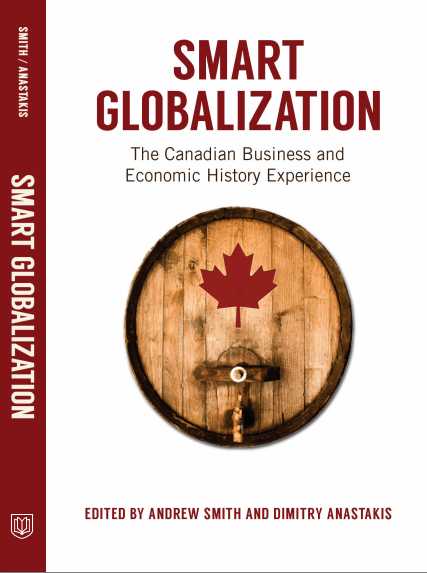
New Book on Canadian Business and Economic History

18 10 2013

University of Toronto Press will soon release this book:


Smart Globalization Cover Art


More details and ordering information will appear here soon.


Tony Slaven Doctoral Workshop in Business History

17 10 2013

The Association of Business Historians is holding its third Tony Slaven doctoral training workshop on 26th and 27th June 2014. This is immediately preceding the 2013 ABH Annual Conference at the Newcastle University Business School and participants will also be welcome to attend the Annual Conference. This is an excellent opportunity for doctoral students to discuss their work with other research students in business history-related disciplines in an informal and supportive environment. Students at any stage of their doctoral career, whether first year or near submitting are encouraged to attend. In addition to providing new researchers with an opportunity to discuss their work with other research students in a related discipline, the workshop will also include at least one skills-related workshop.

Business history doctoral work is spread over a large number of departments and institutions and by bringing students for an annual workshop, we hope to strengthen links between students working on business history and related topics. For the purposes of the workshop `business history’ is therefore interpreted broadly, and it is intended that students in areas such as (but not confined to) the history of international trade, investment, financial history, agricultural history, not for profit organisations, government-industry relations, government policy towards trade and industry, accounting history, social studies of technology, and labour history will find it of interest. Students undertaking topics with a significant business history related element but in disciplines other than economic and business history are therefore also welcome. We would welcome papers from students researching any era whether, modern, early modern or medieval.


Students will present on a pre-circulated paper of no more than 5,000 words, and will be expected to act as discussant on another’s paper, with further time for group discussion. First year students might wish to present an overview of their project, including research questions and methodology. Those at a more advanced stage of their thesis might wish to present part of a draft chapter, or focus on one particular section or aspect of their thesis.

Students interested in attending the workshop should send their application to Dr Sheryllynne Haggerty, Department of History, School of Humanities, University of Nottingham, University Park, Nottingham, NG7 2RD. Email sheryllynne.haggerty@nottingham.ac.uk.


The application should be no more than 4 pages: a one-page CV;  one page stating names of the student’s supervisors, the title of their thesis, the university and department where they are registered, the date of commencement of their thesis registration*; a two page abstract of their paper.


The deadline for submissions is 21 February 2014. Notification of acceptance will be made by 15

April 2014.


Four Tony Slaven scholarships are available, each worth up to £150, to contribute towards the travel, accommodation and registration costs of attending the doctoral workshop (not the ABH main conference). These will be awarded competitively prior to the workshop.  

*Students should clearly state if they wish to be considered for the Tony Slaven scholarships.


For further information, please contact Sheryllynne Haggerty at the above e-mail address.


Repealing The Financial Revolution

15 10 2013

The Financial Revolution made the rise of the modern state possible by establishing the credibility of sovereign borrowers and thus reducing their borrowing costs. Whenever you look at an aircraft carrier or an Interstate Highway, think of the Financial Revolution.  The financial revolutions in the Netherlands, England, and later the United States involved the creation of systems to ensure that the government’s creditors were always promptly and in full. The result was increased state creditworthiness and falling borrowing costs. Even during major wars, governments could borrow. The geopolitical and social implications of this change were massive. All of this was founded on investors’ trust in the state.

Of course,  hardcore libertarians have never been happy about the emergence of the strong states that the Financial Revolution made possible. In the last few decades,  libertarian minarchists and anarcho-capitalists have used a number of tactics to roll back the state: “starve the beast” tax cuts, encouraging tax competition,  constitutional litigation, charter cities, seasteading. These tactics haven’t been terribly effective. 

Now many of the more impatient libertarians are supporting the  Republican legislative posturing that now threatens to cause the US to default, which raise sovereign borrowing costs.

One has to admire the elegant simplicity of this tactic: cause a default and you effectively repeal the Financial Revolution,  making it much harder to operate the fiscal-military welfare- warfare state the libertarians despise.

I would suggest that these libertarians in a hurry need to ask whether libertarian policies have ever emerged from a crisis.